
🚀 宇宙の記憶・カレンダー検索
🚀 象徴的な写真:
APOD第1回
🚀 創造の柱
🚀 スピリット火星着陸
🚀 ハッブル超深宇宙
🚀 地球へようこそ|ブルー・マーブル
🚀 エンケラドス
🚀 ベテルギウス
🚀 火星着陸
🚀 青い夕焼け
🚀 冥王星のハート
🚀 皆既日食
🚀 アースライズ再構築
🚀 ブラックホール
🚀 ウェッブ初画像
🚀 アポロ11着陸
APOD30周年(2025年6月16日)
宇宙蟹星雲
Cosmic Crab Nebula
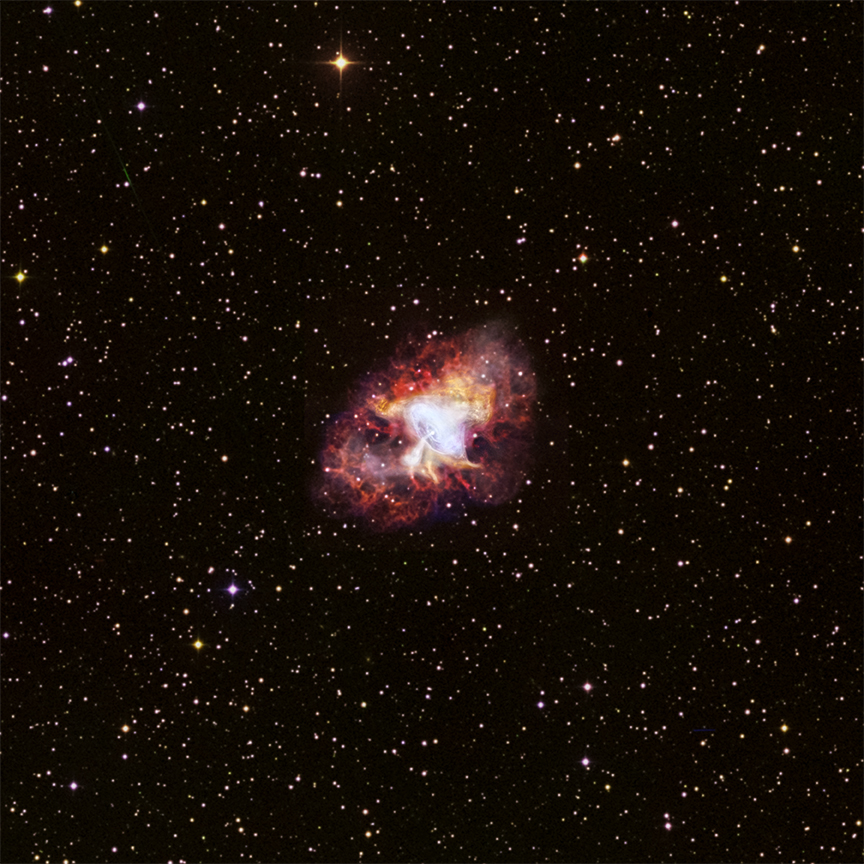
都市ほどの大きさで毎秒 30 回回転する磁化された中性子星であるカニ星雲パルサーは、この魅惑的なカニ星雲の広視野画像の中心に位置しています。天の川銀河の超新星残骸の 1 つを捉えたこの壮大な画像は、光学観測データと軌道上のチャンドラ観測衛星からの X 線データを組み合わせたものです。この合成画像は、チャンドラによる高エネルギー宇宙の 15 年にわたる探査を記念して作成されました。宇宙のダイナモのように、パルサーは星雲からの X 線と光学的放射のエネルギー源となり、荷電粒子を極めて高いエネルギーまで加速して、X 線で輝くジェットとリングを生成します。最も内側のリング構造は、直径約 1 光年です。太陽よりも質量が大きく、原子核と同じ密度を持つ回転するパルサーは、爆発した巨大星の崩壊した核であり、星雲は星の外層の膨張した残骸です。この超新星爆発は1054年に観測されました。参加しよう:美学と天文学に関するアンケートにご協力ください。
原文(English)
The Crab Pulsar, a city-sized, magnetized neutron star spinning 30 times a second, lies at the center of this tantalizing wide-field image of the Crab Nebula. A spectacular picture of one of our Milky Way's supernova remnants, it combines optical survey data with X-ray data from the orbiting Chandra Observatory. The composite was created as part of a celebration of Chandra's 15 year long exploration of the high energy cosmos. Like a cosmic dynamo the pulsar powers the X-ray and optical emission from the nebula, accelerating charged particles to extreme energies to produce the jets and rings glowing in X-rays. The innermost ring structure is about a light-year across. With more mass than the Sun and the density of an atomic nucleus, the spinning pulsar is the collapsed core of the massive star that exploded, while the nebula is the expanding remnant of the star's outer layers. The supernova explosion was witnessed in the year 1054. Participate: Take an Aesthetics & Astronomy Survey
\ この感動を宇宙仲間にシェア /
宇宙をXでシェア
© NASA / APOD