
🚀 宇宙の記憶・カレンダー検索
🚀 象徴的な写真:
APOD第1回
🚀 創造の柱
🚀 スピリット火星着陸
🚀 ハッブル超深宇宙
🚀 地球へようこそ|ブルー・マーブル
🚀 エンケラドス
🚀 ベテルギウス
🚀 火星着陸
🚀 青い夕焼け
🚀 冥王星のハート
🚀 皆既日食
🚀 アースライズ再構築
🚀 ブラックホール
🚀 ウェッブ初画像
🚀 アポロ11着陸
APOD30周年(2025年6月16日)
チュリュモフ・ゲラシメンコ彗星の対照的な地形
Contrasting Terrains on Comet Churyumov-Gerasimenko
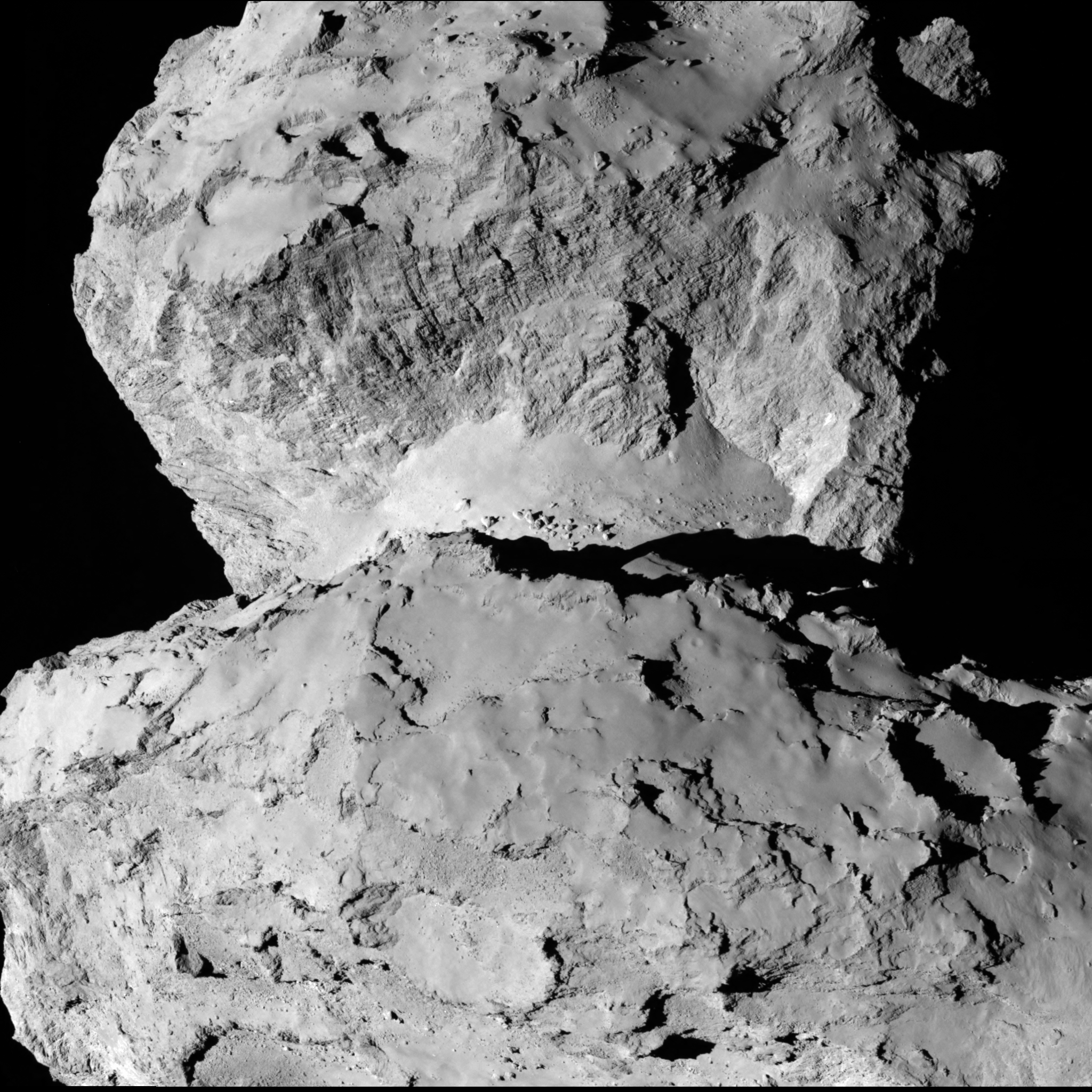
フィラエはどこに着陸すべきか?ESAのロボット探査機ロゼッタが67P/チュリュモフ・ゲラシメンコ彗星に向かって周回するにつれ、最終的には着陸機フィラエの着陸地点を決定する必要がある。今月初めに彗星に到達したロゼッタは、着陸地点として選定される彗星の特異な核の詳細な画像を送信している。上の画像では、画像上部付近の彗星の核の頭部に険しい溝が見られ、画像下部付近の本体には、ギザギザの丘で隔てられたパッチワーク状の領域が見られる。頭部と本体の両方に見られるパッチワーク状の領域の中には、比較的滑らかな地形のフィールドがあるように見えるものもある。しかし、画像中央に見られる首と呼ばれる接続領域には、比較的広い範囲の明るい色の滑らかな地形が現れ、時折大きな岩が点在している。ロゼッタは、暗い山のような大きさの彗星の核に向かってフィラエを放出し、11月に着陸する予定である。
原文(English)
Where should Philae land? As ESA's robotic spacecraft Rosetta circles toward Comet 67P/ Churyumov-Gerasimenko, a decision must eventually be made as to where its mechanical lander should attempt to touch-down. Reaching the comet earlier this month, Rosetta is sending back detailed pictures of the comet's unusual nucleus from which a smooth landing site will be selected. Pictured above, near the image top, the head of the comet's nucleus shows rugged grooves, while near the image bottom, the body shows a patch-work of areas sometimes separated by jagged hills. Some of the patch-work areas apparent on both the head and body seem to have fields of relatively smooth terrain. In the connecting area called the neck, however, visible across the image center, a relatively large swath of light-colored smooth terrain appears, punctuated occasionally by large boulders. Rosetta is scheduled to release Philae toward the dark mountain-sized comet nucleus with an anticipated landing date in November.
\ この感動を宇宙仲間にシェア /
宇宙をXでシェア
© NASA / APOD