
🚀 宇宙の記憶・カレンダー検索
🚀 象徴的な写真:
APOD第1回
🚀 創造の柱
🚀 スピリット火星着陸
🚀 ハッブル超深宇宙
🚀 地球へようこそ|ブルー・マーブル
🚀 エンケラドス
🚀 ベテルギウス
🚀 火星着陸
🚀 青い夕焼け
🚀 冥王星のハート
🚀 皆既日食
🚀 アースライズ再構築
🚀 ブラックホール
🚀 ウェッブ初画像
🚀 アポロ11着陸
APOD30周年(2025年6月16日)
ムーンドッグ・ナイト
Moondog Night
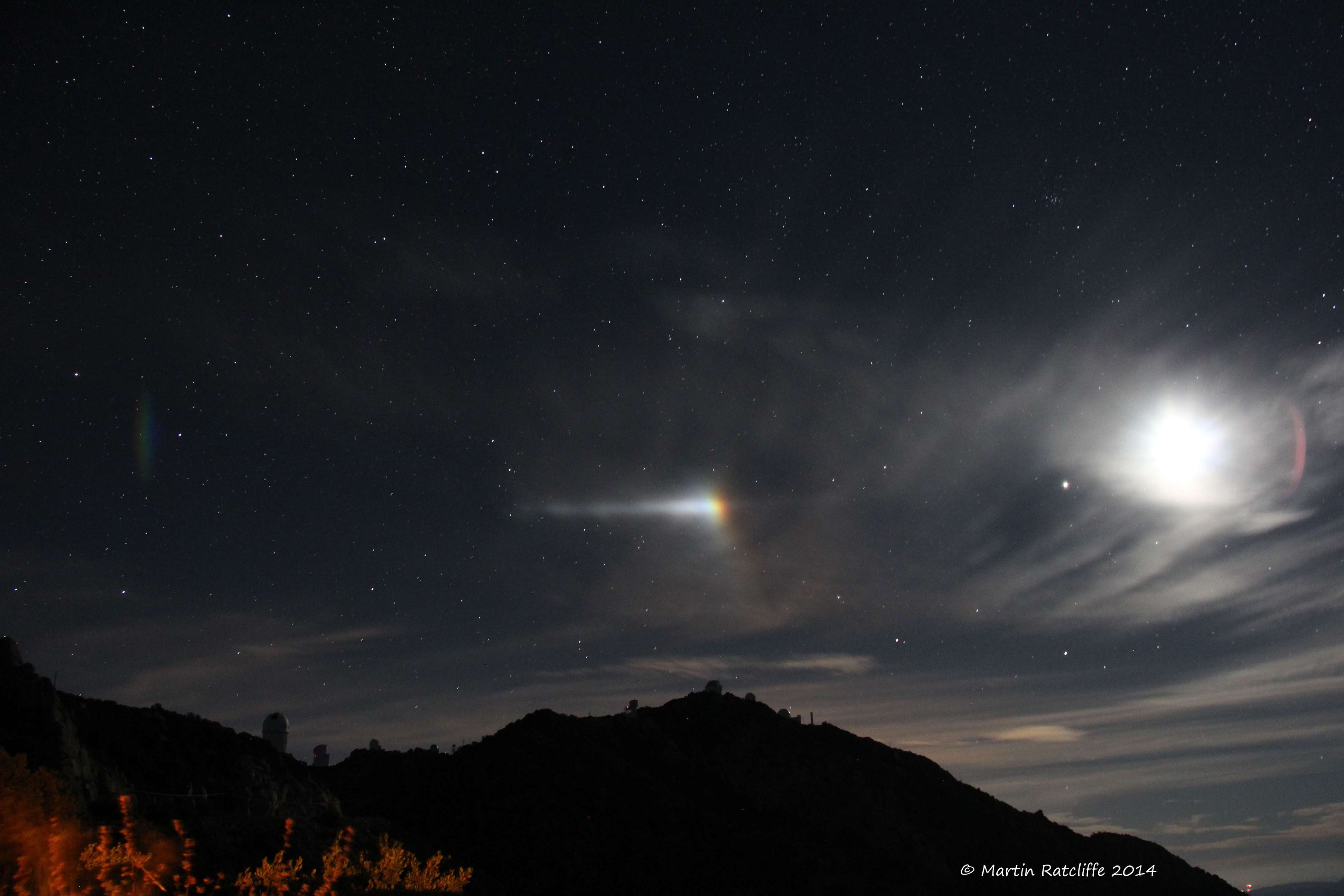
11月14日未明のこの夜景では、アリゾナ州ツーソン近郊のキットピーク国立天文台の山頂ドーム上空の雲が、下弦の月の光に照らされています。明るい木星は、露出オーバーの月の円盤のすぐ左にあり、そのすぐ右にはカメラのレンズフレアの筋が見られますが、写真の中央付近で爆発しているのは火球流星ではありません。代わりに、道路脇から見ると、キットピークのWIYN望遠鏡の真上に、驚くほど明るい月光(パラセレナ)が浮かんでいます。幻日(パラセリオン)に似たパラセレナは、高層巻雲の中にある薄い六角形の板状の氷の結晶を通して月光が屈折することによって生じます。結晶の形状によって決まるパラセレナ(複数形)は、月に対して22度以上の角度で見られます。明るい月の円盤と比べると、パラセレナはより淡く、月が低い位置にあるときに見つけやすくなります。写真撮影から約10分後、この明るい月犬も夜の闇から消え去った。
原文(English)
In this night scene from the early hours of November 14, light from a last quarter Moon illuminates clouds above the mountaintop domes of Kitt Peak National Observatory near Tucson, Arizona. Bright Jupiter is just left of the overexposed lunar disk with a streak of camera lens flare immediately to the right, but that's no fireball meteor exploding near the center of the picture. Instead, from the roadside perspective a stunningly bright moondog or paraselene stands directly over Kitt Peaks's WIYN telescope. Analogous to a sundog or parhelion, a paraselene is produced by moonlight refracted through thin, hexagonal, plate-shaped ice crystals in high cirrus clouds. As determined by the crystal geometry, paraselenae (plural) are seen at an angle of 22 degrees or more from the Moon. Compared to the bright lunar disk they are more often faint and easier to spot when the Moon is low. About 10 minutes after the photograph even this bright moondog had faded from the night.
\ この感動を宇宙仲間にシェア /
宇宙をXでシェア
© Martin Ratcliffe / APOD