
🚀 宇宙の記憶・カレンダー検索
🚀 象徴的な写真:
APOD第1回
🚀 創造の柱
🚀 スピリット火星着陸
🚀 ハッブル超深宇宙
🚀 地球へようこそ|ブルー・マーブル
🚀 エンケラドス
🚀 ベテルギウス
🚀 火星着陸
🚀 青い夕焼け
🚀 冥王星のハート
🚀 皆既日食
🚀 アースライズ再構築
🚀 ブラックホール
🚀 ウェッブ初画像
🚀 アポロ11着陸
APOD30周年(2025年6月16日)
アンドロメダ銀河には1億個の星が存在する
100 Million Stars in the Andromeda Galaxy
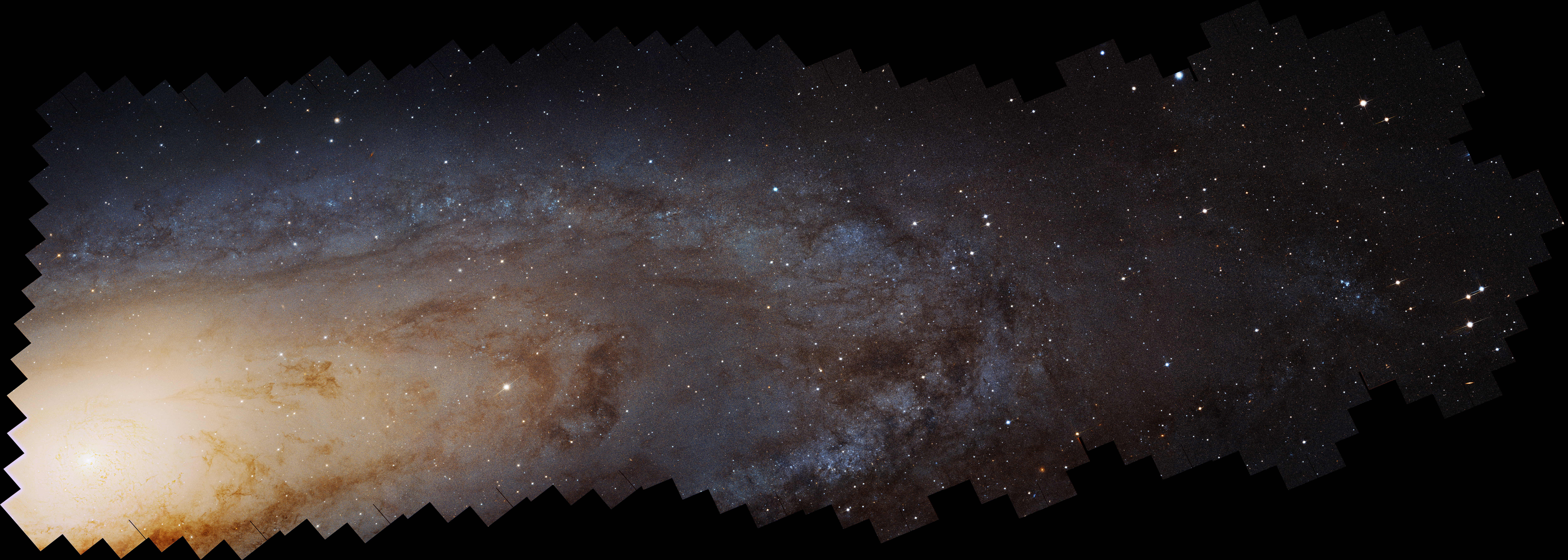
アンドロメダ銀河はどのような星で構成されているのでしょうか?それをより深く理解するために、研究者グループはハッブル宇宙望遠鏡で撮影された史上最大の画像を合成し、近傍の渦巻銀河を研究しました。その結果、「パンクロマティック・ハッブル・アンドロメダ・トレジャリー(PHAT)」と呼ばれる画像が作成され、数千回の観測、数百の視野、銀河の約3分の1を網羅し、1億個以上の星を解像しました。掲載されている合成画像では、銀河の中心部が左端に、青い渦状腕が右側に際立って見えます。画面全体に散らばっている最も明るい星は、実は天の川銀河の前景にある星です。PHATデータは、天の川銀河と対照的に、M31銀河で星がどこでどのように形成されたかをより深く理解するため、またアンドロメダ銀河の星団や遮蔽する塵を特定し特徴づけるために分析されています。
原文(English)
What stars compose the Andromeda galaxy? To better understand, a group of researchers studied the nearby spiral by composing the largest image ever taken with the Hubble Space Telescope. The result, called the Panchromatic Hubble Andromeda Treasury (PHAT), involved thousands of observations, hundreds of fields, spanned about a third of the galaxy, and resolved over 100 million stars. In the featured composite image, the central part of the galaxy is seen on the far left, while a blue spiral arm is prominent on the right. The brightest stars, scattered over the frame, are actually Milky Way foreground stars. The PHAT data is being analyzed to better understand where and how stars have formed in M31 in contrast to our Milky Way Galaxy, and to identify and characterize Andromeda's stellar clusters and obscuring dust.
\ この感動を宇宙仲間にシェア /
宇宙をXでシェア
© NASA / APOD