
🚀 宇宙の記憶・カレンダー検索
🚀 象徴的な写真:
APOD第1回
🚀 創造の柱
🚀 スピリット火星着陸
🚀 ハッブル超深宇宙
🚀 地球へようこそ|ブルー・マーブル
🚀 エンケラドス
🚀 ベテルギウス
🚀 火星着陸
🚀 青い夕焼け
🚀 冥王星のハート
🚀 皆既日食
🚀 アースライズ再構築
🚀 ブラックホール
🚀 ウェッブ初画像
🚀 アポロ11着陸
APOD30周年(2025年6月16日)
カタクリズミック・ドーン
Cataclysmic Dawn
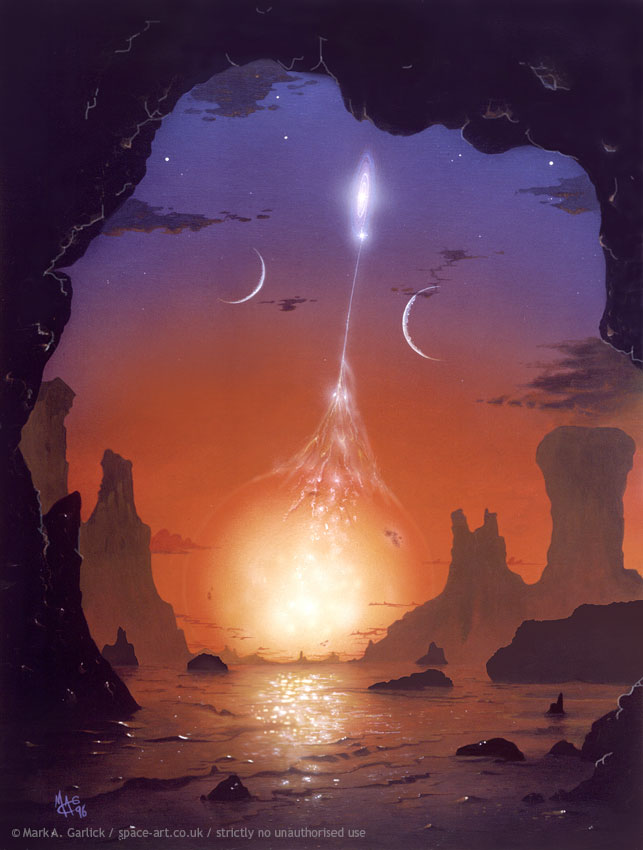
この夜明けにまた新星爆発が起こるのだろうか? 激変する連星系を周回する惑星に住む未来の人類は、いつかこのようなジレンマに思いを馳せるかもしれない。激変する連星系とは、巨大だがコンパクトな白色矮星を取り囲む降着円盤に、大きな恒星からガスが落下する現象である。降着円盤内部のガス塊が一定の温度を超えて加熱されると、矮新星のような爆発的な激変現象が発生する。その時点で、ガス塊は白色矮星に急速に落下し、明るい閃光を伴って着地する。このような矮新星はどちらの恒星も破壊することはなく、数日から数十年の周期で不規則に発生する可能性がある。新星は超新星よりはるかにエネルギーが低いが、繰り返される新星が、落下するガスよりも多くのガスを放出するほど激しくない場合、白色矮星に質量が蓄積され、チャンドラセカール限界を超えることになる。その時点では、手前の洞窟はほとんど保護にならないだろう。なぜなら、白色矮星全体が巨大な超新星爆発を起こしてしまうからだ。
原文(English)
Will this dawn bring another nova? Such dilemmas might be pondered one day by future humans living on a planet orbiting a cataclysmic variable binary star system. Cataclysmic variables involve gas falling from a large star onto an accretion disk surrounding a massive but compact white dwarf star. Explosive cataclysmic events such as a dwarf nova can occur when a clump of gas in the interior of the accretion disk heats up past a certain temperature. At that point, the clump will fall more quickly onto the white dwarf and land with a bright flash. Such dwarf novas will not destroy either star, and may occur irregularly on time scales from a few days to tens of years. Although a nova is much less energetic than a supernova, if recurrent novas are not violent enough to expel more gas than is falling in, mass will accumulate onto the white dwarf star until it passes its Chandrasekhar limit. At that point, a foreground cave may provide little protection, as the entire white dwarf star will explode in a tremendous supernova.
\ この感動を宇宙仲間にシェア /
宇宙をXでシェア
© Mark A. Garlick
(Space-art.co.uk) / APOD