
🚀 宇宙の記憶・カレンダー検索
🚀 象徴的な写真:
APOD第1回
🚀 創造の柱
🚀 スピリット火星着陸
🚀 ハッブル超深宇宙
🚀 地球へようこそ|ブルー・マーブル
🚀 エンケラドス
🚀 ベテルギウス
🚀 火星着陸
🚀 青い夕焼け
🚀 冥王星のハート
🚀 皆既日食
🚀 アースライズ再構築
🚀 ブラックホール
🚀 ウェッブ初画像
🚀 アポロ11着陸
APOD30周年(2025年6月16日)
プランク衛星による銀河の磁場
Our Galaxy's Magnetic Field from Planck
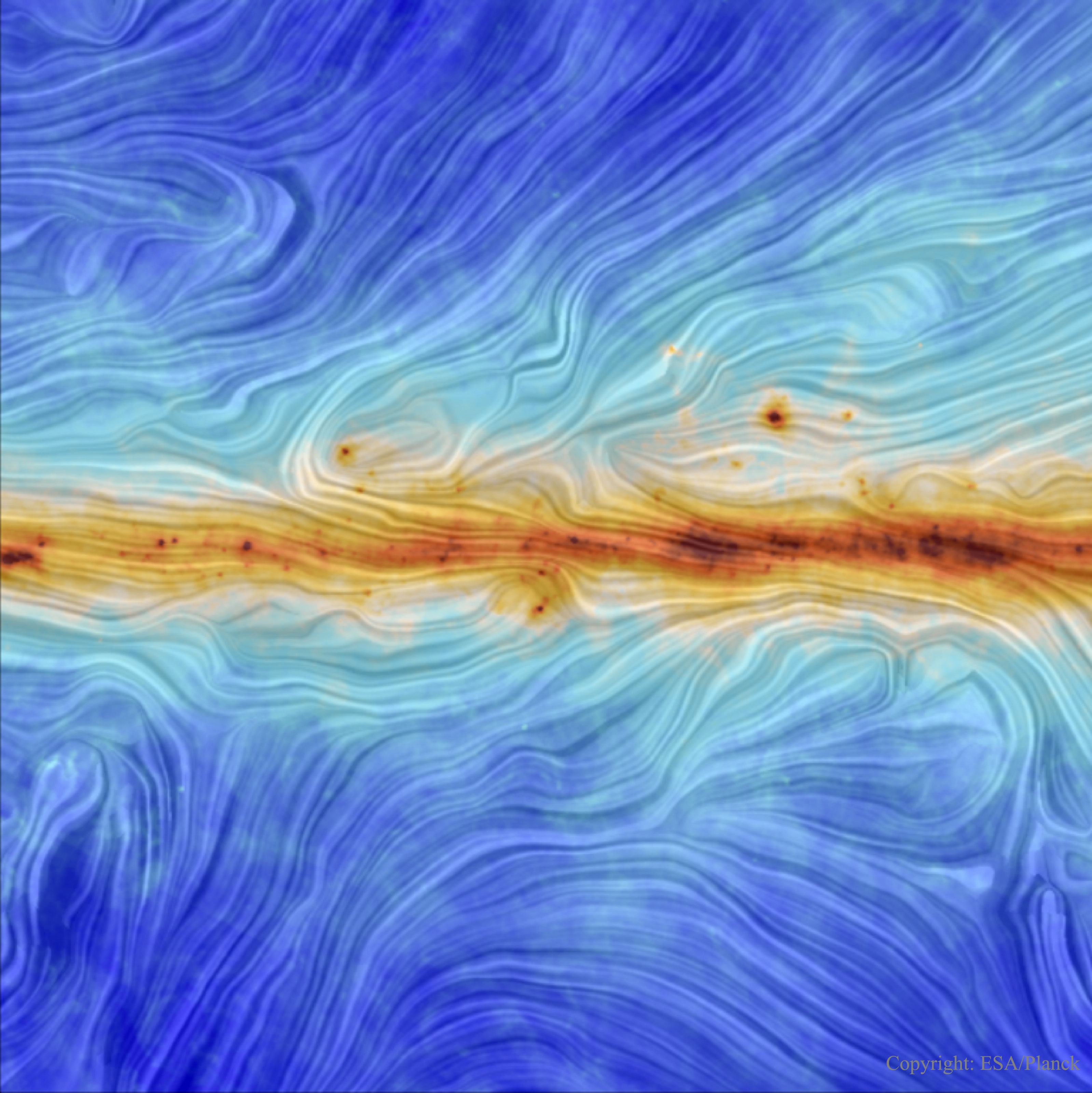
私たちの銀河の磁場はどのようなものなのでしょうか? 天の川銀河には弱い磁場が遍在していることは以前から知られていました。これは、背景光を散乱させる小さな塵の粒子を磁場が整列させていることが観測されているためです。しかし、太陽を周回するプランク衛星がこの磁場の高解像度マップを作成したのはごく最近のことです。色分けされた30度幅のマップは、銀河の星間磁場が中心円盤で最も強いことなどを確認しています。銀河中心の周りを回る荷電ガスの公転がこの磁場を生み出しており、上空から見ると、天の川の磁場は中心から渦巻くように見えると推測されています。このマップや同様のプランクマップに見られる多くの詳細の原因、そして磁場が銀河の進化にどのように影響したのかは、今後何年も研究のテーマであり続けるでしょう。
原文(English)
What does the magnetic field of our Galaxy look like? It has long been known that a modest magnetic field pervades our Milky Way Galaxy because it is seen to align small dust grains that scatter background light. Only recently, however, has the Sun-orbiting Planck satellite made a high-resolution map of this field. Color coded, the 30-degree wide map confirms, among other things, that the Galaxy's interstellar magnetism is strongest in the central disk. The revolution of charged gas around the Galactic center creates this magnetism, and it is hypothesized that viewed from the top, the Milky Way's magnetic field would appear as a spiral swirling out from the center. What caused many of the details in this and similar Planck maps -- and how magnetism in general affected our Galaxy's evolution -- will likely remain topics of research for years to come.
\ この感動を宇宙仲間にシェア /
宇宙をXでシェア
© ESA/Planck;
Acknowledgement:
M.-A. Miville-Desch�nes, CNRS �
IAS,
U. Paris-XI / APOD