
🚀 宇宙の記憶・カレンダー検索
🚀 象徴的な写真:
APOD第1回
🚀 創造の柱
🚀 スピリット火星着陸
🚀 ハッブル超深宇宙
🚀 地球へようこそ|ブルー・マーブル
🚀 エンケラドス
🚀 ベテルギウス
🚀 火星着陸
🚀 青い夕焼け
🚀 冥王星のハート
🚀 皆既日食
🚀 アースライズ再構築
🚀 ブラックホール
🚀 ウェッブ初画像
🚀 アポロ11着陸
APOD30周年(2025年6月16日)
W33のイエローボール
Yellow Balls in W33
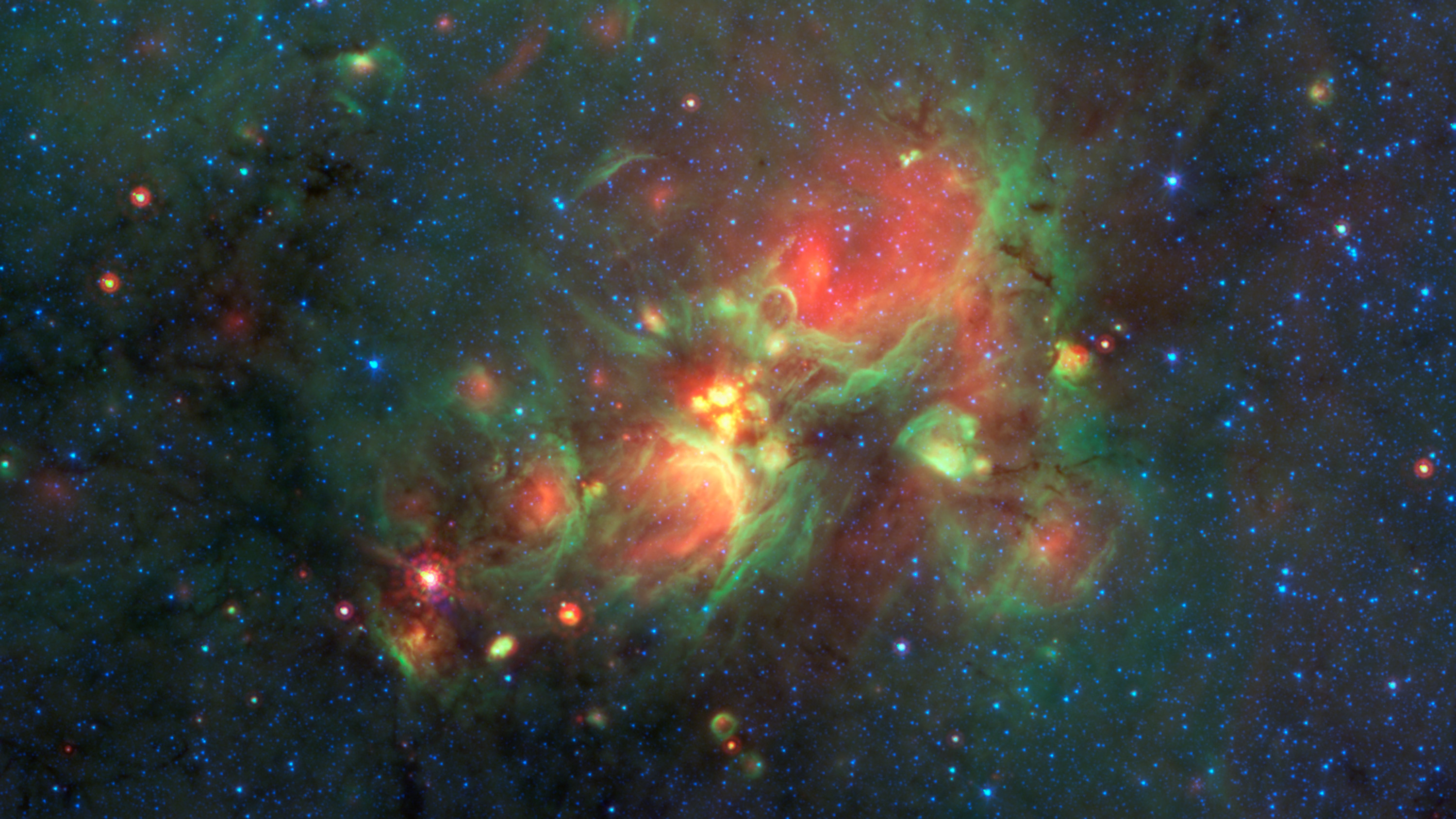
スピッツァー宇宙望遠鏡が観測した3.6、8.0、24.0マイクロメートルの赤外線波長は、この印象的な画像で可視光の色である赤、緑、青にマッピングされています。この宇宙のガスと塵の雲はW33で、私たちの天の川銀河の平面付近、約13,000光年離れた巨大な星形成複合体です。では、これらの黄色い球体は何なのでしょうか?ウェブベースの天の川プロジェクトの市民科学者たちは、スピッツァーの多くの画像をスキャンして黄色い球体と呼ばれる特徴を発見し、研究者にこの質問を執拗に尋ねました。そして今、答えが出ました。スピッツァーの画像にある黄色い球体は、大質量星形成の初期段階であると特定されています。それらが黄色に見えるのは、赤と緑の領域が重なり合っているためです。赤と緑は、スピッツァーの波長でPAHとして知られる塵と有機分子に対応する色です。黄色い球体は、生まれたばかりの大質量星が周囲のガスと塵の空洞を取り除いてスピッツァーの画像で赤い中心を持つ緑の縁の泡として現れる前の段階を表しています。もちろん、この天文学分野におけるクラウドソーシングの成功事例は、Zooniverseのほんの一部に過ぎません。スピッツァー宇宙望遠鏡の画像は、W33までの距離が推定される範囲で、0.5度、つまり約100光年の範囲をカバーしています。
原文(English)
Infrared wavelengths of 3.6, 8.0, and 24.0 microns observed by the Spitzer Space Telescope are mapped into visible colors red, green, and blue in this striking image. The cosmic cloud of gas and dust is W33, a massive starforming complex some 13,000 light-years distant, near the plane of our Milky Way Galaxy. So what are all those yellow balls? Citizen scientists of the web-based Milky Way Project found the features they called yellow balls as they scanned many Spitzer images and persistently asked that question of researchers. Now there is an answer. The yellow balls in Spitzer images are identified as an early stage of massive star formation. They appear yellow because they are overlapping regions of red and green, the assigned colors that correspond to dust and organic molecules known as PAHs at Spitzer wavelengths. Yellow balls represent the stage before newborn massive stars clear out cavities in their surrounding gas and dust and appear as green-rimmed bubbles with red centers in the Spitzer image. Of course, the astronomical crowdsourcing success story is only part of the Zooniverse. The Spitzer image spans 0.5 degrees or about 100 light-years at the estimated distance of W33.
\ この感動を宇宙仲間にシェア /
宇宙をXでシェア
© NASA / APOD