
🚀 宇宙の記憶・カレンダー検索
🚀 象徴的な写真:
APOD第1回
🚀 創造の柱
🚀 スピリット火星着陸
🚀 ハッブル超深宇宙
🚀 地球へようこそ|ブルー・マーブル
🚀 エンケラドス
🚀 ベテルギウス
🚀 火星着陸
🚀 青い夕焼け
🚀 冥王星のハート
🚀 皆既日食
🚀 アースライズ再構築
🚀 ブラックホール
🚀 ウェッブ初画像
🚀 アポロ11着陸
APOD30周年(2025年6月16日)
ベガが北にあるとき
When Vega is North
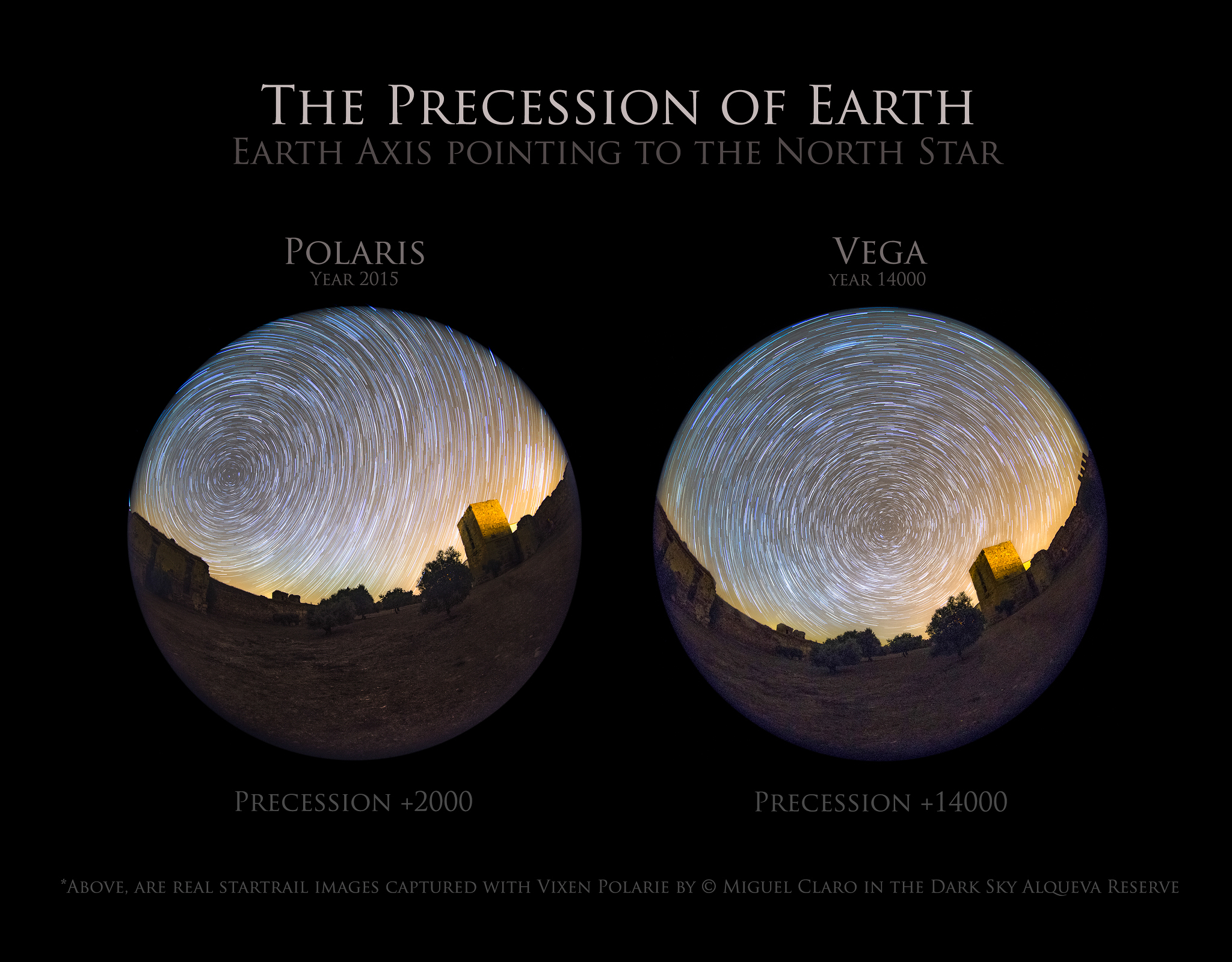
約12,000年後には、ベガが北極星、つまり地球の北天の極に最も近い明るい星になります。その頃には、カメラを三脚に固定して夜空を長時間露光すると、地球が自転するにつれて、ベガ付近の点を中心とした同心円状の星の軌跡が写し出されます。もちろん、現在、北天の極の近くにある明るい星はポラリスですが、地球の自転軸が歳差運動を起こすと、約26,000年の歳差周期で回転するコマのように、北極星の位置も変わります。もしカメラが今すぐ準備できていて、ベガが北極星になるまで12,000年も待ちたくないというのであれば、現代の星の軌跡(左)と西暦14,000年頃の星の軌跡を比較したこの独創的なデモンストレーションをご覧ください。どちらも今年4月にポルトガルのアレンテージョ地方にあるアルケバ暗空保護区で撮影されたものです。遠い未来にベガを中心とした星の軌跡を再現するために、天文学者のミゲル・クラロは、2台の星追尾カメラのマウントを回転させることで、天の北極の見かけ上の移動を作り出しました。(追記:ベガが北極星になったとき、ベガは現在ポラリスが地表に対して位置しているのとほぼ同じ位置に見えることを指摘してくださったAPOD読者の皆様に感謝いたします。)
原文(English)
In only about 12,000 years Vega will be the North Star, the closest bright star to our fair planet's North Celestial Pole. By then, when you fix your camera to a tripod long exposures of the night sky will show the concentric arcs of star trails centered on a point near Vega as Earth rotates on its axis. Of course, presently the bright star conveniently near the North Celestial Pole is Polaris, but that will change as the Earth's axis of rotation precesses, like the wobble of a spinning top with a precession period of about 26,000 years. If your camera is ready now and you don't want to wait 12,000 years for Vega to be the North Star, consider this ingenious demonstration of contemporary star trails (left) versus star trails reminiscent of the year 14000 CE. Both were recorded this April at the Alqueva Dark Sky Reserve in Alentejo, Portugal. To produce the more Vega-centric star trails of the distant future, astronomer Miguel Claro combined the rotation of two startracking camera mounts to create the apparent shift in the North Celestial Pole. (Addendum: Thanks to APOD readers who note that when Vega is the North Star it will also appear near the same position that Polaris is now relative to the landscape.)
\ この感動を宇宙仲間にシェア /
宇宙をXでシェア
© Miguel Claro / APOD