
🚀 宇宙の記憶・カレンダー検索
🚀 象徴的な写真:
APOD第1回
🚀 創造の柱
🚀 スピリット火星着陸
🚀 ハッブル超深宇宙
🚀 地球へようこそ|ブルー・マーブル
🚀 エンケラドス
🚀 ベテルギウス
🚀 火星着陸
🚀 青い夕焼け
🚀 冥王星のハート
🚀 皆既日食
🚀 アースライズ再構築
🚀 ブラックホール
🚀 ウェッブ初画像
🚀 アポロ11着陸
APOD30周年(2025年6月16日)
太陽のすべての色
All the Colors of the Sun
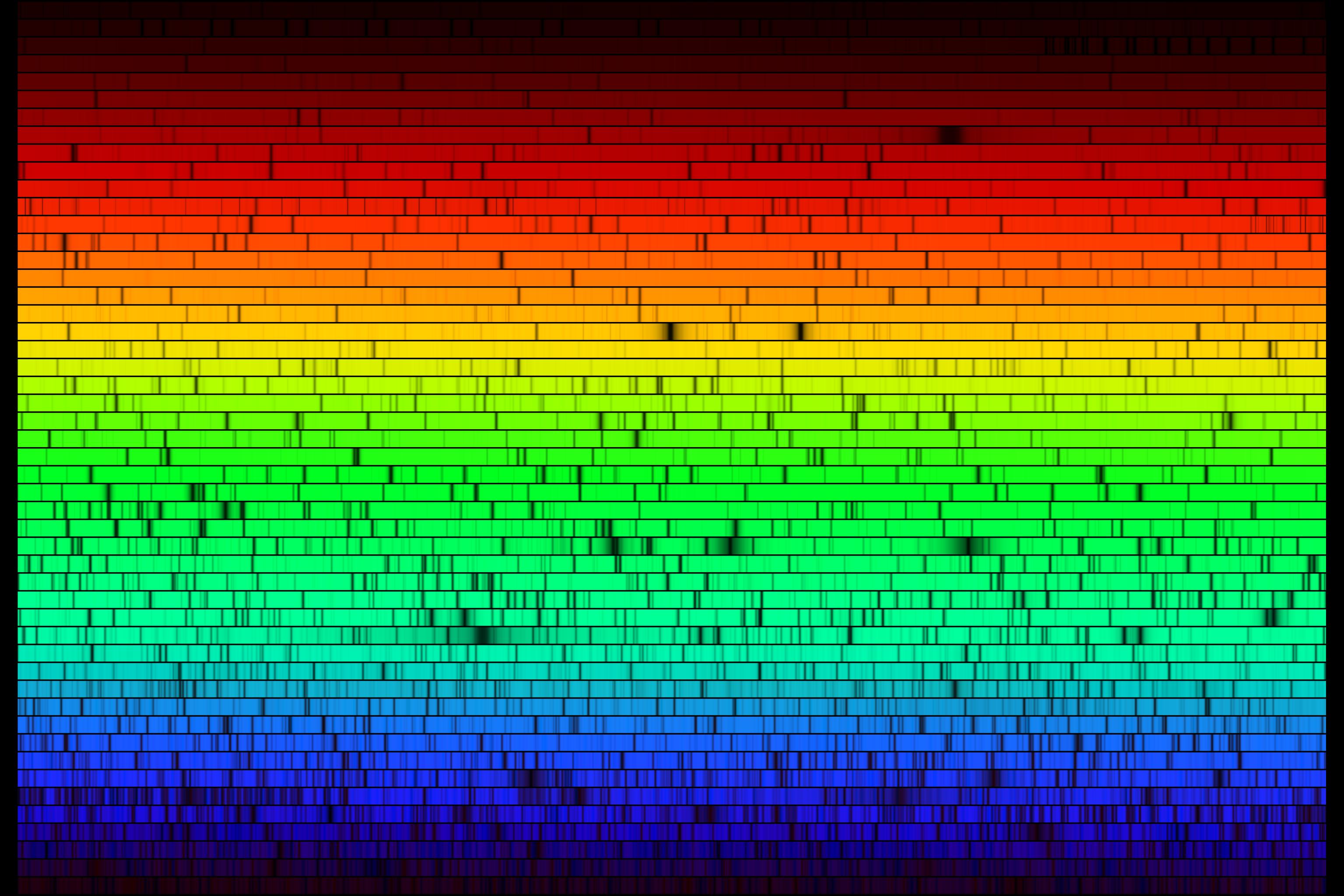
太陽の光にいくつかの色が欠けている理由はまだわかっていません。ここに、プリズムのような装置を通して太陽光を透過させることで生成された、太陽の可視光のすべての色を示します。このスペクトルはマクマス・ピアース太陽観測所で作成され、まず、白く見える太陽はほぼすべての色の光を放出しているものの、実際には黄緑色の光で最も明るく見えることを示しています。上記のスペクトルの暗い部分は、太陽の表面または表面上のガスが下から放出された太陽光を吸収することによって生じます。異なる種類のガスは異なる色の光を吸収するため、太陽を構成するガスを特定することが可能です。たとえば、ヘリウムは1870年に太陽スペクトルで初めて発見され、その後地球上で発見されました。今日では、スペクトル吸収線の大部分が特定されていますが、すべてではありません。新しい翻訳: APODはクロアチア語とモンテネグロ語で利用できるようになりました。
原文(English)
It is still not known why the Sun's light is missing some colors. Here are all the visible colors of the Sun, produced by passing the Sun's light through a prism-like device. The spectrum was created at the McMath-Pierce Solar Observatory and shows, first off, that although our white-appearing Sun emits light of nearly every color, it does indeed appear brightest in yellow-green light. The dark patches in the above spectrum arise from gas at or above the Sun's surface absorbing sunlight emitted below. Since different types of gas absorb different colors of light, it is possible to determine what gasses compose the Sun. Helium, for example, was first discovered in 1870 on a solar spectrum and only later found here on Earth. Today, the majority of spectral absorption lines have been identified - but not all. New Translations: APOD is now available in Croatian and Montenegrin.
\ この感動を宇宙仲間にシェア /
宇宙をXでシェア
© Nigel Sharp / APOD