
🚀 宇宙の記憶・カレンダー検索
🚀 象徴的な写真:
APOD第1回
🚀 創造の柱
🚀 スピリット火星着陸
🚀 ハッブル超深宇宙
🚀 地球へようこそ|ブルー・マーブル
🚀 エンケラドス
🚀 ベテルギウス
🚀 火星着陸
🚀 青い夕焼け
🚀 冥王星のハート
🚀 皆既日食
🚀 アースライズ再構築
🚀 ブラックホール
🚀 ウェッブ初画像
🚀 アポロ11着陸
APOD30周年(2025年6月16日)
パンスターズ彗星と三日月
Comet PanSTARRS and a Crescent Moon
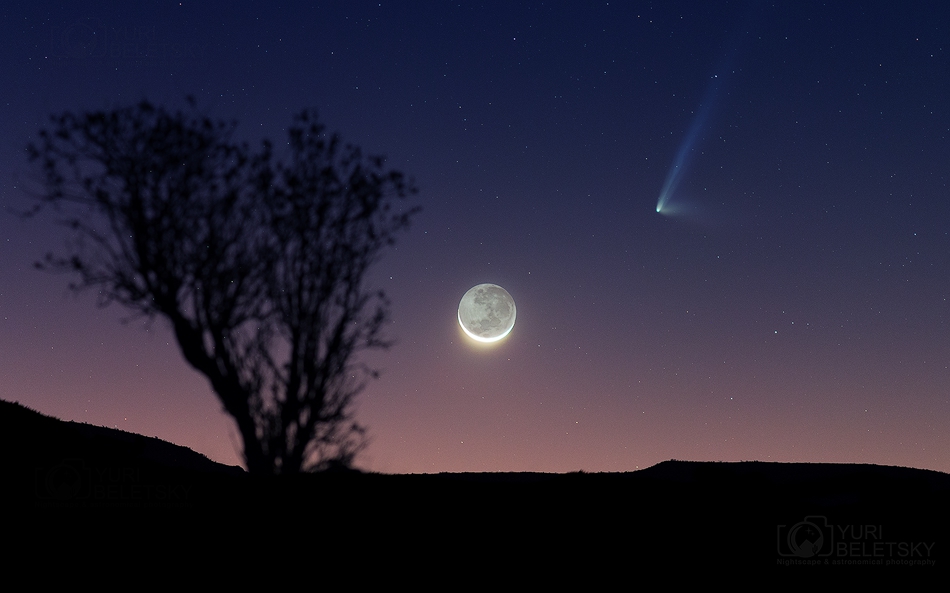
彗星が予想外に急速に明るくなりました。昨年発見された彗星C/2014 Q1(PanSTARRS)は、一部の地域では日没直後に数日間肉眼で見えると予想されています。この彗星は7月6日に太陽を周回し、かなりの量のガスと塵を放出したようです。今日、彗星は地球に最も接近しており、これが最近の見かけの明るさの増大と尾の角度範囲の拡大のもう一つの要因となっています。2日前に撮影された特集画像では、PanSTARRS彗星は右に消えていく短い白い塵の尾と、最近沈んだ太陽から遠ざかる長い青いイオンの尾を伴っているのが見えます。画像の中央には三日月が写っています。明日、PanSTARRS彗星は明るい木星からわずか7度離れたところを通過し、近くにはさらに明るい金星があります。太陽に近いことから、この彗星とその尾は、夕暮れ時の薄明かりの中で双眼鏡や長時間露光カメラを使って最もよく見えるでしょう。APOD編集者が講演:8月8日(土)、キーウィーノー科学技術フェスティバルにて
原文(English)
A comet has brightened quickly and unexpectedly. Discovered last year, Comet C/2014 Q1 (PanSTARRS) is expected to be visible now for a few days to the unaided eye, just after sunset, from some locations. The comet rounded the Sun on July 6 and apparently has shed quite a bit of gas and dust. Today it is now as close as it will ever get to the Earth, which is another factor in its recent great apparent brightness and the large angular extent of its tails. In the featured image taken two days ago, Comet PanSTARRS is seen sporting a short white dust tail fading to the right, and a long blue ion tail pointing away from the recently set Sun. A crescent moon dominates the image center. Tomorrow, Comet PannSTARRS will pass only 7 degrees away from a bright Jupiter, with even brighter Venus nearby. Due to its proximity to the Sun, the comet and its tails may best be seen in the sunset din with binoculars or cameras using long-duration exposures. APOD Editor to Speak: Saturday, August 8 at Keweenaw Science & Engineering Festival
\ この感動を宇宙仲間にシェア /
宇宙をXでシェア
© Yuri Beletsky
(Las Campanas Observatory,
Carnegie Institution) / APOD