
🚀 宇宙の記憶・カレンダー検索
🚀 象徴的な写真:
APOD第1回
🚀 創造の柱
🚀 スピリット火星着陸
🚀 ハッブル超深宇宙
🚀 地球へようこそ|ブルー・マーブル
🚀 エンケラドス
🚀 ベテルギウス
🚀 火星着陸
🚀 青い夕焼け
🚀 冥王星のハート
🚀 皆既日食
🚀 アースライズ再構築
🚀 ブラックホール
🚀 ウェッブ初画像
🚀 アポロ11着陸
APOD30周年(2025年6月16日)
近日点接近
Perihelion Approaches
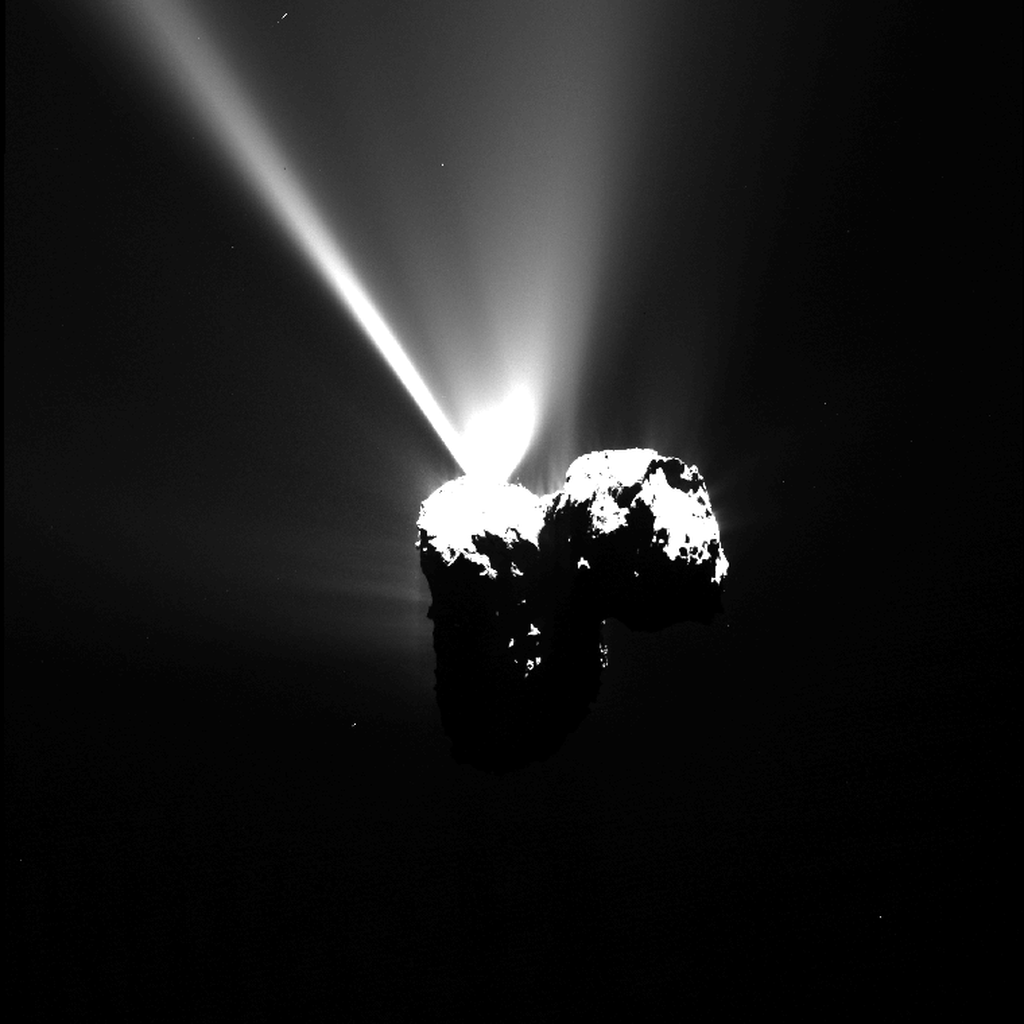
チュリュモフ・ゲラシメンコ彗星(67P)の核からこの劇的な噴出が起こったのは、太陽に最も接近する近日点通過のわずか数時間前の8月12日だった。この周期彗星は6.45年ごとに太陽の周りを一周し、近日点までの距離は約1.3天文単位(AU)で、地球の軌道(1 AU)よりも外側にある。明るい日光と暗い影に覆われた、幅4キロメートルの二重ローブの核の鮮明な画像は、ロゼッタ探査機の科学カメラによって約325キロメートル離れた場所で撮影された。彗星の尾が伸びる様子を見るには近すぎるが、ロゼッタはリングサイドの特等席を維持し、今後数週間で核が温まり、表面から昇華する原始氷がガスと塵の噴流を生み出すにつれて活動が活発化する様子を観測する。もちろん、1992年に地球から0.96天文単位の距離で最後に近日点を通過した周期彗星スウィフト・タットルの核から発生した塵が、まさに今週地球に降り注いだ。
原文(English)
This dramatic outburst from the nucleus of Comet 67P/Churyumov-Gerasimenko occured on August 12, just hours before perihelion, its closest approach to the Sun. Completing an orbit of the Sun once every 6.45 years, perihelion distance for this periodic comet is about 1.3 astronomical units (AU), still outside the orbit of planet Earth (at 1 AU). The stark image of the 4 kilometer wide, double-lobed nucleus in bright sunlight and dark shadows was taken by the Rosetta spacecraft's science camera about 325 kilometers away. Too close to see the comet's growing tail, Rosetta maintains its ringside seat to watch the nucleus warm and become more active in coming weeks, as primordial ices sublimating from the surface produce jets of gas and dust. Of course, dust from the nucleus of periodic comet Swift-Tuttle, whose last perihelion passage was in 1992 at a distance of 0.96 AU, fell to Earth just this week.
\ この感動を宇宙仲間にシェア /
宇宙をXでシェア
© NASA / APOD