
🚀 宇宙の記憶・カレンダー検索
🚀 象徴的な写真:
APOD第1回
🚀 創造の柱
🚀 スピリット火星着陸
🚀 ハッブル超深宇宙
🚀 地球へようこそ|ブルー・マーブル
🚀 エンケラドス
🚀 ベテルギウス
🚀 火星着陸
🚀 青い夕焼け
🚀 冥王星のハート
🚀 皆既日食
🚀 アースライズ再構築
🚀 ブラックホール
🚀 ウェッブ初画像
🚀 アポロ11着陸
APOD30周年(2025年6月16日)
NGC 4372とダークドゥーダッド
NGC 4372 and the Dark Doodad
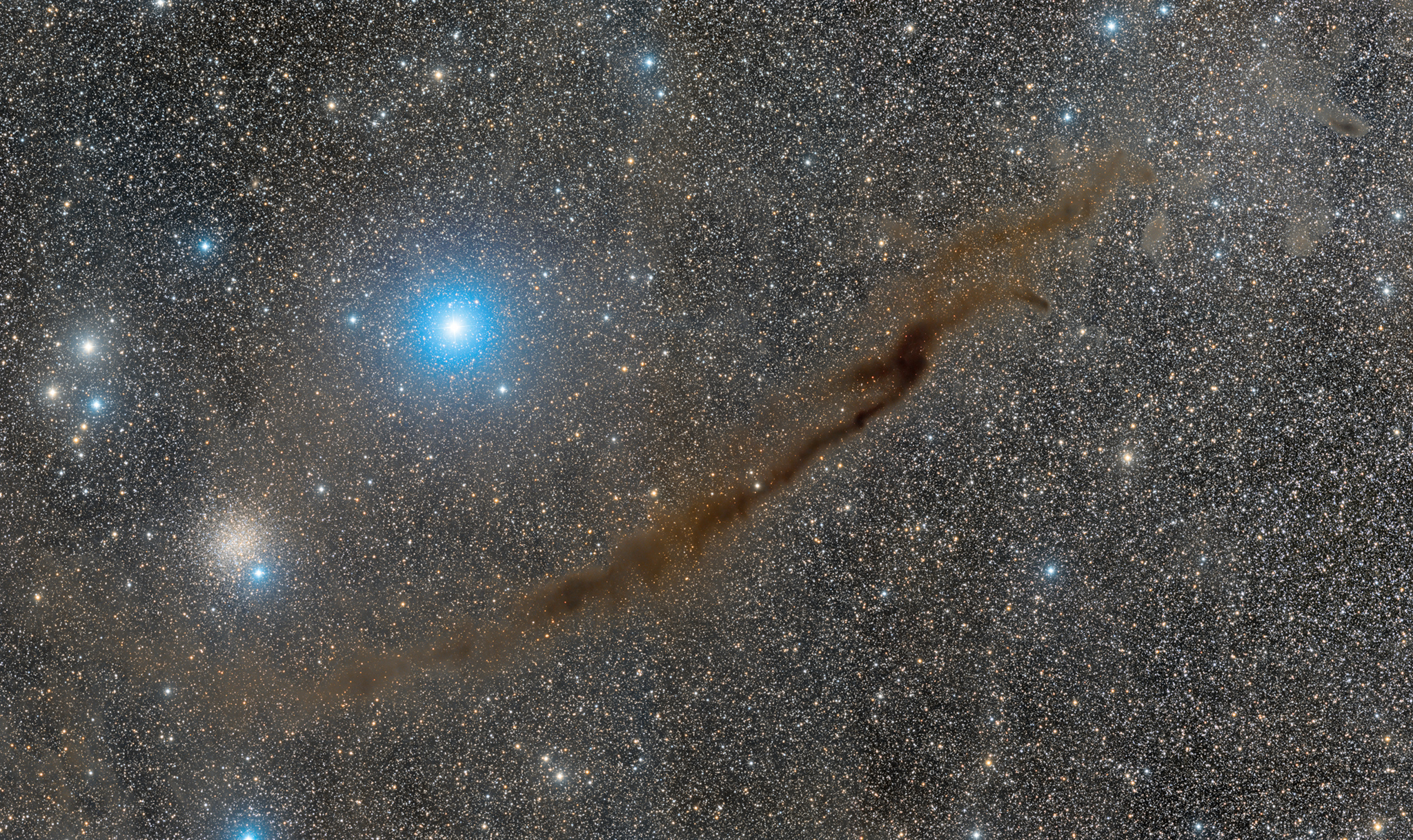
魅力的なダーク・ドゥーダッド星雲は南の空を漂い、ハエ座にある双眼鏡の魅力的なターゲットです。この塵の宇宙雲は、目立つコールサック星雲と南十字星のすぐ南にある豊かな星野を背景に見えます。このシーンで約3度にわたって広がるダーク・ドゥーダッドは、南端(左下)に球状星団NGC 4372によって区切られています。もちろんNGC 4372は、私たちの天の川銀河のハローをさまよう背景天体で、約2万光年離れており、ダーク・ドゥーダッドへの視線上にたまたま位置しているだけです。ダーク・ドゥーダッドの明確なシルエットはハエ座分子雲に属していますが、よりよく知られている頭韻を踏んだ名前は、1986年にオーストラリアの奥地からハレー彗星を観測していた天体写真家で作家のデニス・ディ・チッコによって初めて付けられました。ダーク・ドゥーダッドは地球から約700光年離れており、全長は30光年以上ある。
原文(English)
The delightful Dark Doodad Nebula drifts through southern skies, a tantalizing target for binoculars in the constellation Musca, The Fly. The dusty cosmic cloud is seen against rich starfields just south of the prominent Coalsack Nebula and the Southern Cross. Stretching for about 3 degrees across this scene the Dark Doodad is punctuated at its southern tip (lower left) by globular star cluster NGC 4372. Of course NGC 4372 roams the halo of our Milky Way Galaxy, a background object some 20,000 light-years away and only by chance along our line-of-sight to the Dark Doodad. The Dark Doodad's well defined silhouette belongs to the Musca molecular cloud, but its better known alliterative moniker was first coined by astro-imager and writer Dennis di Cicco in 1986 while observing Comet Halley from the Australian outback. The Dark Doodad is around 700 light-years distant and over 30 light-years long.
\ この感動を宇宙仲間にシェア /
宇宙をXでシェア
© Marco Lorenzi / APOD