
🚀 宇宙の記憶・カレンダー検索
🚀 象徴的な写真:
APOD第1回
🚀 創造の柱
🚀 スピリット火星着陸
🚀 ハッブル超深宇宙
🚀 地球へようこそ|ブルー・マーブル
🚀 エンケラドス
🚀 ベテルギウス
🚀 火星着陸
🚀 青い夕焼け
🚀 冥王星のハート
🚀 皆既日食
🚀 アースライズ再構築
🚀 ブラックホール
🚀 ウェッブ初画像
🚀 アポロ11着陸
APOD30周年(2025年6月16日)
トリフィド、ラグーン、そして火星
Trifid, Lagoon, and Mars
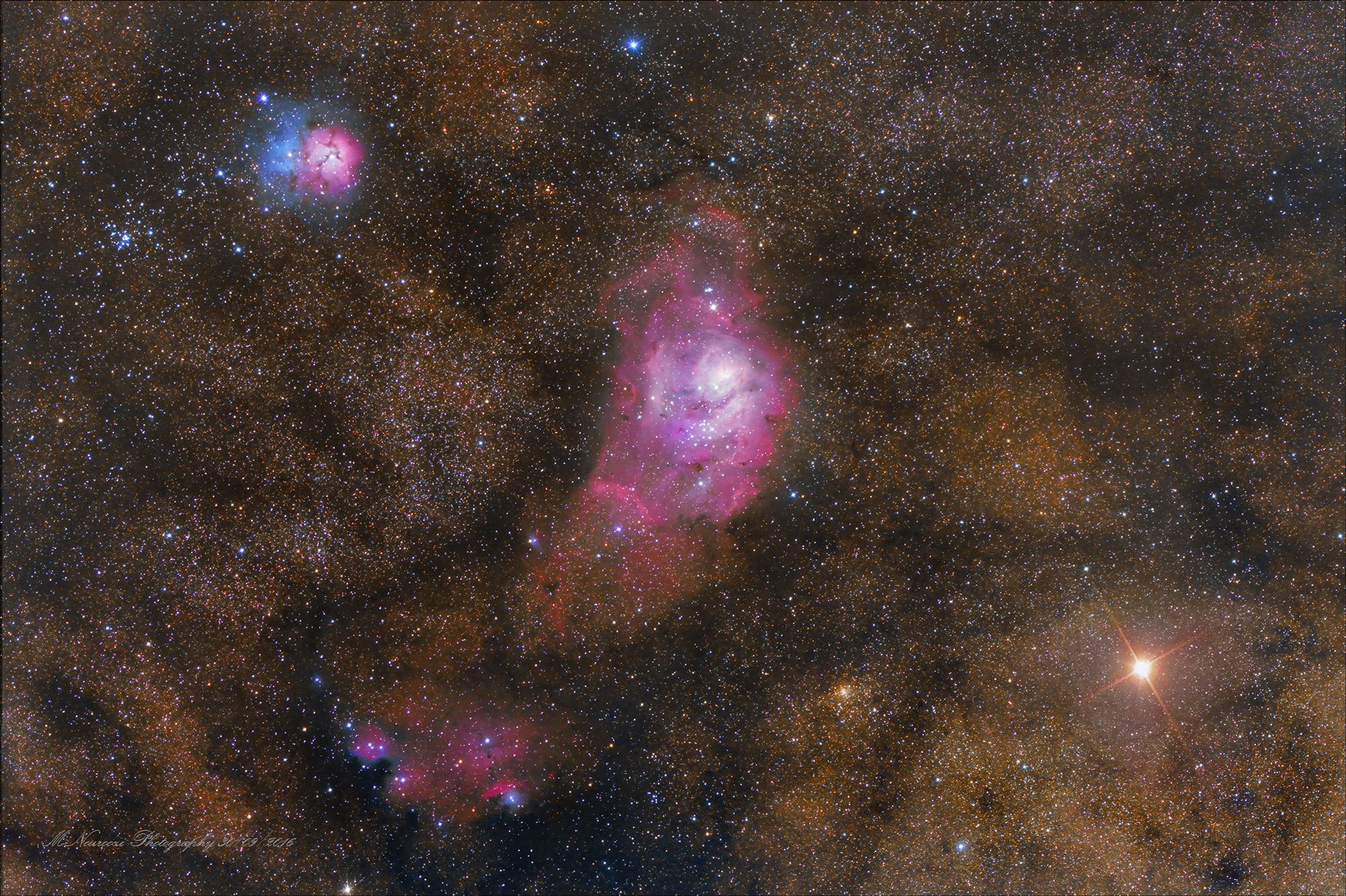
この5度の視野に広がる明るい星雲や星団は、いて座や天の川銀河中心部の密集した星野を望遠鏡で巡るツアーで人気のスポットです。18世紀のフランスの天文学者シャルル・メシエによってカタログ化された、色鮮やかな三裂星雲M20と広大なラグーン星雲M8は、左上と中央にあります。どちらも約5,000光年離れた、よく知られた星形成領域です。9月29日に同じ視野を通過した、右下のM8とM20と一直線に並んだ黄色い星は、実は火星で、その日地球から8.8光分ほど離れています。この距離は、1天文単位、つまり地球から太陽までの距離とほぼ同じです。画像では火星が露出オーバーになっており、望遠鏡のミラーサポートによって生じた回折スパイクがはっきりと見えます。もちろん、火星は地球の夜空をさまようことがずっと前から知られています。
原文(English)
Bright nebulae and star clusters along this 5 degree wide field of view are popular stops on telescopic tours of the constellation Sagittarius and the crowded starfields of the central Milky Way. Cataloged by 18th century French astronomer Charles Messier, M20, the colorful Trifid Nebula, and M8, the expansive Lagoon Nebula, are at upper left and center. Both are well-known star forming regions about 5,000 light-years distant. Just passing through the same field of view on September 29, the yellowish star lined up with M8 and M20 at the lower right is actually Mars, close to 8.8 light-minutes from Earth on that date. That distance is nearly equivalent to 1 astronomical unit or the distance from Earth to Sun. Mars is overexposed in the image, with visible diffraction spikes created by the telescope mirror supports. Of course, Mars has long been known to wander through planet Earth's night skies.
\ この感動を宇宙仲間にシェア /
宇宙をXでシェア
© Mohammad Nouroozi / APOD