
🚀 宇宙の記憶・カレンダー検索
🚀 象徴的な写真:
APOD第1回
🚀 創造の柱
🚀 スピリット火星着陸
🚀 ハッブル超深宇宙
🚀 地球へようこそ|ブルー・マーブル
🚀 エンケラドス
🚀 ベテルギウス
🚀 火星着陸
🚀 青い夕焼け
🚀 冥王星のハート
🚀 皆既日食
🚀 アースライズ再構築
🚀 ブラックホール
🚀 ウェッブ初画像
🚀 アポロ11着陸
APOD30周年(2025年6月16日)
Arp 299:衝突する銀河におけるブラックホール
Arp 299: Black Holes in Colliding Galaxies
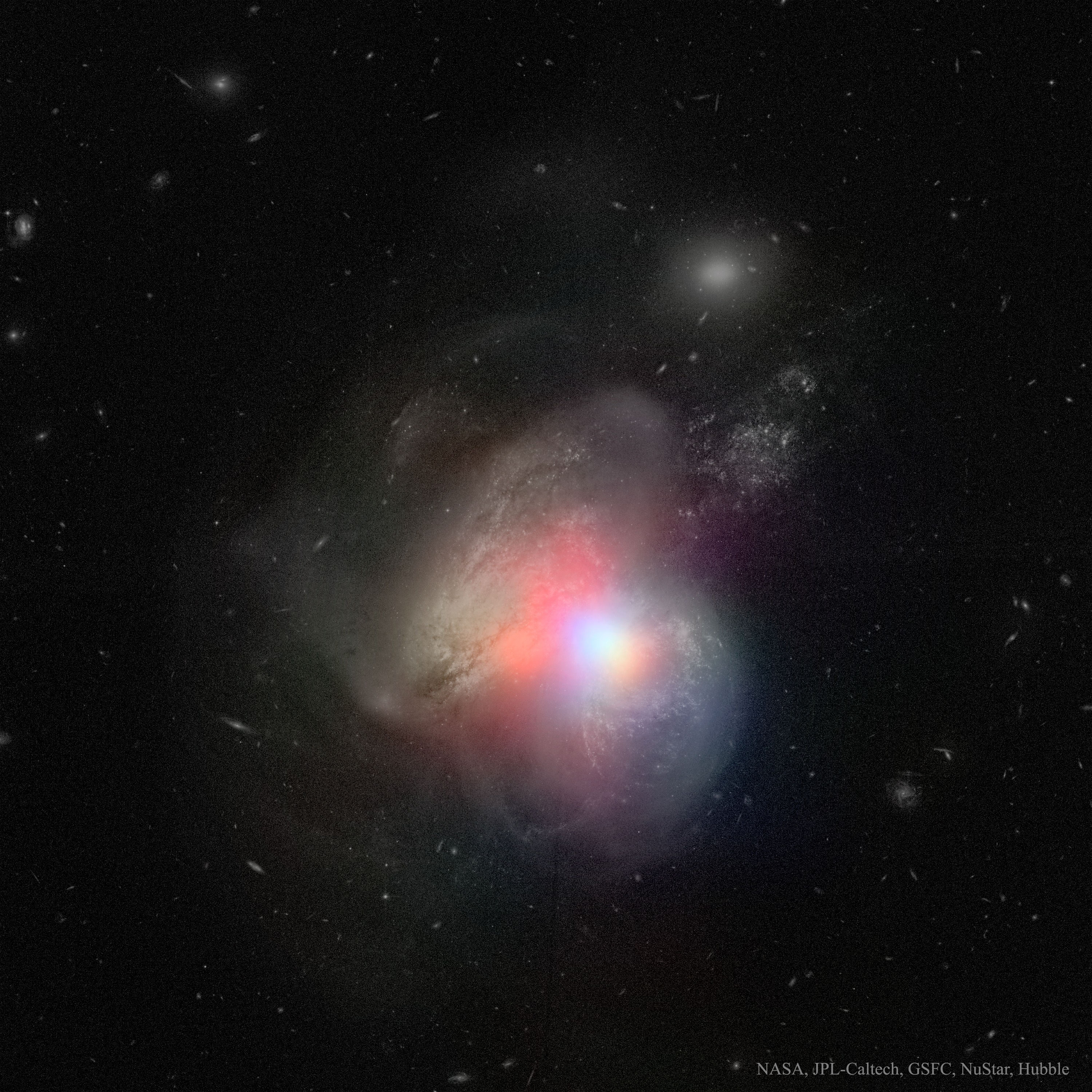
高エネルギー放射線を放出しているブラックホールは1つだけなのか、それとも2つなのか?それを解明するために、天文学者たちは、放射線を放出している謎めいた衝突銀河、Arp 299に、NASAの地球周回望遠鏡NuSTARとChandraを向けた。Arp 299の2つの銀河は何百万年も重力による戦いを繰り広げており、その中心にあるブラックホールもまもなく戦いを始めるだろう。掲載されている高解像度の可視光画像はハッブル宇宙望遠鏡で撮影されたもので、重ね合わされた拡散X線光はNuSTARで撮影され、擬似カラーの赤、緑、青で表示されている。NuSTARの観測によると、中心にあるブラックホールのうち1つだけがガスと塵の領域を突き進み、物質を吸収してX線を放出しているのが見える。右側の銀河中心からのみ放出されている高エネルギー放射線は、中心ブラックホールの事象の地平線のすぐ近く、ただし外側で生成されているに違いない。およそ10億年後には、複合銀河は1つだけになり、中心にある超大質量ブラックホールも1つだけになるでしょう。しかし、その後まもなく、別の銀河が誕生するかもしれません。透明な科学:天体物理学ソースコードライブラリにある1,350以上のコードを閲覧できます。
原文(English)
Is only one black hole spewing high energy radiation -- or two? To help find out, astronomers trained NASA's Earth-orbiting NuSTAR and Chandra telescopes on Arp 299, the enigmatic colliding galaxies expelling the radiation. The two galaxies of Arp 299 have been locked in a gravitational combat for millions of years, while their central black holes will soon do battle themselves. Featured, the high-resolution visible-light image was taken by Hubble, while the superposed diffuse glow of X-ray light was imaged by NuSTAR and shown in false-color red, green, and blue. NuSTAR observations show that only one of the central black holes is seen fighting its way through a region of gas and dust -- and so absorbing matter and emitting X-rays. The energetic radiation, coming only from the galaxy center on the right, is surely created nearby -- but outside -- the central black hole's event horizon. In a billion years or so, only one composite galaxy will remain, and only one central supermassive black hole. Soon thereafter, though, another galaxy may enter the fray. Transparent Science: Browse 1,350+ codes in the Astrophysics Source Code Library
\ この感動を宇宙仲間にシェア /
宇宙をXでシェア
© NASA / APOD