
🚀 宇宙の記憶・カレンダー検索
🚀 象徴的な写真:
APOD第1回
🚀 創造の柱
🚀 スピリット火星着陸
🚀 ハッブル超深宇宙
🚀 地球へようこそ|ブルー・マーブル
🚀 エンケラドス
🚀 ベテルギウス
🚀 火星着陸
🚀 青い夕焼け
🚀 冥王星のハート
🚀 皆既日食
🚀 アースライズ再構築
🚀 ブラックホール
🚀 ウェッブ初画像
🚀 アポロ11着陸
APOD30周年(2025年6月16日)
M63:ハッブル宇宙望遠鏡が捉えたひまわり銀河
M63: The Sunflower Galaxy from Hubble
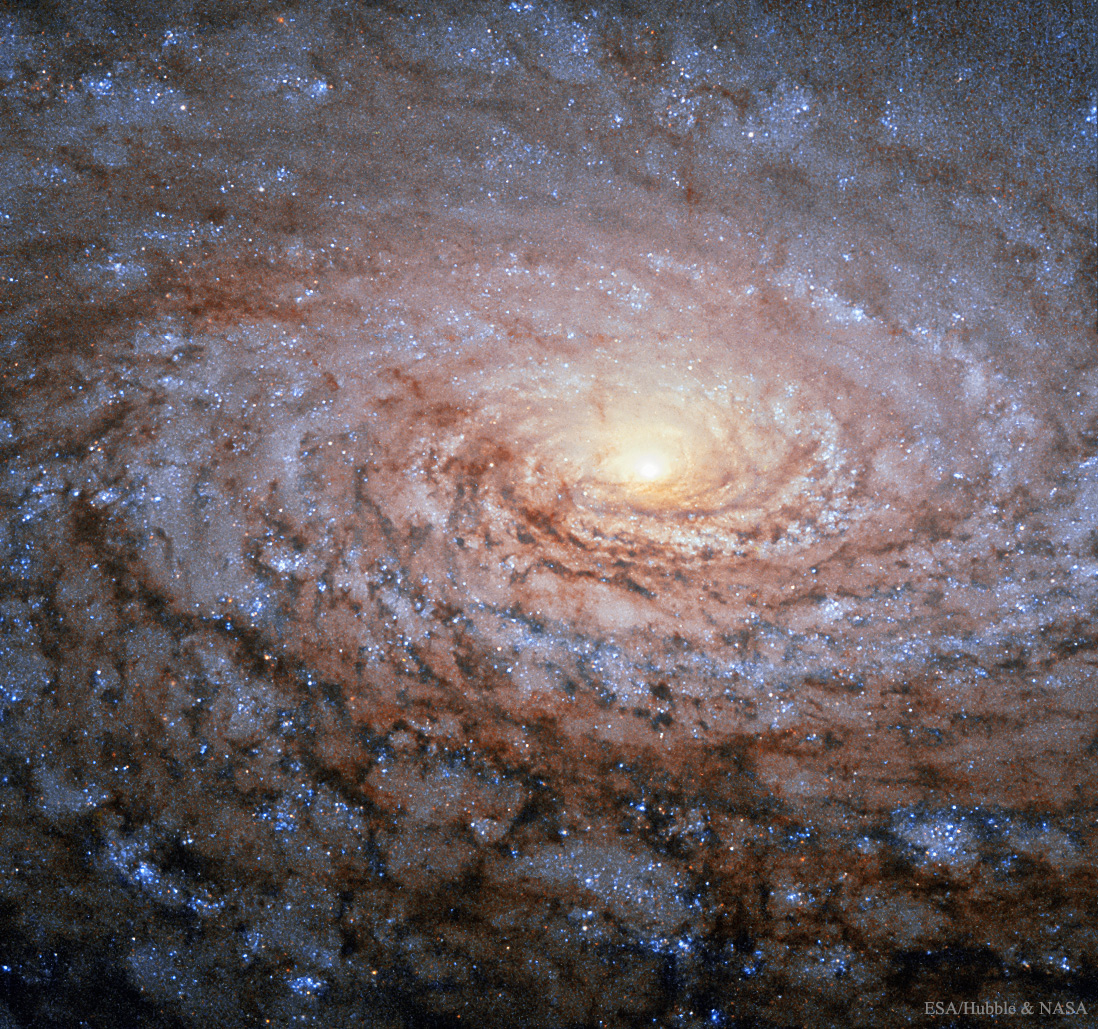
北の空に見える明るい渦巻銀河の1つに、ひまわり銀河M63があります。NGC 5055としてもカタログ化されているM63は、小型望遠鏡で猟犬座(りょうけん座)の方向に見つけることができます。ハッブル宇宙望遠鏡で撮影されたこの画像には、M63の中心部が写っており、いくつかの明るい若い星から青く輝く長く曲がりくねった渦巻腕、高温の電離水素ガスから赤く輝く輝線星雲、そして無数のフィラメント状の暗い塵が見られます。M63は、M51(渦巻銀河)やいくつかの小さな銀河と重力的に相互作用しています。M63から地球に光が届くまでには約3500万年、渦巻銀河を横断するのには約6万年かかります。ひまわり銀河の外縁部の星は中心の周りを非常に高速で回転しており、観測された物質と通常の重力を考慮すると、宇宙空間に飛び出してしまうはずです。星々が残っているという事実は、目に見えない重力的に結合した暗黒物質の存在を示唆している。無料ダウンロード:APOD 2017カレンダー:NASA画像
原文(English)
One of the bright spiral galaxies visible in the north sky is M63, the Sunflower Galaxy. M63, also catalogued as NGC 5055, can be found with a small telescope toward the constellation of Hunting Dogs (Canes Venatici). The featured picture from the Hubble Space Telescope exhibits the center of M63, complete with long winding spiral arms glowing blue from a few bright young stars, emission nebulae glowing red from hot ionized hydrogen gas, and dark dust in numerous filaments. M63 interacts gravitationally with M51 (the Whirlpool Galaxy) and several smaller galaxies. Light takes about 35 million years to reach us from M63, and about 60,000 years to cross the spiral galaxy. Stars in the outer regions of the Sunflower Galaxy rotate about the center at a speed so high that, given the matter seen and assuming normal gravity, they should fly off into space. The fact that the stars remain indicates the presence of sort of invisible, gravitationally-binding, dark matter. Free Download: APOD 2017 Calendar: NASA Images
\ この感動を宇宙仲間にシェア /
宇宙をXでシェア
© NASA / APOD