
🚀 宇宙の記憶・カレンダー検索
🚀 象徴的な写真:
APOD第1回
🚀 創造の柱
🚀 スピリット火星着陸
🚀 ハッブル超深宇宙
🚀 地球へようこそ|ブルー・マーブル
🚀 エンケラドス
🚀 ベテルギウス
🚀 火星着陸
🚀 青い夕焼け
🚀 冥王星のハート
🚀 皆既日食
🚀 アースライズ再構築
🚀 ブラックホール
🚀 ウェッブ初画像
🚀 アポロ11着陸
APOD30周年(2025年6月16日)
ハッブル宇宙望遠鏡が捉えたイルカ銀河
The Porpoise Galaxy from Hubble
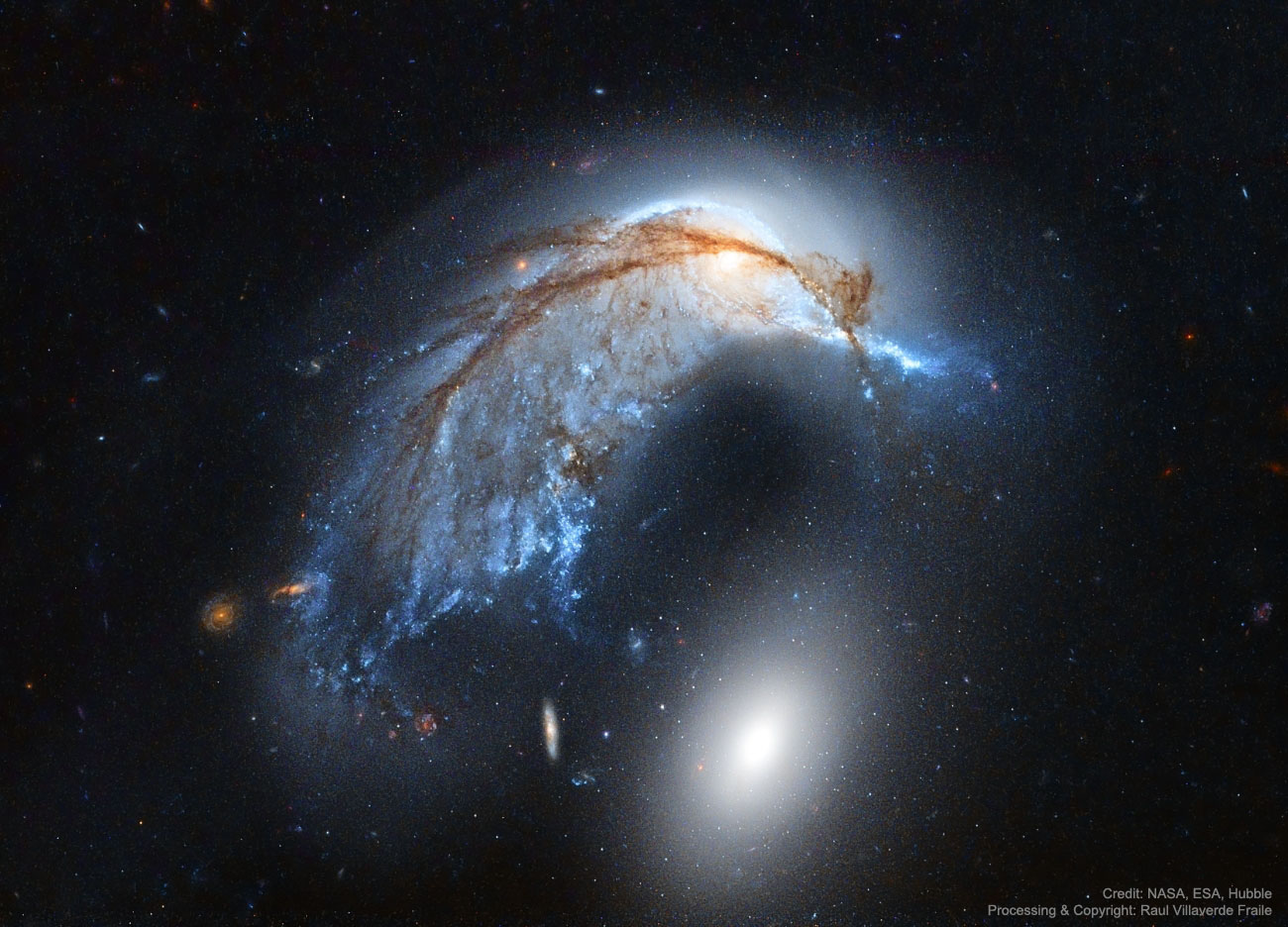
この渦巻銀河に何が起こっているのでしょうか?ほんの数億年前、図示されている2つの大きな銀河のうち上のNGC 2936は、おそらく普通の渦巻銀河で、回転し、星を作り、何事もなく過ごしていたのでしょう。しかしその後、下の巨大な楕円銀河NGC 2937に近づきすぎて、急降下してしまいました。その特徴的な形から「イルカ銀河」と呼ばれるNGC 2936は、近接した重力相互作用によって、軌道が逸れるだけでなく、歪められています。上の銀河の右側には、若い青い星の集まりがイルカの鼻を形成し、渦巻の中心は目のように見えます。あるいは、この2つの銀河は合わせてArp 142と呼ばれ、卵を守るペンギンのように見えると言う人もいます。いずれにせよ、複雑な暗い塵の帯と明るい青い星の流れが、この混乱した銀河の右下を流れています。ハッブル宇宙望遠鏡が昨年撮影した、Arp 142をかつてないほど詳細に捉えた再処理画像が掲載されています。Arp 142は、偶然にもうみへび座の方向、約3億光年離れた場所に位置しています。10億年後には、この2つの銀河は合体して1つの大きな銀河になると考えられています。Almost Hyperspace: Random APOD Generator
原文(English)
What's happening to this spiral galaxy? Just a few hundred million years ago, NGC 2936, the upper of the two large galaxies shown, was likely a normal spiral galaxy -- spinning, creating stars -- and minding its own business. But then it got too close to the massive elliptical galaxy NGC 2937 below and took a dive. Dubbed the Porpoise Galaxy for its iconic shape, NGC 2936 is not only being deflected but also being distorted by the close gravitational interaction. A burst of young blue stars forms the nose of the porpoise toward the right of the upper galaxy, while the center of the spiral appears as an eye. Alternatively, the galaxy pair, together known as Arp 142, look to some like a penguin protecting an egg. Either way, intricate dark dust lanes and bright blue star streams trail the troubled galaxy to the lower right. The featured re-processed image showing Arp 142 in unprecedented detail was taken by the Hubble Space Telescope last year. Arp 142 lies about 300 million light years away toward the constellation, coincidently, of the Water Snake (Hydra). In a billion years or so the two galaxies will likely merge into one larger galaxy. Almost Hyperspace: Random APOD Generator
\ この感動を宇宙仲間にシェア /
宇宙をXでシェア
© Raul Villaverde / APOD