
🚀 宇宙の記憶・カレンダー検索
🚀 象徴的な写真:
APOD第1回
🚀 創造の柱
🚀 スピリット火星着陸
🚀 ハッブル超深宇宙
🚀 地球へようこそ|ブルー・マーブル
🚀 エンケラドス
🚀 ベテルギウス
🚀 火星着陸
🚀 青い夕焼け
🚀 冥王星のハート
🚀 皆既日食
🚀 アースライズ再構築
🚀 ブラックホール
🚀 ウェッブ初画像
🚀 アポロ11着陸
APOD30周年(2025年6月16日)
中央白鳥座のスカイスケープ
Central Cygnus Skyscape
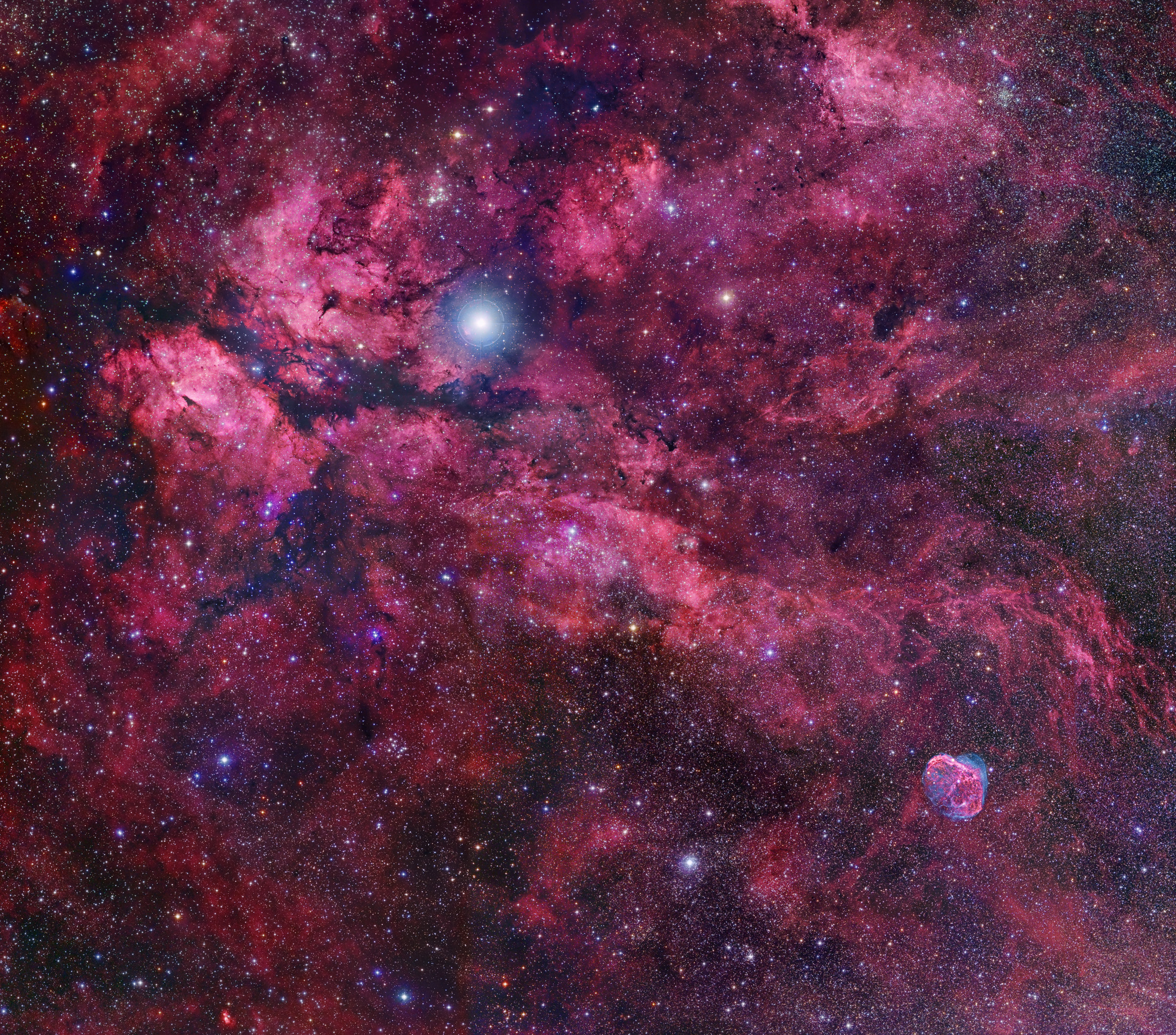
輝く水素ガスの宇宙的な筆致で描かれたこの美しい星空は、天の川銀河の北端、大裂け目付近、白鳥座の中心付近に広がっています。望遠鏡画像データの36枚のパネルからなるモザイク画像で、約6度の範囲を捉えています。画像の左上にある明るい超巨星ガンマ・シグニ(サドル)は、複雑なガスと塵の雲、そして星が密集した領域の前景に位置しています。ガンマ・シグニの左には、長い暗い塵の帯で隔てられた2枚の光り輝く翼のような形をしたIC 1318があり、その通称は蝶星雲です。右下にあるよりコンパクトで明るい星雲はNGC 6888、三日月星雲です。はくちょう座γ星までの距離については、約1,800光年という推定値がある一方、IC 1318とNGC 6888については、2,000光年から5,000光年という推定値がある。
原文(English)
In cosmic brush strokes of glowing hydrogen gas, this beautiful skyscape unfolds across the plane of our Milky Way Galaxy near the northern end of the Great Rift and the center of the constellation Cygnus the Swan. A 36 panel mosaic of telescopic image data, the scene spans about six degrees. Bright supergiant star Gamma Cygni (Sadr) to the upper left of the image center lies in the foreground of the complex gas and dust clouds and crowded star fields. Left of Gamma Cygni, shaped like two luminous wings divided by a long dark dust lane is IC 1318 whose popular name is understandably the Butterfly Nebula. The more compact, bright nebula at the lower right is NGC 6888, the Crescent Nebula. Some distance estimates for Gamma Cygni place it at around 1,800 light-years while estimates for IC 1318 and NGC 6888 range from 2,000 to 5,000 light-years.
\ この感動を宇宙仲間にシェア /
宇宙をXでシェア
© Robert Gendler / APOD