
🚀 宇宙の記憶・カレンダー検索
🚀 象徴的な写真:
APOD第1回
🚀 創造の柱
🚀 スピリット火星着陸
🚀 ハッブル超深宇宙
🚀 地球へようこそ|ブルー・マーブル
🚀 エンケラドス
🚀 ベテルギウス
🚀 火星着陸
🚀 青い夕焼け
🚀 冥王星のハート
🚀 皆既日食
🚀 アースライズ再構築
🚀 ブラックホール
🚀 ウェッブ初画像
🚀 アポロ11着陸
APOD30周年(2025年6月16日)
彗星、フクロウ、そして銀河
The Comet, the Owl, and the Galaxy
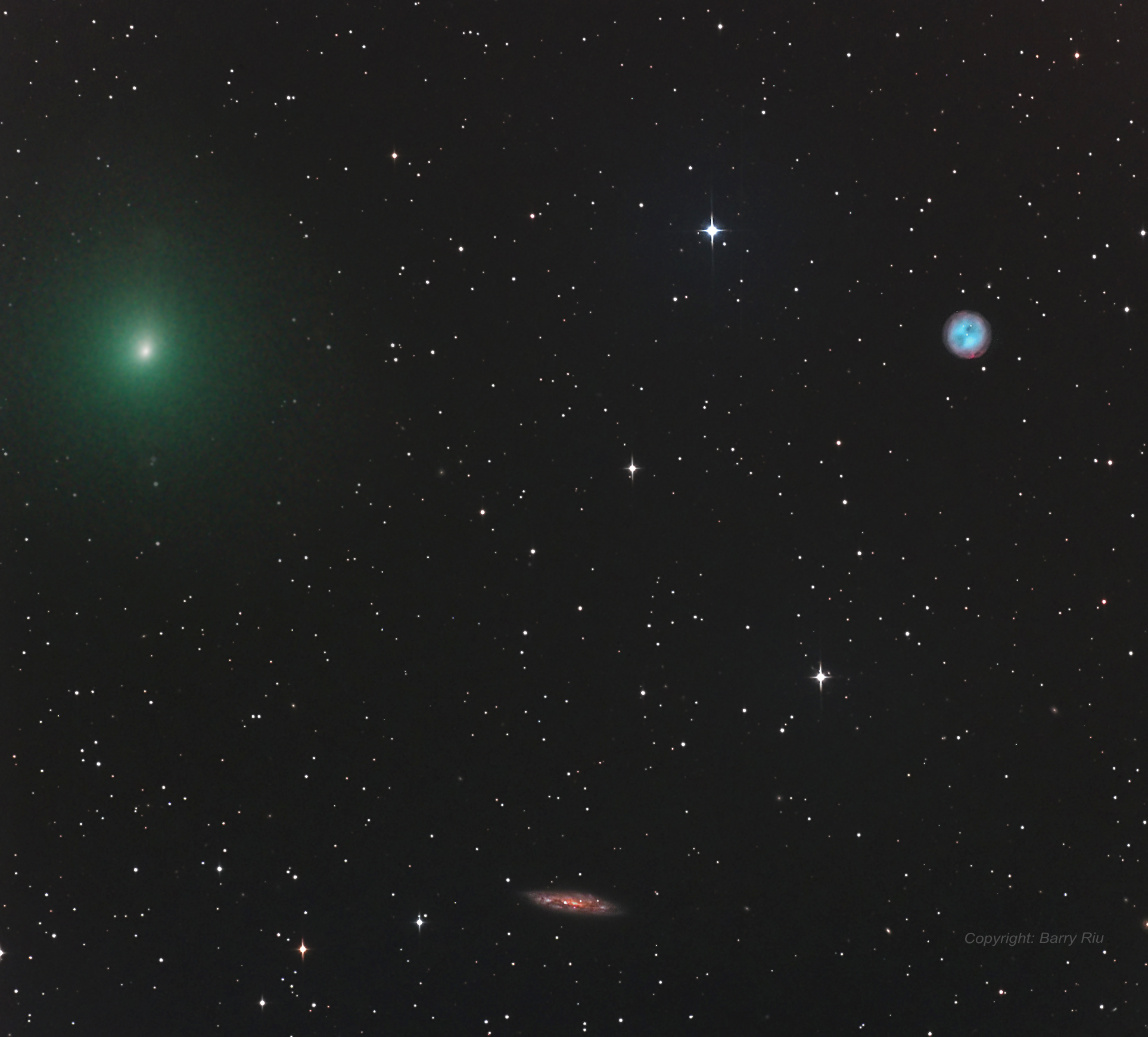
3月21日に撮影されたこの望遠鏡のスナップショットでは、彗星41P/タットル・ジャコビニ・クレサックがメシエの瞬間を捉えています。実際、この彗星は、18世紀の彗星ハンターの天文学者の有名なカタログに載っている2つの有名な彗星と同じ1度の視野を共有しています。北の春の空を北斗七星のすぐ下を横切る淡い緑がかった彗星は、地球から約75光秒の距離にありました。塵に覆われた、エッジオンの渦巻銀河メシエ108(中央下)は、約4500万光年離れています。右上には、老齢ながらも非常に高温の中心星を持つ惑星状星雲、フクロウのようなメシエ97がありますが、これは約1万2000光年しか離れておらず、私たちの天の川銀河の中にあります。発見者と再発見者の名にちなんで名付けられたこの淡い周期彗星は、1858年に初めて観測され、その後1907年と1951年まで再び観測されることはありませんでした。軌道計算の結果、同じ彗星がかなり離れた時期に観測されていたことが示されました。4月1日に100年以上ぶりに最もよく見えるようになり、地球に最も接近する彗星41Pは、約5.4年の周期で太陽の周りを公転しています。
原文(English)
Comet 41P/Tuttle-Giacobini-Kresak poses for a Messier moment in this telescopic snapshot from March 21. In fact it shares the 1 degree wide field-of-view with two well-known entries in the 18th century comet-hunting astronomer's famous catalog. Sweeping through northern springtime skies just below the Big Dipper, the faint greenish comet was about 75 light-seconds from our fair planet. Dusty, edge-on spiral galaxy Messier 108 (bottom center) is more like 45 million light-years away. At upper right, the planetary nebula with an aging but intensely hot central star, the owlish Messier 97 is only about 12 thousand light-years distant though, still well within our own Milky Way galaxy. Named for its discoverer and re-discoverers, this faint periodic comet was first sighted in 1858 and not again until 1907 and 1951. Matching orbit calculations indicated that the same comet had been observed at widely separated times. Nearing its best apparition and closest approach to Earth in over 100 years on April 1, comet 41P orbits the Sun with a period of about 5.4 years.
\ この感動を宇宙仲間にシェア /
宇宙をXでシェア
© Barry Riu / APOD