
🚀 宇宙の記憶・カレンダー検索
🚀 象徴的な写真:
APOD第1回
🚀 創造の柱
🚀 スピリット火星着陸
🚀 ハッブル超深宇宙
🚀 地球へようこそ|ブルー・マーブル
🚀 エンケラドス
🚀 ベテルギウス
🚀 火星着陸
🚀 青い夕焼け
🚀 冥王星のハート
🚀 皆既日食
🚀 アースライズ再構築
🚀 ブラックホール
🚀 ウェッブ初画像
🚀 アポロ11着陸
APOD30周年(2025年6月16日)
銀河団のガスがマイクロ波背景放射に穴を開ける
Galaxy Cluster Gas Creates Hole in Microwave Background
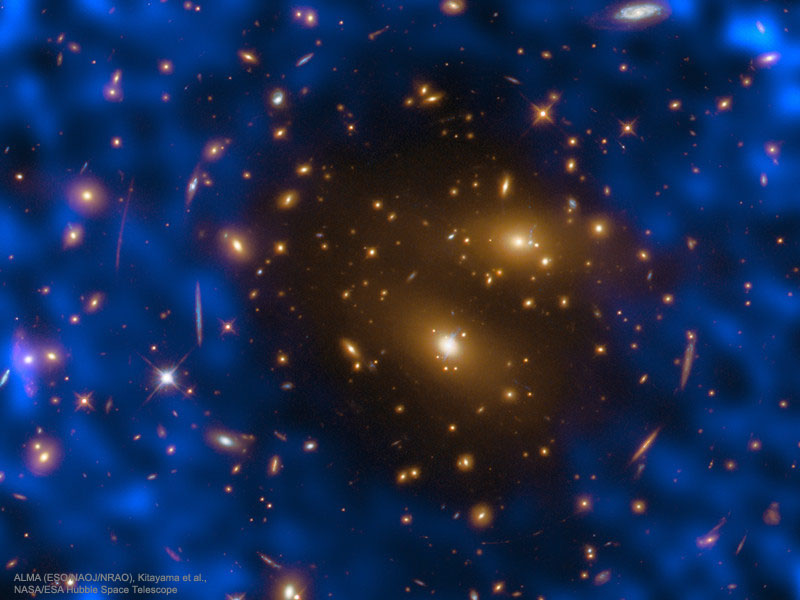
なぜこの銀河団が宇宙マイクロ波背景放射(CMB)に穴を開けるのでしょうか?まず、有名なCMBは初期宇宙でガスが冷えることによって生成され、宇宙のほとんどのガスや塵をそのまま通過します。それは私たちの周りの至る所に存在します。大きな銀河団は、非常に高温のガスを含むのに十分な重力を持っています。このガスは、マイクロ波光子をはるかに高いエネルギーの光にアップスキャッターするほど高温であり、それによってCMBマップに穴が開きます。このスニャエフ・ゼルドビッチ(SZ)効果は、数十年にわたり、銀河団内の高温ガスに関する新しい情報を明らかにし、シンプルかつ均一な方法で銀河団を発見するのに役立ってきました。図は、現在、ALMAでCMBを測定し、ハッブル宇宙望遠鏡で巨大銀河団RX J1347.5-1145の銀河を測定することで得られた、SZ効果のこれまでで最も詳細な画像です。擬似カラーの青色はCMBからの光を表し、黄色の物体のほとんどすべてが銀河です。 SZホールの形状は、この銀河団に高温ガスが存在するだけでなく、それが驚くほど不均一に分布していることを示している。
原文(English)
Why would this cluster of galaxy punch a hole in the cosmic microwave background (CMB)? First, the famous CMB was created by cooling gas in the early universe and flies right through most gas and dust in the universe. It is all around us. Large clusters of galaxies have enough gravity to contain very hot gas -- gas hot enough to up-scatter microwave photons into light of significantly higher energy, thereby creating a hole in CMB maps. This Sunyaev�Zel'dovich (SZ) effect has been used for decades to reveal new information about hot gas in clusters and even to help discover galaxy clusters in a simple yet uniform way. Pictured is the most detailed image yet obtained of the SZ effect, now using both ALMA to measure the CMB and the Hubble Space Telescope to measure the galaxies in the massive galaxy cluster RX J1347.5-1145. False-color blue depicts light from the CMB, while almost every yellow object is a galaxy. The shape of the SZ hole indicates not only that hot gas is present in this galaxy cluster, but also that it is distributed in a surprisingly uneven manner.
\ この感動を宇宙仲間にシェア /
宇宙をXでシェア
© NASA / APOD