
🚀 宇宙の記憶・カレンダー検索
🚀 象徴的な写真:
APOD第1回
🚀 創造の柱
🚀 スピリット火星着陸
🚀 ハッブル超深宇宙
🚀 地球へようこそ|ブルー・マーブル
🚀 エンケラドス
🚀 ベテルギウス
🚀 火星着陸
🚀 青い夕焼け
🚀 冥王星のハート
🚀 皆既日食
🚀 アースライズ再構築
🚀 ブラックホール
🚀 ウェッブ初画像
🚀 アポロ11着陸
APOD30周年(2025年6月16日)
赤いクモ星雲
The Red Spider Planetary Nebula
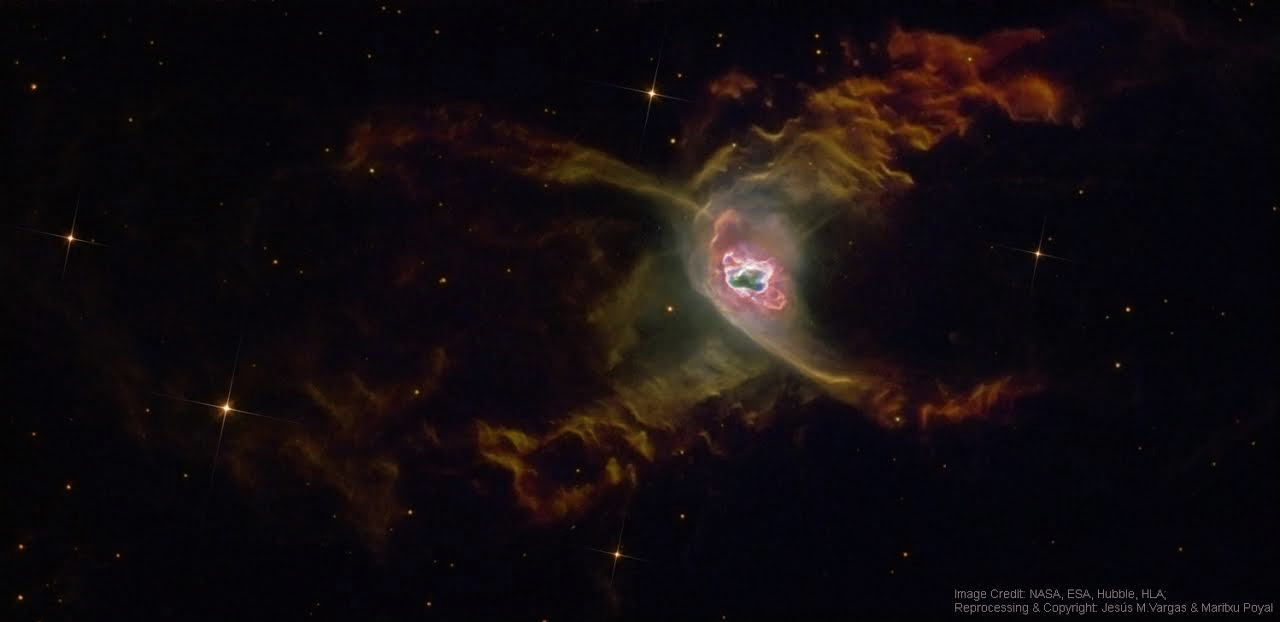
惑星状星雲はなんと複雑な網を織りなすのでしょう。赤いクモ星雲は、通常の恒星が外層ガスを放出して白色矮星になったときに生じる複雑な構造を示しています。正式にはNGC 6537と名付けられたこの2つのローブを持つ対称的な惑星状星雲には、おそらく連星系の一部として、これまで観測された中で最も高温の白色矮星の1つが存在します。中心部に見える中心星から放出される内部風は、毎秒1000キロメートルを超える速度で測定されています。これらの風は星雲を膨張させ、星雲の壁に沿って流れ、高温のガスと塵の波を衝突させます。これらの衝突衝撃波に巻き込まれた原子は、ハッブル宇宙望遠鏡による上記の代表的なカラー画像に示されているように光を放射します。赤いクモ星雲は射手座の方向に位置しています。その距離は正確には分かっていませんが、約4,000光年と推定する人もいます。APODをフォローするには、Facebook、Google Plus、Instagram、またはTwitterをご覧ください。
原文(English)
Oh what a tangled web a planetary nebula can weave. The Red Spider Planetary Nebula shows the complex structure that can result when a normal star ejects its outer gases and becomes a white dwarf star. Officially tagged NGC 6537, this two-lobed symmetric planetary nebula houses one of the hottest white dwarfs ever observed, probably as part of a binary star system. Internal winds emanating from the central stars, visible in the center, have been measured in excess of 1000 kilometers per second. These winds expand the nebula, flow along the nebula's walls, and cause waves of hot gas and dust to collide. Atoms caught in these colliding shocks radiate light shown in the above representative-color picture by the Hubble Space Telescope. The Red Spider Nebula lies toward the constellation of the Archer (Sagittarius). Its distance is not well known but has been estimated by some to be about 4,000 light-years. Follow APOD on: Facebook, Google Plus, Instagram, or Twitter
\ この感動を宇宙仲間にシェア /
宇宙をXでシェア
© Jes�s M.Vargas & Maritxu Poyal / APOD