
🚀 宇宙の記憶・カレンダー検索
🚀 象徴的な写真:
APOD第1回
🚀 創造の柱
🚀 スピリット火星着陸
🚀 ハッブル超深宇宙
🚀 地球へようこそ|ブルー・マーブル
🚀 エンケラドス
🚀 ベテルギウス
🚀 火星着陸
🚀 青い夕焼け
🚀 冥王星のハート
🚀 皆既日食
🚀 アースライズ再構築
🚀 ブラックホール
🚀 ウェッブ初画像
🚀 アポロ11着陸
APOD30周年(2025年6月16日)
銀河団アベル370とその先
Galaxy Cluster Abell 370 and Beyond
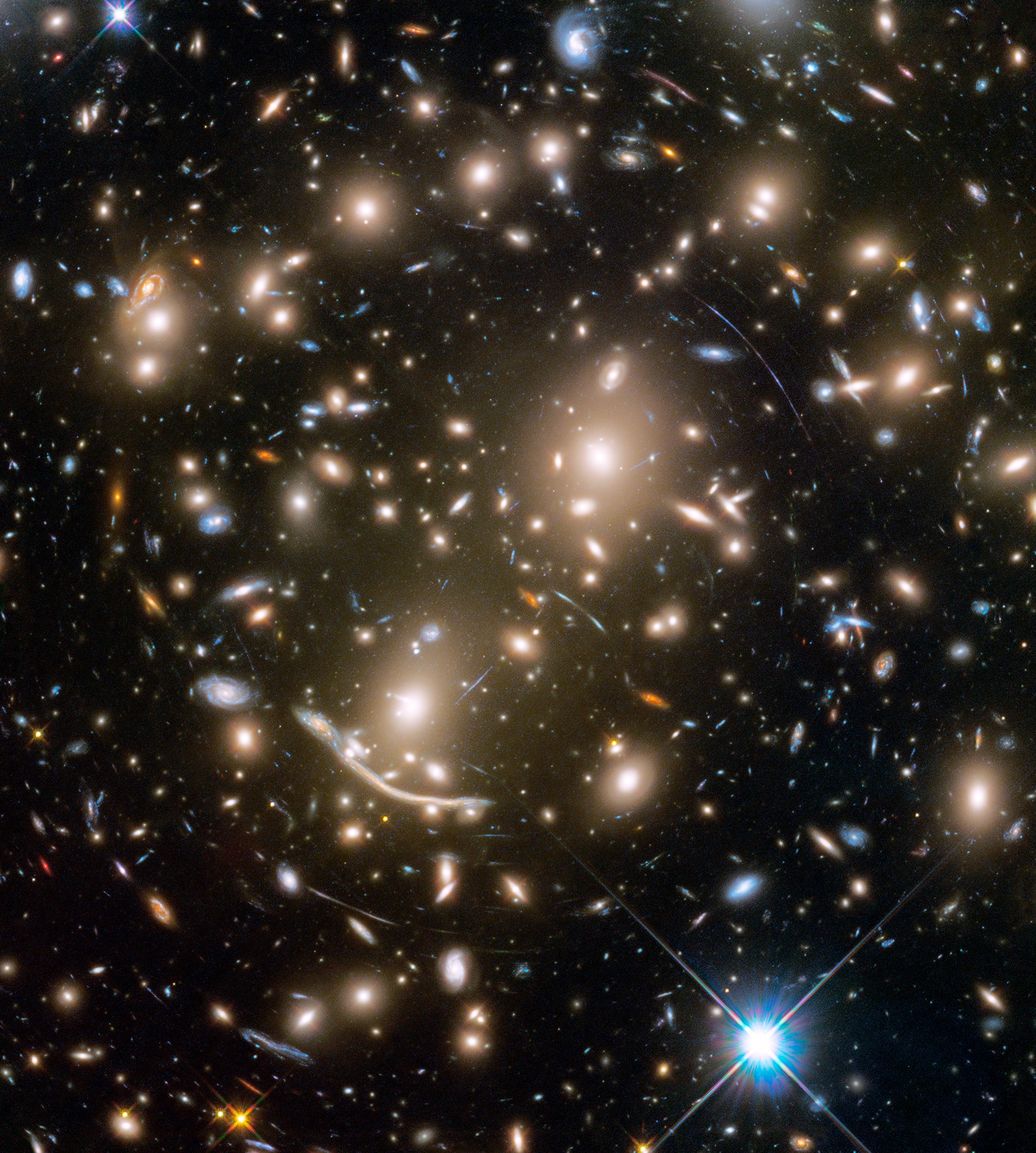
約40億光年離れた巨大な銀河団アベル370は、ハッブル宇宙望遠鏡が捉えたこの鮮明な画像では、2つの巨大な楕円銀河が支配的で、かすかな弧が散在しているように見えるだけです。中央の左下にある、よりかすかに散らばった青みがかった弧と、印象的なドラゴンの弧は、アベル370のはるか彼方にある銀河の画像です。約2倍の距離にあるこれらの銀河は、通常は検出されない光が、目に見えない暗黒物質が支配する銀河団の巨大な重力によって増幅され、歪められています。初期宇宙の銀河を垣間見ることができるこの効果は、重力レンズ効果として知られています。歪んだ時空の結果であるこの効果は、1世紀前にアインシュタインによって初めて予測されました。右下にあるとがった前景の天の川の星のはるか彼方に、アベル370はくじら座の方向から見ることができます。これは、最近終了したフロンティア・フィールズ・プロジェクトで撮影された6つの銀河団のうち最後のものである。
原文(English)
Some 4 billion light-years away, massive galaxy cluster Abell 370 only appears to be dominated by two giant elliptical galaxies and infested with faint arcs in this sharp Hubble Space Telescope snapshot. The fainter, scattered bluish arcs along with the dramatic dragon arc below and left of center are images of galaxies that lie far beyond Abell 370. About twice as distant, their otherwise undetected light is magnified and distorted by the cluster's enormous gravitational mass, dominated by unseen dark matter. Providing a tantalizing glimpse of galaxies in the early universe, the effect is known as gravitational lensing. A consequence of warped spacetime it was first predicted by Einstein a century ago. Far beyond the spiky foreground Milky Way star at lower right, Abell 370 is seen toward the constellation Cetus, the Sea Monster. It is the last of six galaxy clusters imaged in the recently concluded Frontier Fields project.
\ この感動を宇宙仲間にシェア /
宇宙をXでシェア
© NASA / APOD