
🚀 宇宙の記憶・カレンダー検索
🚀 象徴的な写真:
APOD第1回
🚀 創造の柱
🚀 スピリット火星着陸
🚀 ハッブル超深宇宙
🚀 地球へようこそ|ブルー・マーブル
🚀 エンケラドス
🚀 ベテルギウス
🚀 火星着陸
🚀 青い夕焼け
🚀 冥王星のハート
🚀 皆既日食
🚀 アースライズ再構築
🚀 ブラックホール
🚀 ウェッブ初画像
🚀 アポロ11着陸
APOD30周年(2025年6月16日)
複合メシエ20と21
Composite Messier 20 and 21
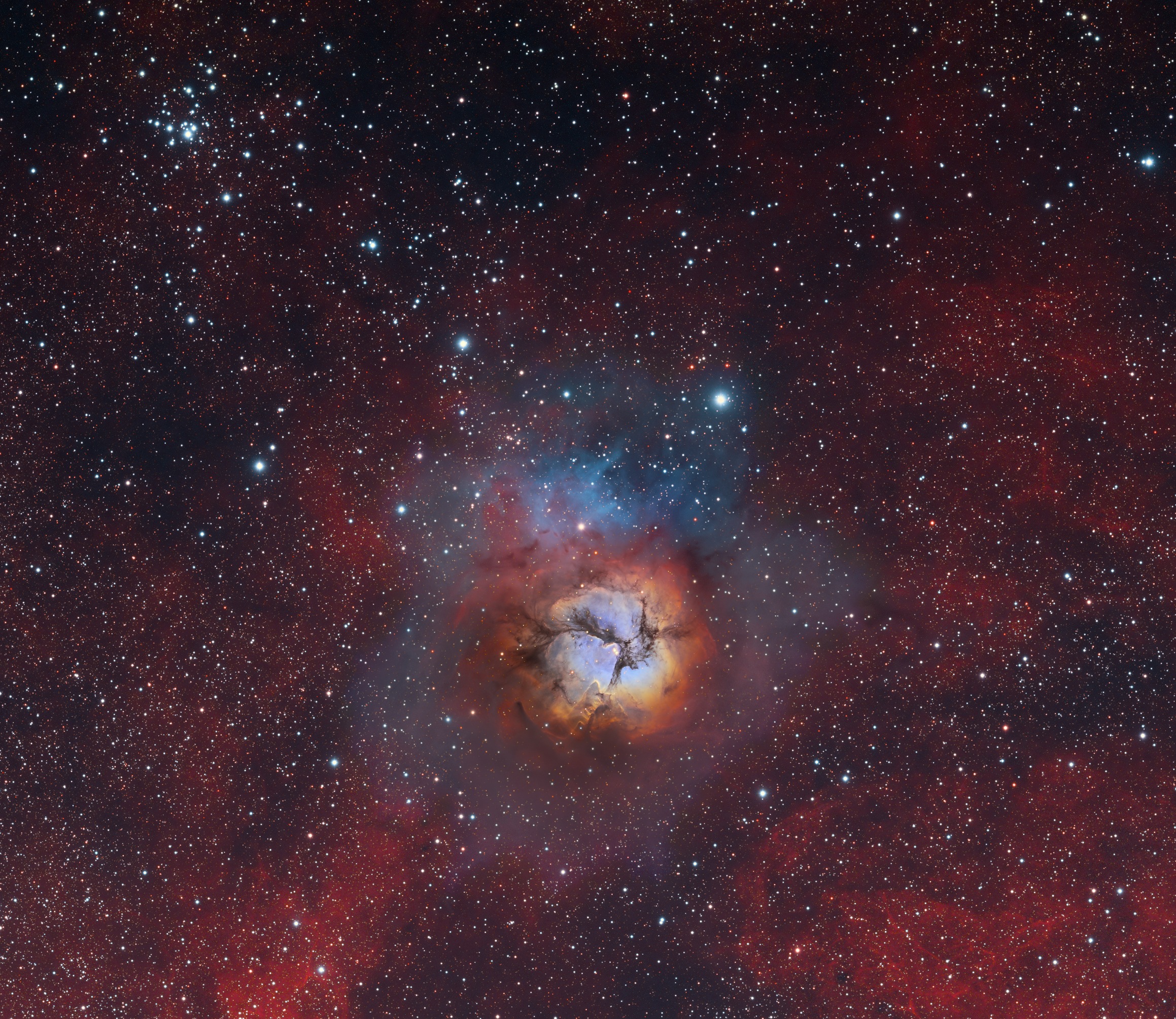
美しい三裂星雲(メシエ20としても知られる)は、約5,000光年離れたところにあり、宇宙のコントラストを色鮮やかに表現した天体です。この星雲は、散開星団メシエ21(左上)と、ほぼ1度の視野を共有しています。塵の帯によって三分割された三裂星雲自体は、直径約40光年で、わずか30万歳です。これは、生まれたばかりの星や胚のような星が誕生時の塵とガスの雲に埋め込まれているため、私たちの空で最も若い星形成領域の1つです。散開星団M21までの距離の推定値はM20と似ていますが、この美しい望遠鏡の空の景色を共有しているにもかかわらず、2つの間に明らかな関連性はありません。M21の星ははるかに古く、約800万歳です。M20とM21は、星雲が豊富ないて座にあるため、小型望遠鏡でも簡単に見つけることができます。実際、このよく構成されたシーンは、2つの異なる望遠鏡からの合成画像です。狭帯域データを使用することで、M20の高解像度画像と、M21まで広がる広視野画像を合成する。
原文(English)
The beautiful Trifid Nebula, also known as Messier 20, lies about 5,000 light-years away, a colorful study in cosmic contrasts. It shares this nearly 1 degree wide field with open star cluster Messier 21 (top left). Trisected by dust lanes the Trifid itself is about 40 light-years across and a mere 300,000 years old. That makes it one of the youngest star forming regions in our sky, with newborn and embryonic stars embedded in its natal dust and gas clouds. Estimates of the distance to open star cluster M21 are similar to M20's, but though they share this gorgeous telescopic skyscape there is no apparent connection between the two. M21's stars are much older, about 8 million years old. M20 and M21 are easy to find with even a small telescope in the nebula rich constellation Sagittarius. In fact, this well-composed scene is a composite from two different telescopes. Using narrowband data it blends a high resolution image of M20 with a wider field image extending to M21.
\ この感動を宇宙仲間にシェア /
宇宙をXでシェア
© Martin Pugh / APOD