
🚀 宇宙の記憶・カレンダー検索
🚀 象徴的な写真:
APOD第1回
🚀 創造の柱
🚀 スピリット火星着陸
🚀 ハッブル超深宇宙
🚀 地球へようこそ|ブルー・マーブル
🚀 エンケラドス
🚀 ベテルギウス
🚀 火星着陸
🚀 青い夕焼け
🚀 冥王星のハート
🚀 皆既日食
🚀 アースライズ再構築
🚀 ブラックホール
🚀 ウェッブ初画像
🚀 アポロ11着陸
APOD30周年(2025年6月16日)
遠日点の日の出
Aphelion Sunrise
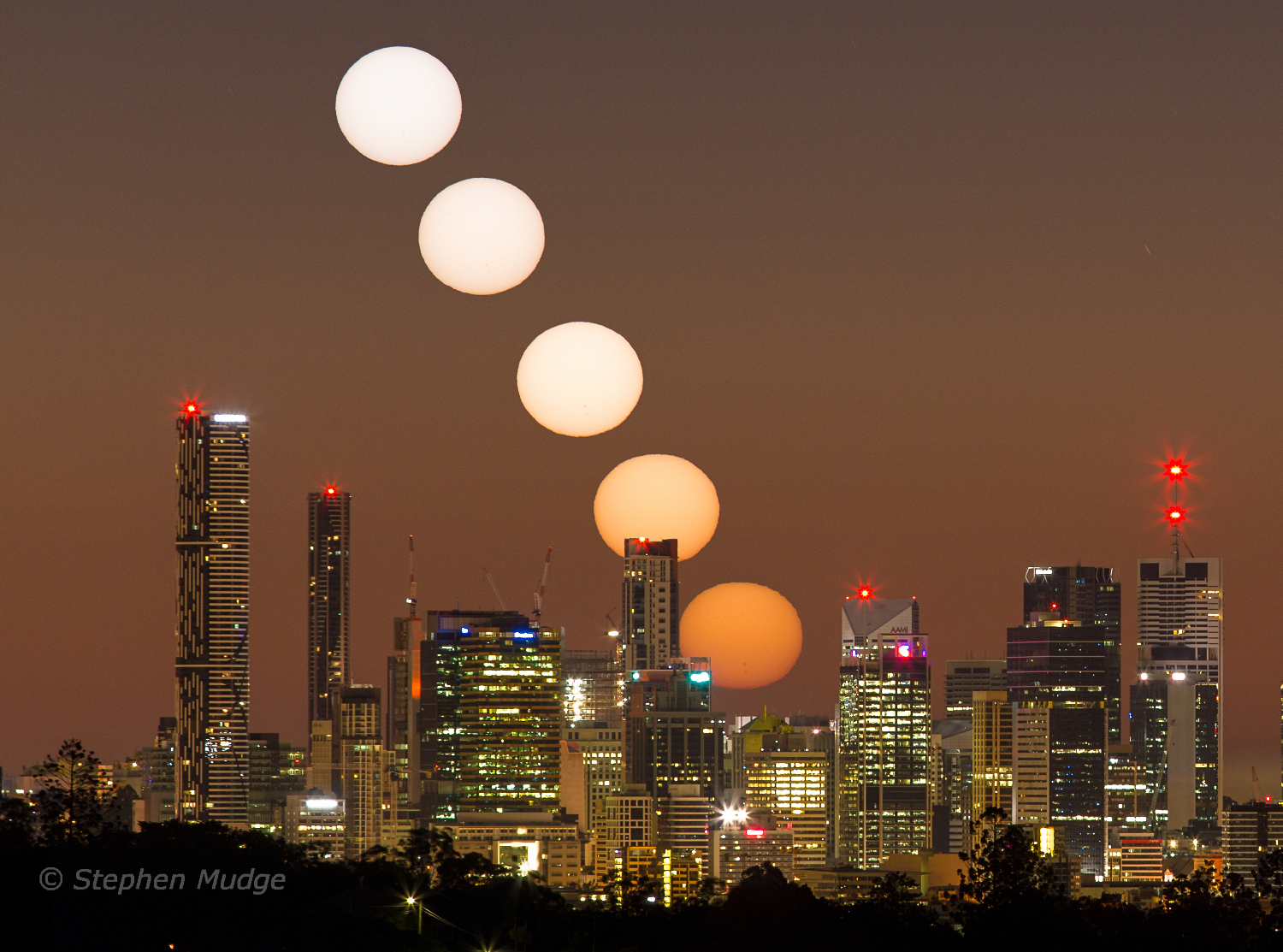
7月3日、地球は太陽の周りを楕円軌道で公転する中、最も遠い地点である遠日点に到達しました。毎年、太陽が最も遠ざかるこの日は、南半球では冬に当たります。2015年のこの遠日点の日の出は、オーストラリアのブリスベンのスカイラインを背景にした時系列合成画像で捉えられました。もちろん、この美しい惑星の季節は太陽からの距離ではなく、地球の自転軸が軌道面である黄道面に対して傾いていることによって決まります。黄道傾斜角として知られるこの傾きは、軌道面に対して垂直な方向から約23.4度です。そのため、最も遠い日の出は北半球の夏に起こります。北半球では、北極が太陽の方に傾き、北半球では日が長く暖かくなります。
原文(English)
On July 3rd, planet Earth reached aphelion, the farthest point in its elliptical orbit around the Sun. Each year, this day of the most distant Sun happens to occur during winter in the southern hemisphere. That's where this aphelion sunrise from 2015 was captured in a time series composite against the skyline of Brisbane, Australia. Of course, seasons for our fair planet are not determined by distance to the Sun, but by the tilt of Earth's rotational axis with respect to the ecliptic, the plane of its orbit. Fondly known as the obliquity of the ecliptic, the angle of the tilt is about 23.4 degrees from perpendicular to the orbital plane. So the most distant sunrise occurs during northern summer, when the planet's north pole is tilted toward the Sun and the north enjoys longer, warmer days.
\ この感動を宇宙仲間にシェア /
宇宙をXでシェア
© Stephen Mudge / APOD