
🚀 宇宙の記憶・カレンダー検索
🚀 象徴的な写真:
APOD第1回
🚀 創造の柱
🚀 スピリット火星着陸
🚀 ハッブル超深宇宙
🚀 地球へようこそ|ブルー・マーブル
🚀 エンケラドス
🚀 ベテルギウス
🚀 火星着陸
🚀 青い夕焼け
🚀 冥王星のハート
🚀 皆既日食
🚀 アースライズ再構築
🚀 ブラックホール
🚀 ウェッブ初画像
🚀 アポロ11着陸
APOD30周年(2025年6月16日)
ワシと白鳥
The Eagle and The Swan
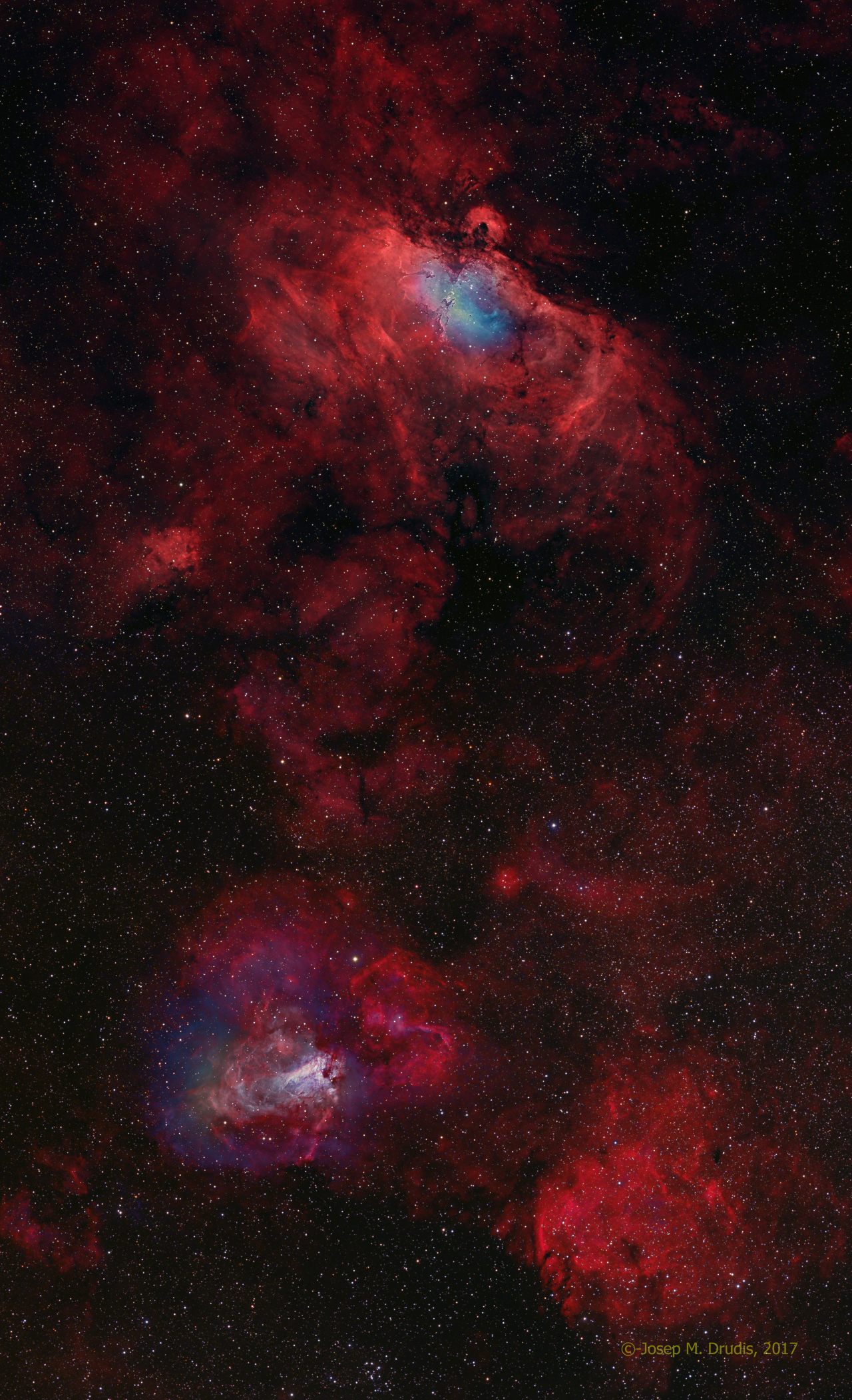
わし星雲と白鳥星雲は、いて座の渦状腕と天の川銀河の中心方向を望遠鏡で捉えたこの広大な星空に広がっています。M16としても知られるわし星雲はフレームの上部に、白鳥星雲として知られるM17はフレームの下部に位置し、活発な星形成の明るい領域として宇宙の雲を示しています。これらは原子状水素ガスに特徴的な赤みがかった放射と塵の暗い星雲で満たされた渦状腕に沿って存在します。オメガ星雲とも呼ばれるM17は約5500光年、M16は約6500光年離れています。両星雲の中心は、ハッブル宇宙望遠鏡による星形成のよく知られたクローズアップ画像の位置です。空を約3度にわたって広げるこのモザイク画像では、狭帯域の高解像度画像データを使用して、わし星雲と白鳥星雲の中心領域が強調されています。わし星雲の翼を広げた部分は、およそ120光年にわたって広がっている。白鳥星雲は、直径が30光年以上ある。
原文(English)
The Eagle Nebula and the Swan Nebula span this broad starscape, a telescopic view toward the Sagittarius spiral arm and the center of our Milky Way galaxy. The Eagle, also known as M16, is at top and M17, the Swan, at bottom of the frame showing the cosmic clouds as brighter regions of active star-formation. They lie along the spiral arm suffused with reddish emission charactistic of atomic hydrogen gas, and dusty dark nebulae. M17, also called the Omega Nebula, is about 5500 light-years away, while M16 is some 6500 light-years distant. The center of both nebulae are locations of well-known close-up images of star formation from the Hubble Space Telescope. In this mosaic image that extends about 3 degrees across the sky, narrowband, high-resultion image data has been used to enhance the central regions of the Eagle and Swan. The extended wings of the Eagle Nebula spread almost 120 light-years. The Swan is over 30 light-years across.
\ この感動を宇宙仲間にシェア /
宇宙をXでシェア
© Josep Drudis / APOD