
🚀 宇宙の記憶・カレンダー検索
🚀 象徴的な写真:
APOD第1回
🚀 創造の柱
🚀 スピリット火星着陸
🚀 ハッブル超深宇宙
🚀 地球へようこそ|ブルー・マーブル
🚀 エンケラドス
🚀 ベテルギウス
🚀 火星着陸
🚀 青い夕焼け
🚀 冥王星のハート
🚀 皆既日食
🚀 アースライズ再構築
🚀 ブラックホール
🚀 ウェッブ初画像
🚀 アポロ11着陸
APOD30周年(2025年6月16日)
満月の年
A Year of Full Moons
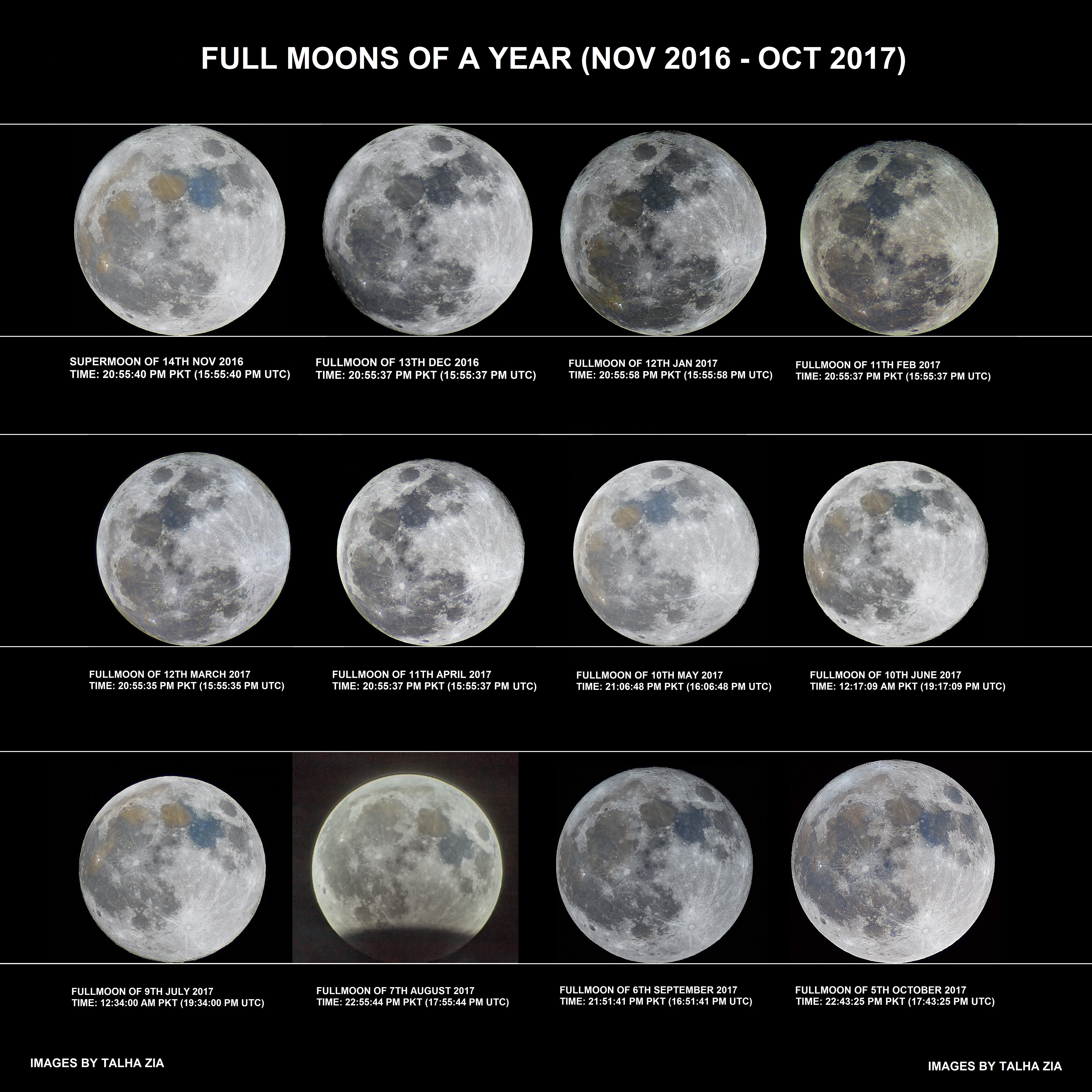
満月はすべて同じように見えますか? いいえ。わずかな違いを見るには、この 12 個の満月のグリッドを見てください。左上から右下にかけて、画像はパキスタンから撮影された 2016 年 11 月から 2017 年 10 月までのすべての満月を表しています。連続する満月はすべて同じ縮尺で表示されているため、有名な月の錯覚とは異なり、ここで見られる見かけの大きさの変化は実際のものです。この変化は、月の軌道が著しく円ではないため、月までの距離が変化することによって生じます。2017 年 8 月の満月の下部にある暗い切り込みは地球の影であり、これは部分月食です。時折誇張された色の他に、注意深く観察すると、より微妙な外観の変化も確認できます。月は満月から次の満月までわずかに揺れているように見えます。この効果は秤動として知られており、月が 1 か月 (moon-th) にわたってどのように変化するかを強調したこの満月ビデオでは、より劇的で見やすくなっています。
原文(English)
Do all full moons look the same? No. To see the slight differences, consider this grid of twelve full moons. From upper left to lower right, the images represent every lunation from 2016 November through 2017 October, as imaged from Pakistan. The consecutive full moons are all shown at the same scale, so unlike the famous Moon Illusion, the change in apparent size seen here is real. The change is caused by the variation in lunar distance due to the Moon's significantly non-circular orbit. The dark notch at the bottom of the full moon of 2017 August is the shadow of the Earth -- making this a partial lunar eclipse. Besides the sometimes exaggerated coloring, a subtler change in appearance can also be noticed on close examination, as the Moon seems to wobble slightly from one full moon to the next. This effect, known as libration, is more dramatic and easier to see in this lunation video highlighting all of the ways that the Moon appears to change over a month (moon-th).
\ この感動を宇宙仲間にシェア /
宇宙をXでシェア
© Talha Zia / APOD