
🚀 宇宙の記憶・カレンダー検索
🚀 象徴的な写真:
APOD第1回
🚀 創造の柱
🚀 スピリット火星着陸
🚀 ハッブル超深宇宙
🚀 地球へようこそ|ブルー・マーブル
🚀 エンケラドス
🚀 ベテルギウス
🚀 火星着陸
🚀 青い夕焼け
🚀 冥王星のハート
🚀 皆既日食
🚀 アースライズ再構築
🚀 ブラックホール
🚀 ウェッブ初画像
🚀 アポロ11着陸
APOD30周年(2025年6月16日)
牡羊座の星屑
Stardust in Aries
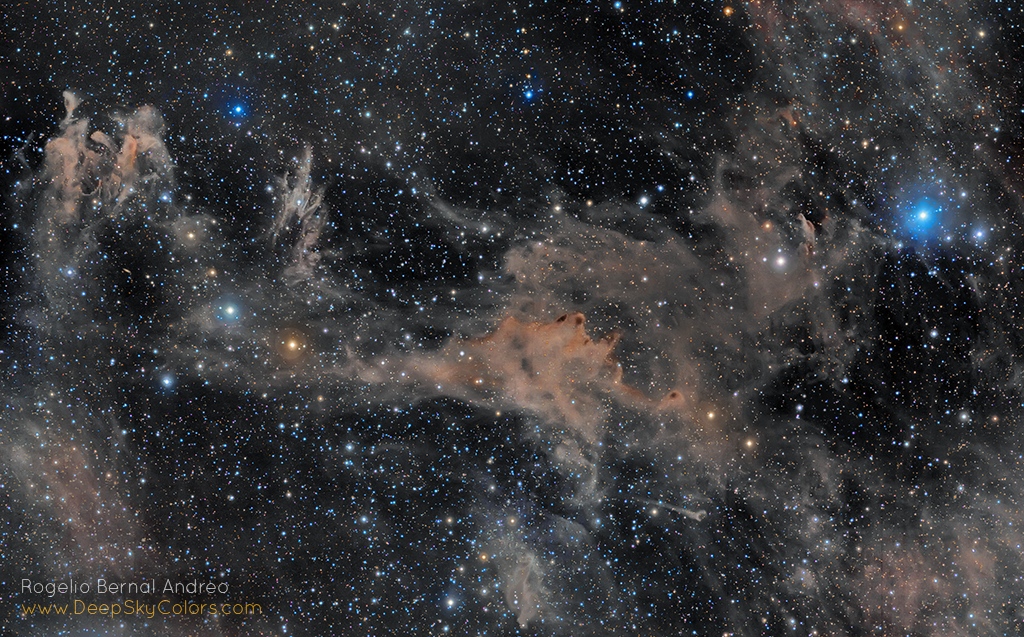
この星屑の合成画像は、北天の8度以上の領域をカバーしています。モザイク状に並べられた視野は、おなじみのプレアデス星団の西、黄道十二星座のおひつじ座と天の川銀河の平面の方向です。深い空の風景の右側には、肉眼で見える青みがかった星、イプシロン・アリエティスがあり、地球から約330光年離れています。この領域の星の光を反射して、塵の星雲LBN762、LBN753、LBN743が視野の左から右に広がっていますが、おそらく約1,000光年離れています。その推定距離では、宇宙のキャンバスは140光年以上に渡ります。大きな分子雲の端付近では、暗い内部が新しく形成された星や若い恒星状天体、または原始星を光学望遠鏡から隠してしまうことがあります。原始星は、自己重力によって収縮し、分子雲に埋め込まれた高密度の核の周りに形成されます。
原文(English)
This composition in stardust covers over 8 degrees on the northern sky. The mosaicked field of view is west of the familiar Pleiades star cluster, toward the zodiacal constellation Aries and the plane of our Milky Way Galaxy. At right in the deep skyscape is bluish Epsilon Arietis, a star visible to the naked-eye and about 330 light-years away. Reflecting starlight in the region, dusty nebulae LBN762, LBN753, and LBN743 sprawl left to right across the field, but are likely some 1,000 light-years away. At that estimated distance, the cosmic canvas is over 140 light-years across. Near the edge of a large molecular cloud, their dark interiors can hide newly formed stars and young stellar objects or protostars from prying optical telescopes. Collapsing due to self-gravity, the protostars form around dense cores embedded in the molecular cloud.
\ この感動を宇宙仲間にシェア /
宇宙をXでシェア
© Rogelio Bernal
Andreo / APOD