
🚀 宇宙の記憶・カレンダー検索
🚀 象徴的な写真:
APOD第1回
🚀 創造の柱
🚀 スピリット火星着陸
🚀 ハッブル超深宇宙
🚀 地球へようこそ|ブルー・マーブル
🚀 エンケラドス
🚀 ベテルギウス
🚀 火星着陸
🚀 青い夕焼け
🚀 冥王星のハート
🚀 皆既日食
🚀 アースライズ再構築
🚀 ブラックホール
🚀 ウェッブ初画像
🚀 アポロ11着陸
APOD30周年(2025年6月16日)
カシオペヤ座Aのリサイクル
Recycling Cassiopeia A
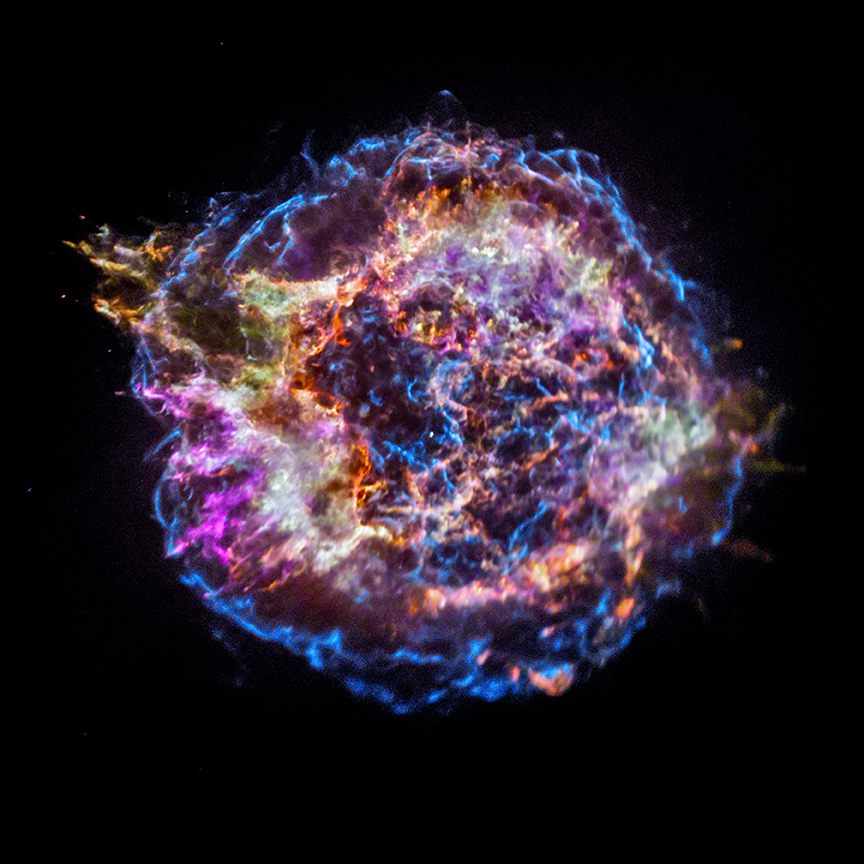
天の川銀河に存在する巨大な星々は、壮大な一生を送ります。広大な宇宙雲から崩壊した星々は、中心部で核融合反応を起こし、重元素を生成します。数百万年後、濃縮された物質は星間空間へと放出され、そこで新たな星形成が始まります。カシオペヤ座Aとして知られる膨張する残骸雲は、この恒星ライフサイクルの最終段階の一例です。この超新星残骸を生み出した爆発の光は、約350年前に地球の空で初めて観測されましたが、その光が地球に届くまでには約1万1000年かかりました。このチャンドラX線観測衛星による擬似カラー画像は、カシオペヤ座A残骸に残る、まだ高温のフィラメントと結び目を示しています。特定の元素からの高エネルギー放射は色分けされており、シリコンは赤、硫黄は黄色、カルシウムは緑、鉄は紫で、天文学者が銀河の星の物質のリサイクルを調査するのに役立っています。膨張を続ける爆発波は、青い外側のリングとして見られます。鮮明なX線画像は、カシオペヤ座Aの推定距離で約30光年に及びます。中心付近の明るい斑点は中性子星で、巨大な恒星核の信じられないほど高密度で崩壊した残骸です。
原文(English)
Massive stars in our Milky Way Galaxy live spectacular lives. Collapsing from vast cosmic clouds, their nuclear furnaces ignite and create heavy elements in their cores. After a few million years, the enriched material is blasted back into interstellar space where star formation can begin anew. The expanding debris cloud known as Cassiopeia A is an example of this final phase of the stellar life cycle. Light from the explosion which created this supernova remnant would have been first seen in planet Earth's sky about 350 years ago, although it took that light about 11,000 years to reach us. This false-color Chandra X-ray Observatory image shows the still hot filaments and knots in the Cassiopeia A remnant. High-energy emission from specific elements has been color coded, silicon in red, sulfur in yellow, calcium in green and iron in purple, to help astronomers explore the recycling of our galaxy's star stuff - Still expanding, the blast wave is seen as the blue outer ring. The sharp X-ray image, spans about 30 light-years at the estimated distance of Cassiopeia A. The bright speck near the center is a neutron star, the incredibly dense, collapsed remains of the massive stellar core.
\ この感動を宇宙仲間にシェア /
宇宙をXでシェア
© NASA / APOD