
🚀 宇宙の記憶・カレンダー検索
🚀 象徴的な写真:
APOD第1回
🚀 創造の柱
🚀 スピリット火星着陸
🚀 ハッブル超深宇宙
🚀 地球へようこそ|ブルー・マーブル
🚀 エンケラドス
🚀 ベテルギウス
🚀 火星着陸
🚀 青い夕焼け
🚀 冥王星のハート
🚀 皆既日食
🚀 アースライズ再構築
🚀 ブラックホール
🚀 ウェッブ初画像
🚀 アポロ11着陸
APOD30周年(2025年6月16日)
ハッブル宇宙望遠鏡による赤外線画像で見る木星
Jupiter in Infrared from Hubble
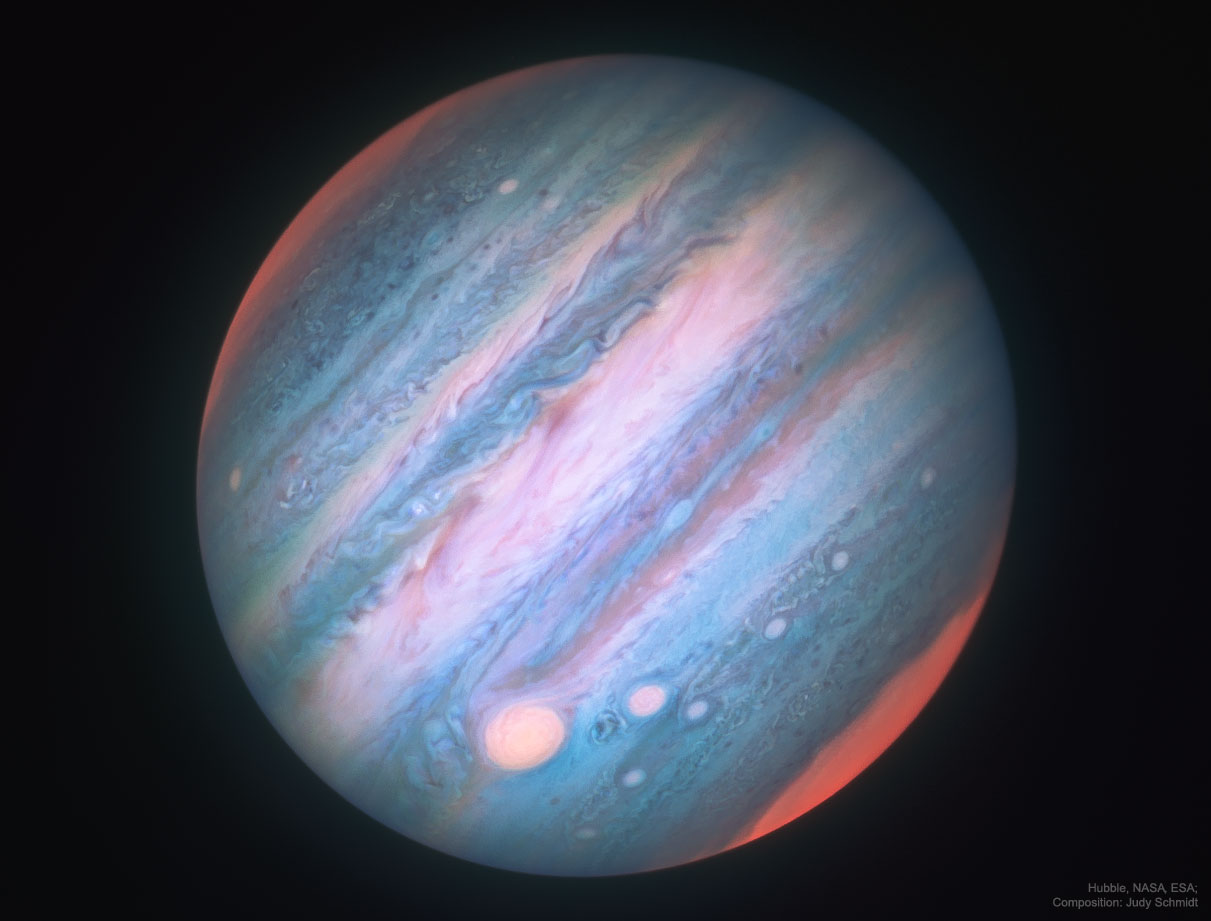
木星は赤外線で見ると少し違って見える。木星の雲の動きをよりよく理解し、NASAのロボット探査機ジュノーが観測する小さな領域の惑星的な文脈を理解するのを助けるために、ハッブル宇宙望遠鏡は木星全体を定期的に撮影するように指示されている。監視されている木星の色は、通常の人間の視覚範囲を超えて、紫外線と赤外線の両方を含む。2016年にここに掲載されている画像では、3つの近赤外線バンドがデジタル的に再割り当てされ、マッピングされたカラー画像になっている。木星が赤外線で違って見えるのは、反射される太陽光の量が異なるため、雲の高さと緯度によって明るさが異なるためである。それでも、赤道付近を惑星を囲む明るいゾーンと暗い帯、左下にある大赤斑、大赤斑の南にある真珠の首飾りのような嵐のシステムなど、木星の多くの馴染みのある特徴はそのまま残っている。極地が光るのは、高高度の霞が木星の磁気圏から放出される荷電粒子によってエネルギーを帯びているためです。ジュノー探査機は、計画されている12回の木星周回軌道のうち10回を完了し、木星の気象だけでなく、厚い雲の下に何があるのかを人類が理解するのに役立つデータの記録を続けています。
原文(English)
Jupiter looks a bit different in infrared light. To better understand Jupiter's cloud motions and to help NASA's robotic Juno spacecraft understand the planetary context of the small fields that it sees, the Hubble Space Telescope is being directed to regularly image the entire Jovian giant. The colors of Jupiter being monitored go beyond the normal human visual range to include both ultraviolet and infrared light. Featured here in 2016, three bands of near-infrared light have been digitally reassigned into a mapped color image. Jupiter appears different in infrared partly because the amount of sunlight reflected back is distinct, giving differing cloud heights and latitudes discrepant brightnesses. Nevertheless, many familiar features on Jupiter remain, including the light zones and dark belts that circle the planet near the equator, the Great Red Spot on the lower left, and the string-of-pearls storm systems south of the Great Red Spot. The poles glow because high altitude haze there is energized by charged particles from Jupiter's magnetosphere. Juno has now completed 10 of 12 planned science orbits of Jupiter and continues to record data that are helping humanity to understand not only Jupiter's weather but what lies beneath Jupiter's thick clouds.
\ この感動を宇宙仲間にシェア /
宇宙をXでシェア
© NASA / APOD