
🚀 宇宙の記憶・カレンダー検索
🚀 象徴的な写真:
APOD第1回
🚀 創造の柱
🚀 スピリット火星着陸
🚀 ハッブル超深宇宙
🚀 地球へようこそ|ブルー・マーブル
🚀 エンケラドス
🚀 ベテルギウス
🚀 火星着陸
🚀 青い夕焼け
🚀 冥王星のハート
🚀 皆既日食
🚀 アースライズ再構築
🚀 ブラックホール
🚀 ウェッブ初画像
🚀 アポロ11着陸
APOD30周年(2025年6月16日)
南西部の雌馬の繁殖力
Southwest Mare Fecunditatis
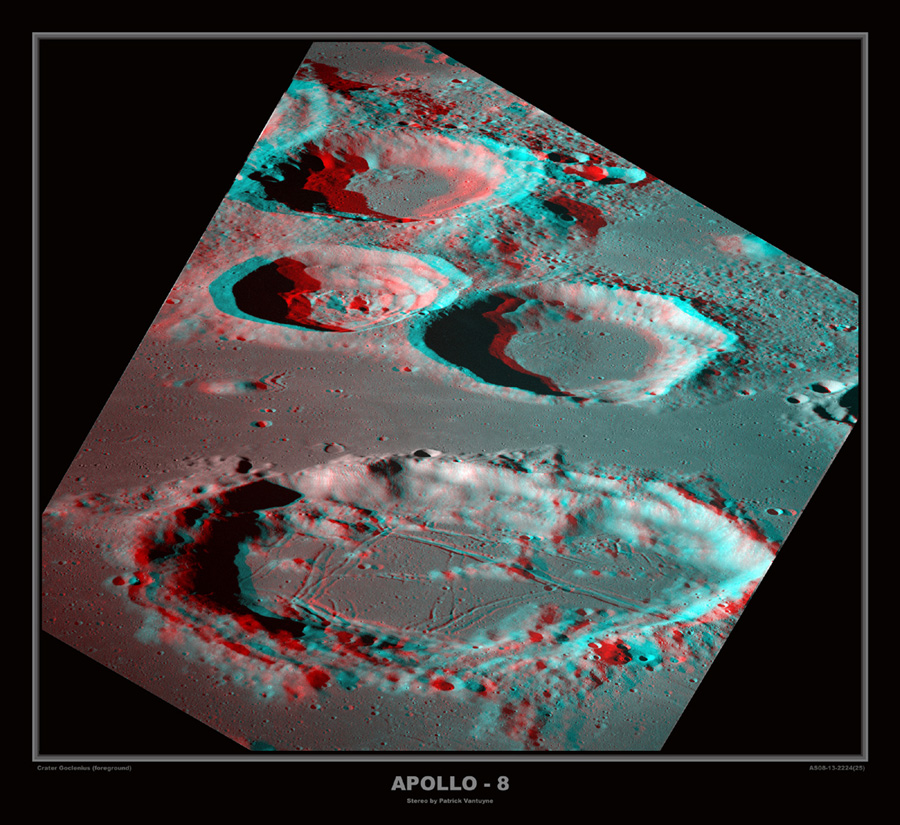
フランク・ボーマン、ジェームズ・ラヴェル、ウィリアム・アンダースは、1968年12月に地球から月へ行き、再び地球へ戻りました。月周回軌道から撮影された、豊穣の海の南西部のクレーターの眺めを、このステレオアナグリフに収めました。地球上の肘掛け椅子に座って、赤/青のメガネをかけると、最もよく見えるでしょう。手前にある大きな衝突クレーターはゴクレニウスです。直径約70キロメートル(45マイル)の溶岩で覆われた底面には、細長く狭い窪みであるリルが刻まれています。クレーターの壁と中央のピークを横切るリルは、クレーター自体が形成された後にできたと考えられます。背景にある、底面が滑らかな2つの大きなクレーターは、コロンボA(上)とマゼランです。不規則な底面を持つ背景のクレーター、マゼランAは、直径約35キロメートル(20マイル)です。
原文(English)
Frank Borman, James Lovell, and William Anders journeyed from Earth to the Moon and back again in December of 1968. From lunar orbit, their view of craters in southwest Mare Fecunditatis is featured in this stereo anaglyph, best experienced from armchairs on planet Earth with red/blue glasses. Goclenius is the large impact crater in the foreground. About 70 kilometers (45 miles) in diameter its lava-flooded floor is scarred by rilles or grooves, long, narrow depressions in the surface. Crossing the crater walls and central peaks the rilles were likely formed after the crater itself. In the background, the two large craters with smooth floors are Colombo A (top) and Magelhaens. Magelhaens A, the background crater with the irregular floor, is about 35 kilometers (20 miles) in diameter.
\ この感動を宇宙仲間にシェア /
宇宙をXでシェア
© NASA / APOD