
🚀 宇宙の記憶・カレンダー検索
🚀 象徴的な写真:
APOD第1回
🚀 創造の柱
🚀 スピリット火星着陸
🚀 ハッブル超深宇宙
🚀 地球へようこそ|ブルー・マーブル
🚀 エンケラドス
🚀 ベテルギウス
🚀 火星着陸
🚀 青い夕焼け
🚀 冥王星のハート
🚀 皆既日食
🚀 アースライズ再構築
🚀 ブラックホール
🚀 ウェッブ初画像
🚀 アポロ11着陸
APOD30周年(2025年6月16日)
カタログ番号1
Catalog Entry Number 1
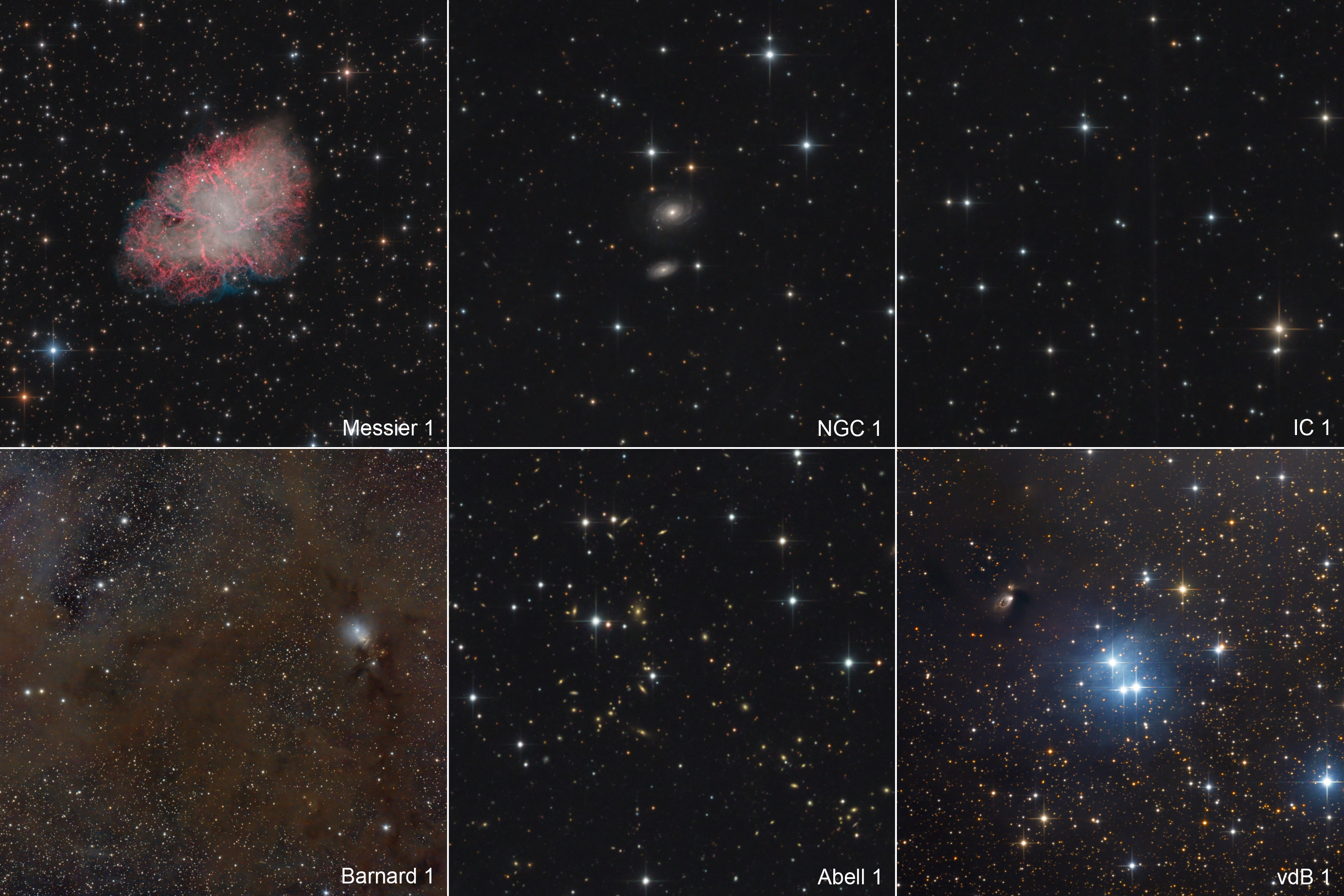
どんな旅にも最初のステップがあり、どんなカタログにも最初のエントリーがあります。6 つの有名な深宇宙カタログの最初のエントリーが、左上から右下へ、元のカタログの出版順にこれらのパネルに表示されます。1774 年、シャルル・メシエのカタログのエントリー番号 1 は、有名な宇宙の甲殻類であり超新星残骸であるかに星雲 M1 です。J.L.E. ドレイヤーの (それほど新しいものではない) 新一般カタログは 1888 年に出版されました。ペガスス座の渦巻銀河、NGC 1 が次のパネルの中央にあります。そのすぐ下のフレームには、NGC 2 としてカタログ化された別の渦巻銀河があります。ドレイヤーの続編インデックスカタログ (次のパネル) では、IC 1 は実際にはかすかな二重星です。現在ペルセウス座分子雲複合体の一部として認識されている暗黒星雲 Barnard 1 は、E.E. バーナードによる 1919 年のカタログ「空の暗い模様」の最下段の始まりです。アベル1は、ジョージ・アベルが1958年に発表した『豊かな銀河団カタログ』に掲載されている、ペガスス座にある遠方の銀河団です。最後のパネルは、シドニー・ファン・デン・ベルフが1966年に発表したvdB 1を中心にしています。美しい青い銀河反射星雲は、カシオペヤ座にあります。
原文(English)
very journey has a first step and every catalog a first entry. First entries in six well-known deep sky catalogs appear in these panels, from upper left to lower right in chronological order of original catalog publication. From 1774, Charles Messier's catalog entry number 1 is M1, famous cosmic crustacean and supernova remnant the Crab Nebula. J.L.E. Dreyer's (not so new) New General Catalog was published in 1888. A spiral galaxy in Pegasus, his NGC 1 is centered in the next panel. Just below it in the frame is another spiral galaxy cataloged as NGC 2. In Dreyer's follow-on Index Catalog (next panel), IC 1 is actually a faint double star, though. Now recognized as part of the Perseus molecular cloud complex, dark nebula Barnard 1 begins the bottom row from Dark Markings of the Sky, a 1919 catalog by E.E. Barnard. Abell 1 is a distant galaxy cluster in Pegasus, from George Abell's 1958 catalog of Rich Clusters of Galaxies. The final panel is centered on vdB 1, from Sidney van den Bergh's 1966 study. The pretty, blue galactic reflection nebula is found in the constellation Cassiopeia.
\ この感動を宇宙仲間にシェア /
宇宙をXでシェア
© Bernhard Hubl / APOD