
🚀 宇宙の記憶・カレンダー検索
🚀 象徴的な写真:
APOD第1回
🚀 創造の柱
🚀 スピリット火星着陸
🚀 ハッブル超深宇宙
🚀 地球へようこそ|ブルー・マーブル
🚀 エンケラドス
🚀 ベテルギウス
🚀 火星着陸
🚀 青い夕焼け
🚀 冥王星のハート
🚀 皆既日食
🚀 アースライズ再構築
🚀 ブラックホール
🚀 ウェッブ初画像
🚀 アポロ11着陸
APOD30周年(2025年6月16日)
オーロラと日の出
The Aurora and the Sunrise
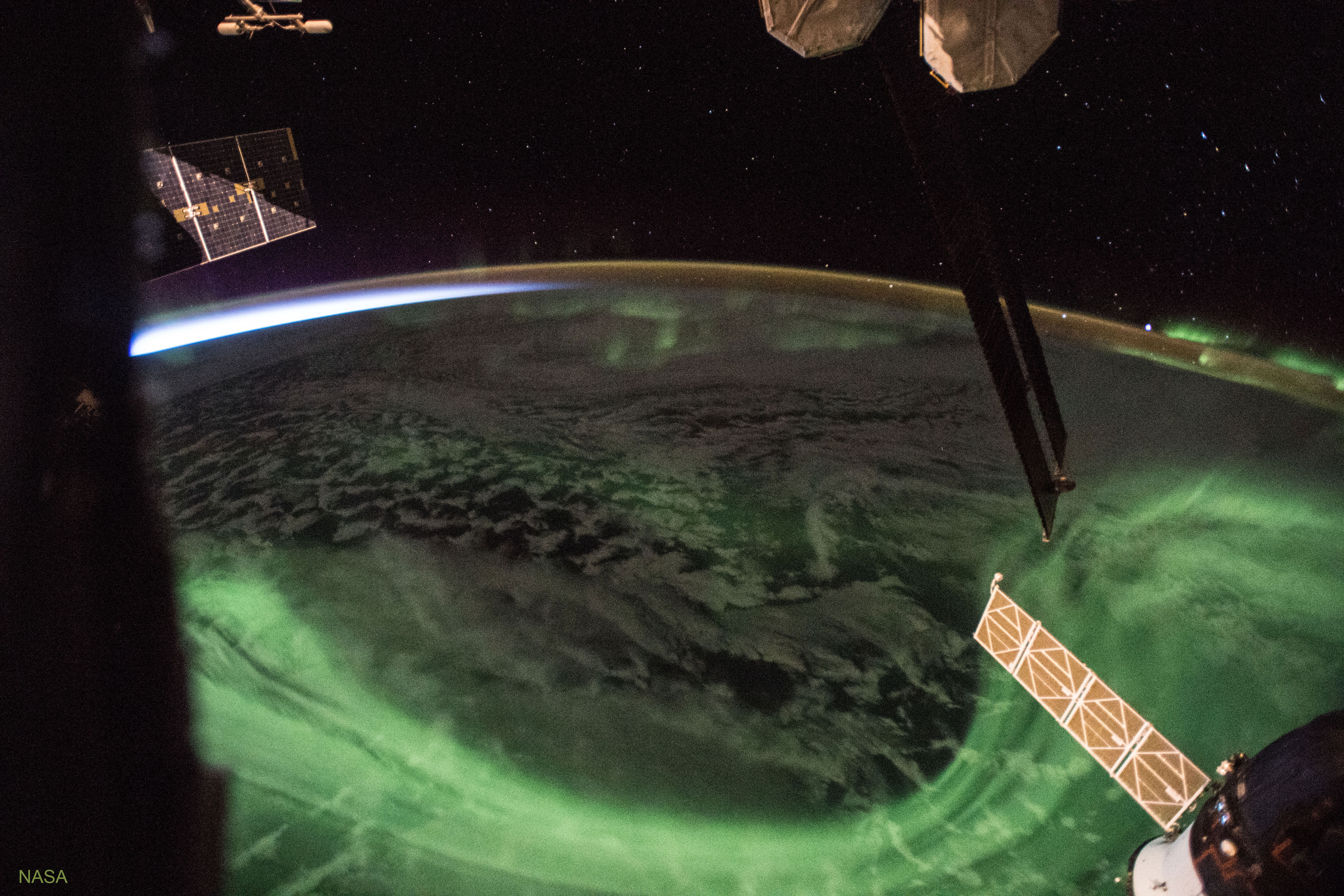
国際宇宙ステーション(ISS)では、オーロラを鑑賞できるのは日の出までです。日の出後は、背景の地球が明るすぎて見えなくなってしまいます。残念ながら、日没後、ISSは地球を高速で周回しているため、日の出まで通常47分もありません。掲載画像では、ISSの下、右上の地平線上に緑色のオーロラが見え、左上からは不気味に日の出が近づいています。宇宙からオーロラを眺めるのは魅惑的で、その変化する形は巨大な緑色のアメーバに例えられます。オーロラは、太陽からの高エネルギー電子と陽子が地球の磁場に衝突し、地球に向かって高速で螺旋状に落下することで、大気中の原子や分子を発光させることで発生します。ISSはオーロラとほぼ同じ高度を周回しており、オーロラの薄い上層部を通過することもよくありますが、宇宙飛行士に危害を加えたり、オーロラの形を変えたりすることはありません。Share the Sky: NASA Open API for APOD
原文(English)
On the International Space Station (ISS), you can only admire an aurora until the sun rises. Then the background Earth becomes too bright. Unfortunately, after sunset, the rapid orbit of the ISS around the Earth means that sunrise is usually less than 47 minutes away. In the featured image, a green aurora is visible below the ISS -- and on the horizon to the upper right, while sunrise approaches ominously from the upper left. Watching an aurora from space can be mesmerizing as its changing shape has been compared to a giant green amoeba. Auroras are composed of energetic electrons and protons from the Sun that impact the Earth's magnetic field and then spiral down toward the Earth so fast that they cause atmospheric atoms and molecules to glow. The ISS orbits at nearly the same height as auroras, many times flying right through an aurora's thin upper layers, an event that neither harms astronauts nor changes the shape of the aurora. Share the Sky: NASA Open API for APOD
\ この感動を宇宙仲間にシェア /
宇宙をXでシェア
© NASA / APOD