
🚀 宇宙の記憶・カレンダー検索
🚀 象徴的な写真:
APOD第1回
🚀 創造の柱
🚀 スピリット火星着陸
🚀 ハッブル超深宇宙
🚀 地球へようこそ|ブルー・マーブル
🚀 エンケラドス
🚀 ベテルギウス
🚀 火星着陸
🚀 青い夕焼け
🚀 冥王星のハート
🚀 皆既日食
🚀 アースライズ再構築
🚀 ブラックホール
🚀 ウェッブ初画像
🚀 アポロ11着陸
APOD30周年(2025年6月16日)
天の川 vs エアグロー・オーストラリス
Milky Way vs Airglow Australis
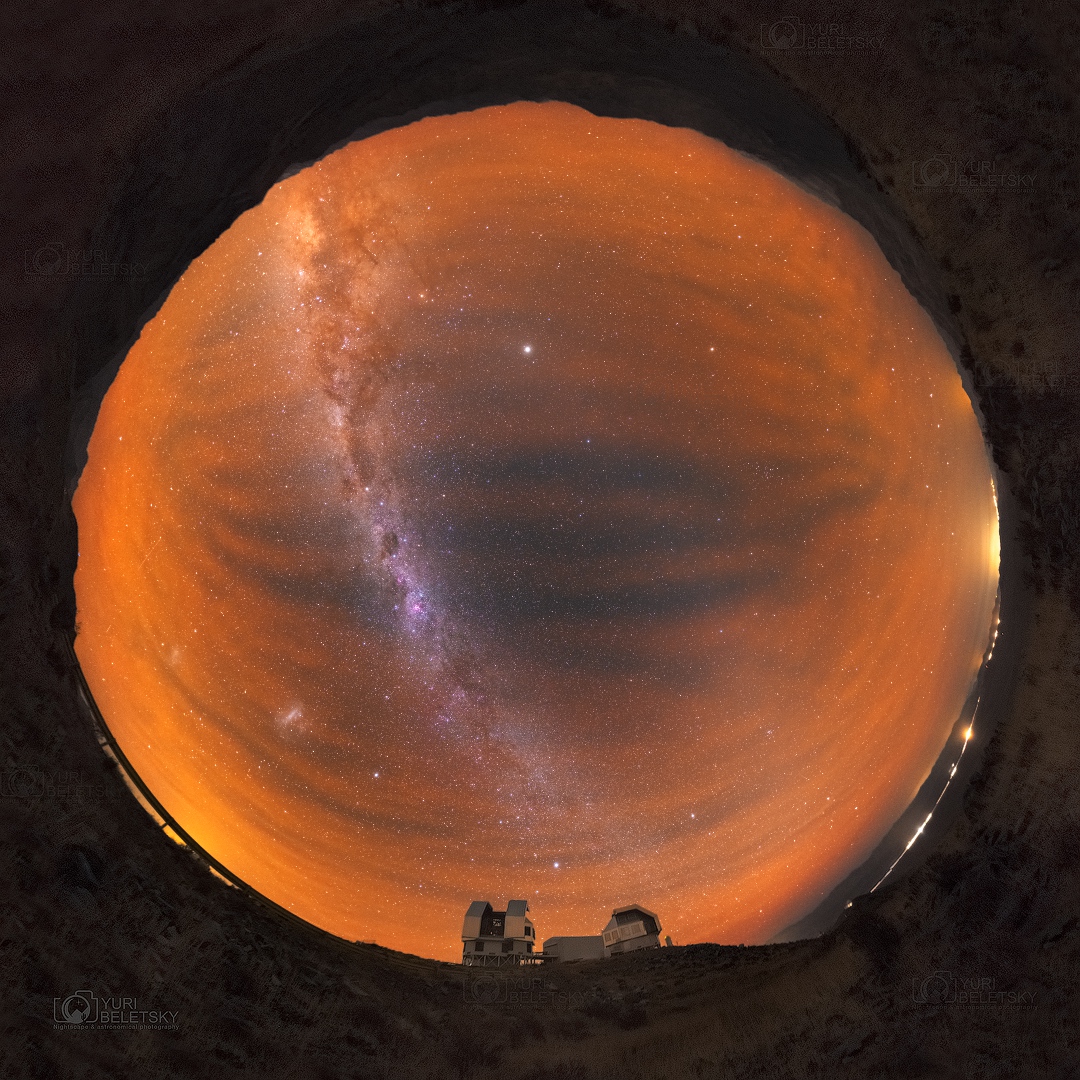
先週、チリの秋の夜に日没後に撮影されたこのラス・カンパナス天文台からの全天の眺めは、並外れた大気光に覆われています。大気光は非常に強く、アタカマ砂漠の高地の上空を地平線から地平線まで弧を描くように広がるため、天の川の一部がかすんで見えました。オーロラと同程度の高度で発生するこの明るい大気光は、化学発光、つまり化学励起による発光です。高感度デジタルカメラでカラーで撮影されることが多いこの大気光の発光は、燃えるような外観をしています。これは主に極めて低密度の大気中の酸素原子から発生し、ここ数年、南半球の夜によく見られます。天の川と同様に、この暗い夜には強い大気光は肉眼で非常によく見えましたが、色は見えませんでした。しかし、最も明るい天体は木星で、太陽の反対側に位置し、東(上)の地平線から昇る天の川の中心の膨らみの近くにあります。大マゼラン雲と小マゼラン雲は、銀河面の左下、南の地平線に向かって、大気光を通して輝いている。
原文(English)
Captured last week after sunset on a Chilean autumn night, an exceptional airglow floods this allsky view from Las Campanas Observatory. The airglow was so intense it diminished parts of the Milky Way as it arced horizon to horizon above the high Atacama desert. Originating at an altitude similar to aurorae, the luminous airglow is due to chemiluminescence, the production of light through chemical excitation. Commonly recorded in color by sensitive digital cameras, the airglow emission here is fiery in appearance. It is predominately from atmospheric oxygen atoms at extremely low densities and has often been present during southern hemisphere nights over the last few years. Like the Milky Way, on that dark night the strong airglow was very visible to the eye, but seen without color. Jupiter is the brightest celestial beacon though, standing opposite the Sun and near the central bulge of the Milky Way rising above the eastern (top) horizon. The Large and Small Magellanic clouds both shine through the airglow to the lower left of the galactic plane, toward the southern horizon.
\ この感動を宇宙仲間にシェア /
宇宙をXでシェア
© Yuri Beletsky / APOD