
🚀 宇宙の記憶・カレンダー検索
🚀 象徴的な写真:
APOD第1回
🚀 創造の柱
🚀 スピリット火星着陸
🚀 ハッブル超深宇宙
🚀 地球へようこそ|ブルー・マーブル
🚀 エンケラドス
🚀 ベテルギウス
🚀 火星着陸
🚀 青い夕焼け
🚀 冥王星のハート
🚀 皆既日食
🚀 アースライズ再構築
🚀 ブラックホール
🚀 ウェッブ初画像
🚀 アポロ11着陸
APOD30周年(2025年6月16日)
銀河面からアンタレスまで
From the Galactic Plane through Antares
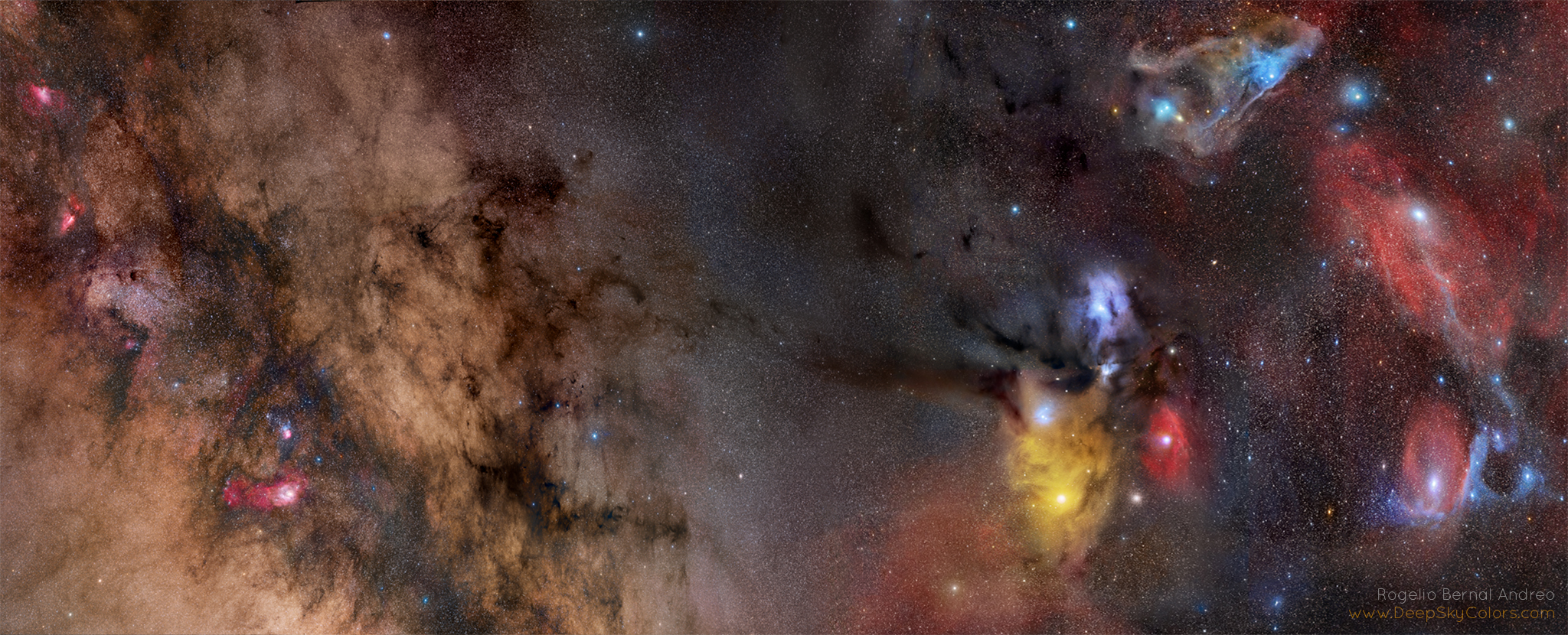
夜空で最も写真映えする領域の一つを、見事に捉えた写真をご覧ください。左端には天の川銀河の帯が斜めに走っており、中央のすぐ右には明るいオレンジ色の星アンタレスを含む色鮮やかなへびつかい座ρ星雲、右端にはシャープレス1星雲(Sh2-1)が見えます。天の川銀河の帯の手前には、わし星雲(M16)、三裂星雲(M20)、潟星雲(M8)など、いくつかの有名な星雲が見えます。その他の注目すべき星雲には、パイプ星雲とブルーホースヘッド星雲があります。一般的に、赤色は励起された水素ガスの光で輝く星雲から発せられ、青色は明るい若い星の光を優先的に反射する星間塵を示しています。厚い塵は、それ以外の場合は濃い茶色に見えます。見える大きな星の塊には、球状星団M4、M9、M19、M28、M80が含まれており、それぞれ注釈付きの付随画像にマークされています。この非常に広い視野(約50度)は、左下にいて座、左上にへび座、中央にへびつかい座、右にさそり座の星座を網羅しています。この画像を作成するために、100時間以上の天体撮影に加え、綿密な計画とデジタル処理が行われました。
原文(English)
Behold one of the most photogenic regions of the night sky, captured impressively. Featured, the band of our Milky Way Galaxy runs diagonally along the far left, while the colorful Rho Ophiuchus region including the bright orange star Antares is visible just right of center, and the nebula Sharpless 1 (Sh2-1) appears on the far right. Visible in front of the Milk Way band are several famous nebulas including the Eagle Nebula (M16), the Trifid Nebula (M20), and the Lagoon Nebula (M8). Other notable nebulas include the Pipe and Blue Horsehead. In general, red emanates from nebulas glowing in the light of exited hydrogen gas, while blue marks interstellar dust preferentially reflecting the light of bright young stars. Thick dust appears otherwise dark brown. Large balls of stars visible include the globular clusters M4, M9, M19, M28, and M80, each marked on the annotated companion image. This extremely wide field -- about 50 degrees across -- spans the constellations of Sagittarius is on the lower left, Serpens on the upper left, Ophiuchus across the middle, and Scorpius on the right. It took over 100 hours of sky imaging, combined with meticulous planning and digital processing, to create this image.
\ この感動を宇宙仲間にシェア /
宇宙をXでシェア
© NASA / APOD