
🚀 宇宙の記憶・カレンダー検索
🚀 象徴的な写真:
APOD第1回
🚀 創造の柱
🚀 スピリット火星着陸
🚀 ハッブル超深宇宙
🚀 地球へようこそ|ブルー・マーブル
🚀 エンケラドス
🚀 ベテルギウス
🚀 火星着陸
🚀 青い夕焼け
🚀 冥王星のハート
🚀 皆既日食
🚀 アースライズ再構築
🚀 ブラックホール
🚀 ウェッブ初画像
🚀 アポロ11着陸
APOD30周年(2025年6月16日)
遠方のブレーザージェットに関連するニュートリノ
Neutrino Associated with Distant Blazar Jet
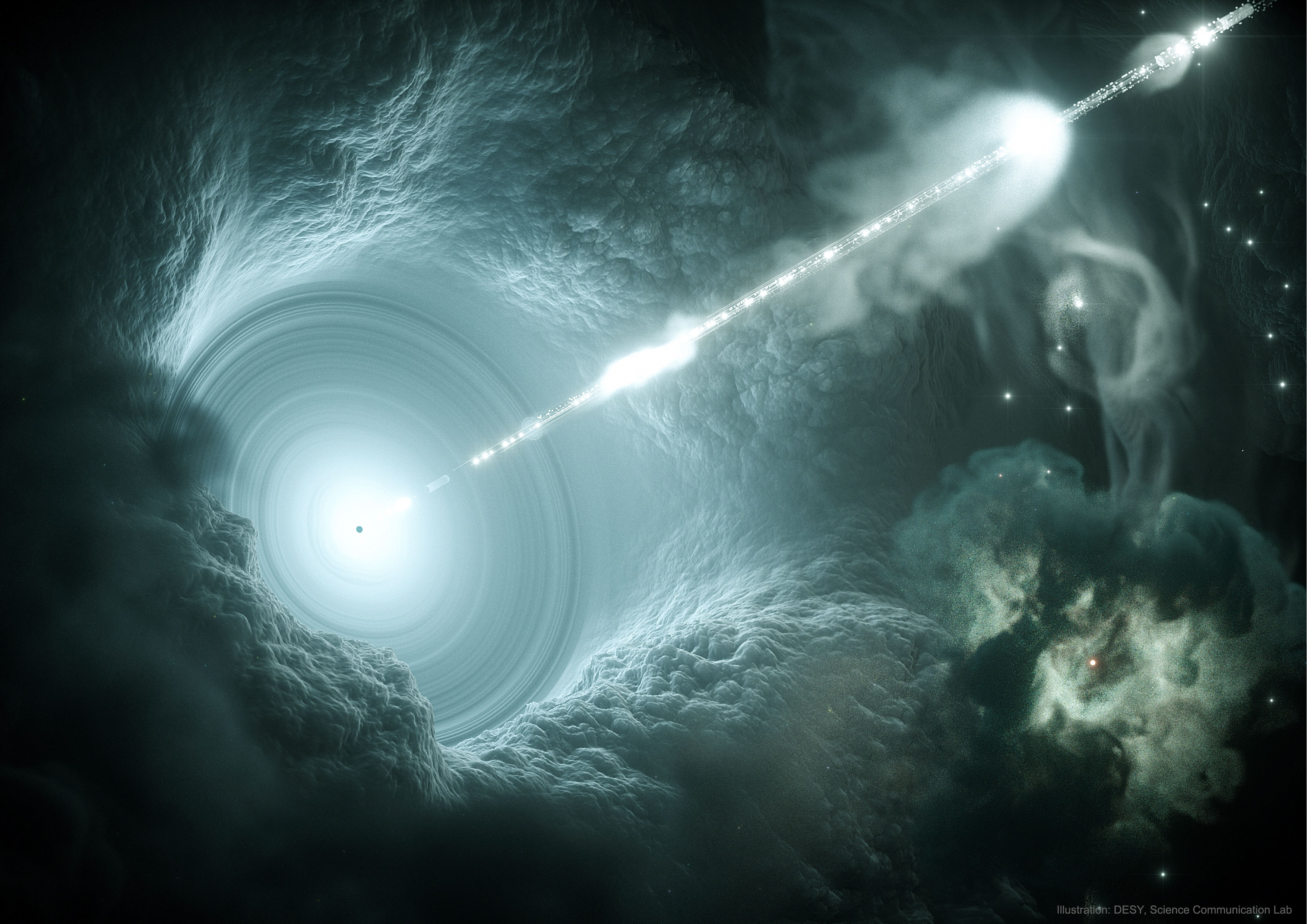
地球の南極の氷の下に深く閉じ込められた装置によって、人類は宇宙のはるか彼方から来たニュートリノを発見したようだ。これが確認されれば、宇宙論的に遠いニュートリノの初の明確な検出となり、高エネルギーニュートリノと、燃え盛るクエーサー(ブレーザー)から放出される強力なジェットによって生成される宇宙線との間の観測された関連性の始まりとなるだろう。2017年9月に南極のアイスキューブ検出器が高エネルギーニュートリノを測定すると、人類の主要な天文台の多くが、光で対応するものを特定しようと動き出した。そして、彼らはそれを成し遂げた。噴出する対応天体は、AGILE、Fermi、HAWC、H.E.S.S.、INTEGRAL、MAGIC、NuSTAR、Swift、VERITASなどの高エネルギー観測所によって特定され、ガンマ線ブレーザーTXS 0506+056が正しい方向にあり、フレアからのガンマ線がニュートリノとほぼ同時に到達していることがわかった。この位置と時間の一致は統計的に強いものの、天文学者は、絶対的な確信を得るために、他の同様のニュートリノとブレーザー光の関連性を待つことになるだろう。ここに示されているのは、ブレーザーの中心にあるブラックホールから噴出する粒子ジェットのアーティストによる図である。
原文(English)
With equipment frozen deep into ice beneath Earth's South Pole, humanity appears to have discovered a neutrino from far across the universe. If confirmed, this would mark the first clear detection of cosmologically-distant neutrinos and the dawn of an observed association between energetic neutrinos and cosmic rays created by powerful jets emanating from blazing quasars (blazars). Once the Antarctican IceCube detector measured an energetic neutrino in 2017 September, many of humanity's premier observatories sprang into action to try to identify a counterpart in light. And they did. An erupting counterpart was pinpointed by high energy observatories including AGILE, Fermi, HAWC, H.E.S.S., INTEGRAL, MAGIC, NuSTAR, Swift, and VERITAS, which found that gamma-ray blazar TXS 0506+056 was in the right direction and with gamma-rays from a flare arriving nearly coincidental in time with the neutrino. Even though this and other position and time coincidences are statistically strong, astronomers will await other similar neutrino - blazar light associations to be absolutely sure. Pictured here is an artist's drawing of a particle jet emanating from a black hole at the center of a blazar.
\ この感動を宇宙仲間にシェア /
宇宙をXでシェア
© NASA / APOD