
🚀 宇宙の記憶・カレンダー検索
🚀 象徴的な写真:
APOD第1回
🚀 創造の柱
🚀 スピリット火星着陸
🚀 ハッブル超深宇宙
🚀 地球へようこそ|ブルー・マーブル
🚀 エンケラドス
🚀 ベテルギウス
🚀 火星着陸
🚀 青い夕焼け
🚀 冥王星のハート
🚀 皆既日食
🚀 アースライズ再構築
🚀 ブラックホール
🚀 ウェッブ初画像
🚀 アポロ11着陸
APOD30周年(2025年6月16日)
プランク衛星がマイクロ波背景放射をマッピング
Planck Maps the Microwave Background
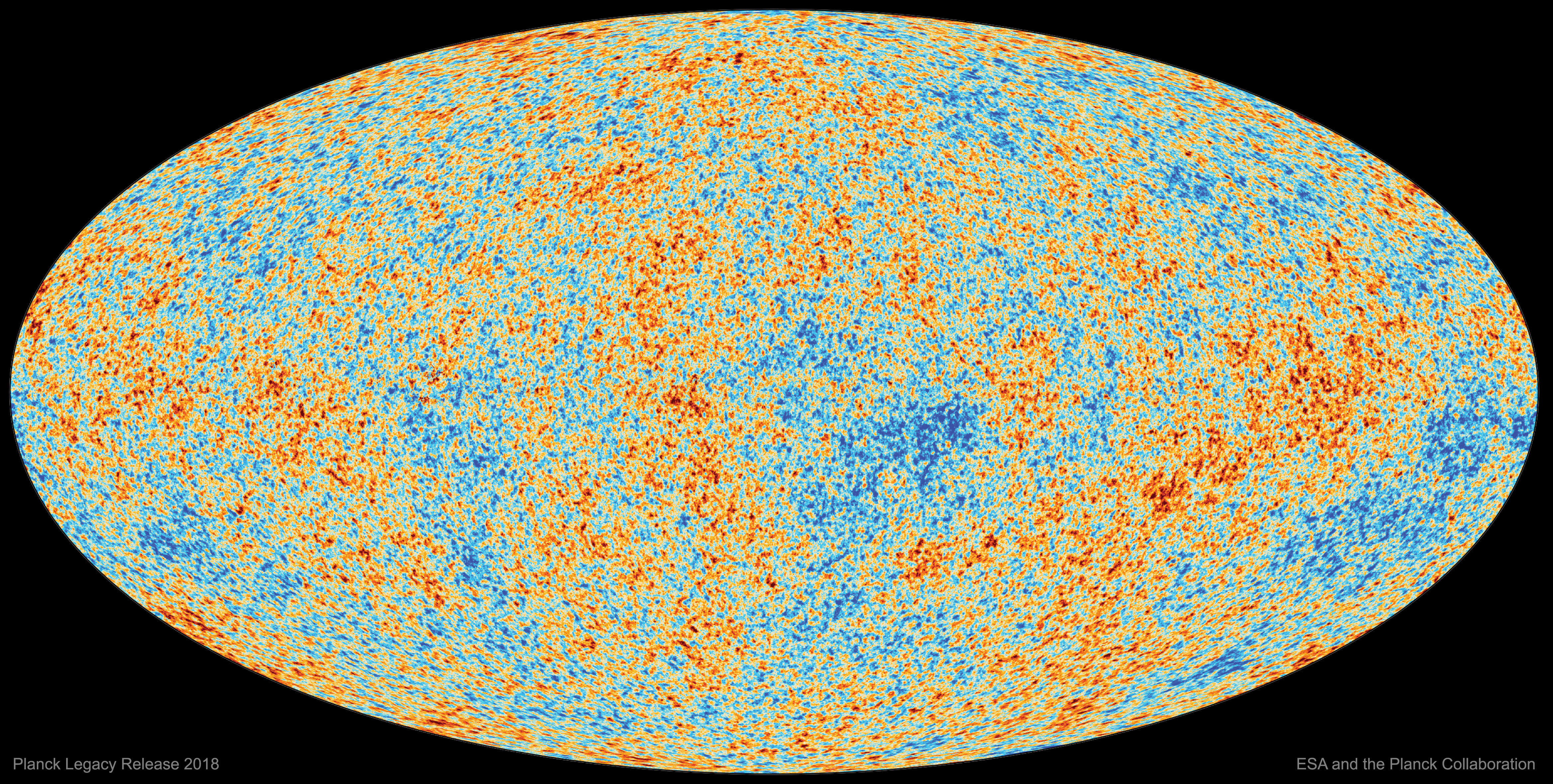
私たちの宇宙は何でできているのでしょうか?それを知るために、ESAは2009年から2013年にかけてプランク衛星を打ち上げ、宇宙が初めて光に対して透明になったときの背景空、つまり既知の最も古い光学的表面のわずかな温度差を前例のない詳細さでマッピングしました。あらゆる方向から見えるこの宇宙マイクロ波背景放射は複雑なタペストリーであり、宇宙が特定の方法で進化してきた特定の種類のエネルギーで構成されている場合にのみ、観測された高温と低温のパターンを示すことができます。先週報告された最終結果は、私たちの宇宙の大部分が謎めいた未知のダークエネルギーで構成されており、残りの物質エネルギーのほとんども奇妙なほど暗いことを改めて確認しました。さらに、2018年の「最終」プランクデータは、宇宙の年齢を約138億年、ハッブル定数と呼ばれる局所的な膨張率を67.4(±0.5)km/秒/Mpcと印象的に示しています。奇妙なことに、この初期宇宙で決定されたハッブル定数は、後期宇宙で他の方法で決定された値よりもわずかに低く、この矛盾が多くの議論や憶測を引き起こしている。
原文(English)
What is our universe made of? To help find out, ESA launched the Planck satellite from 2009 to 2013 to map, in unprecedented detail, slight temperature differences on the oldest optical surface known -- the background sky when our universe first became transparent to light. Visible in all directions, this cosmic microwave background is a complex tapestry that could only show the hot and cold patterns observed were the universe to be composed of specific types of energy that evolved in specific ways. The final results, reported last week, confirm again that most of our universe is mostly composed of mysterious and unfamiliar dark energy, and that even most of the remaining matter energy is strangely dark. Additionally, the "final" 2018 Planck data impressively peg the age of the universe at about 13.8 billion years and the local expansion rate -- called the Hubble constant -- at 67.4 (+/- 0.5) km/sec/Mpc. Oddly, this early-universe determined Hubble constant is slightly lower than that determined by other methods in the late-universe, creating a tension that is causing much discussion and speculation.
\ この感動を宇宙仲間にシェア /
宇宙をXでシェア
© NASA / APOD