
🚀 宇宙の記憶・カレンダー検索
🚀 象徴的な写真:
APOD第1回
🚀 創造の柱
🚀 スピリット火星着陸
🚀 ハッブル超深宇宙
🚀 地球へようこそ|ブルー・マーブル
🚀 エンケラドス
🚀 ベテルギウス
🚀 火星着陸
🚀 青い夕焼け
🚀 冥王星のハート
🚀 皆既日食
🚀 アースライズ再構築
🚀 ブラックホール
🚀 ウェッブ初画像
🚀 アポロ11着陸
APOD30周年(2025年6月16日)
ハッブル宇宙望遠鏡が捉えた紫外線画像で見る木星
Jupiter in Ultraviolet from Hubble
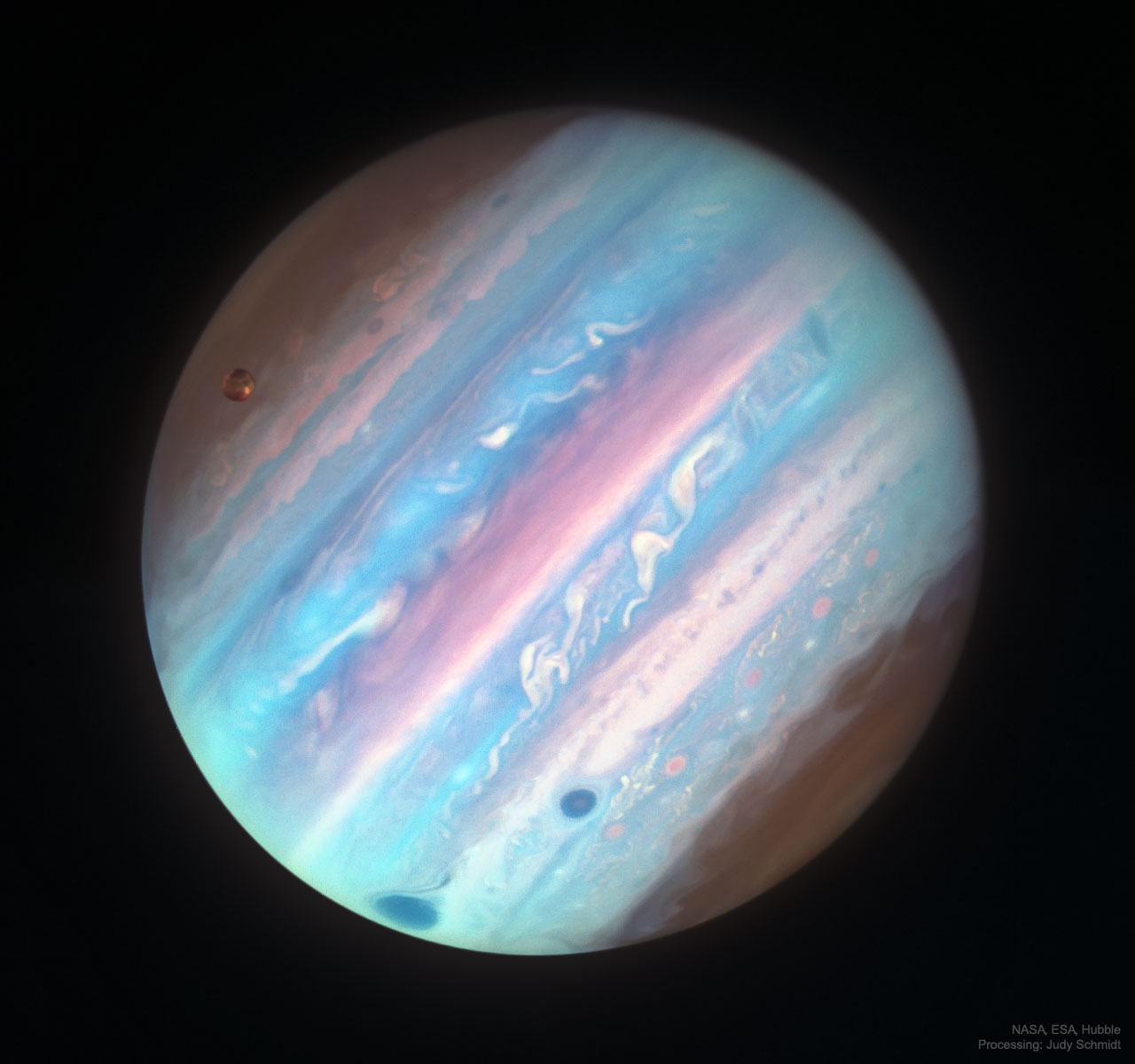
木星は紫外線で見ると少し違って見える。木星の雲の動きをより正確に解釈し、NASAの探査機ジュノーが観測する小さな領域の惑星的な文脈を理解するのを助けるために、ハッブル宇宙望遠鏡は木星全体を定期的に撮影するように指示されている。監視されている木星の色は、通常の人間の視覚範囲を超え、紫外線と(画像には写っていない)赤外線の両方を含む。2017年に撮影されたこの画像では、木星は近紫外線で違って見える。これは、反射される太陽光の量が異なるため、雲の高さと緯度によって明るさが異なるためである。近紫外線では、木星の極は比較的暗く見え、大赤斑と右側のより小さな(光学的に)白い楕円も同様である。しかし、さらに右側にある真珠の首飾り嵐は近紫外線で最も明るく、ここでは(擬似カラーで)ピンク色に見える。木星最大の衛星ガニメデは左上に写っている。ジュノー探査機は木星の周りを53日周期で周回する軌道を続けている一方、地球周回軌道上のハッブル宇宙望遠鏡は、姿勢安定化ジャイロスコープの故障から復旧作業を行っている。
原文(English)
Jupiter looks a bit different in ultraviolet light. To better interpret Jupiter's cloud motions and to help NASA's robotic Juno spacecraft understand the planetary context of the small fields that it sees, the Hubble Space Telescope is being directed to regularly image the entire Jovian giant. The colors of Jupiter being monitored go beyond the normal human visual range to include both ultraviolet and (not pictured) infrared light. Featured from 2017, Jupiter appears different in near ultraviolet light, partly because the amount of sunlight reflected back is distinct, giving differing cloud heights and latitudes discrepant brightnesses. In the near UV, Jupiter's poles appear relatively dark, as does its Great Red Spot and a smaller (optically) white oval to the right. The String of Pearl storms farther to the right, however, are brightest in near ultraviolet, and so here appear (false-color) pink. Jupiter's largest moon Ganymede appears on the upper left. Juno continues on its looping 53-day orbits around Jupiter, while Earth-orbiting Hubble is now recovering from the loss of a stabilizing gyroscope.
\ この感動を宇宙仲間にシェア /
宇宙をXでシェア
© NASA / APOD