
🚀 宇宙の記憶・カレンダー検索
🚀 象徴的な写真:
APOD第1回
🚀 創造の柱
🚀 スピリット火星着陸
🚀 ハッブル超深宇宙
🚀 地球へようこそ|ブルー・マーブル
🚀 エンケラドス
🚀 ベテルギウス
🚀 火星着陸
🚀 青い夕焼け
🚀 冥王星のハート
🚀 皆既日食
🚀 アースライズ再構築
🚀 ブラックホール
🚀 ウェッブ初画像
🚀 アポロ11着陸
APOD30周年(2025年6月16日)
ハイペリオン:既知の銀河原始超銀河団の中で最大
Hyperion: Largest Known Galaxy Proto-Supercluster
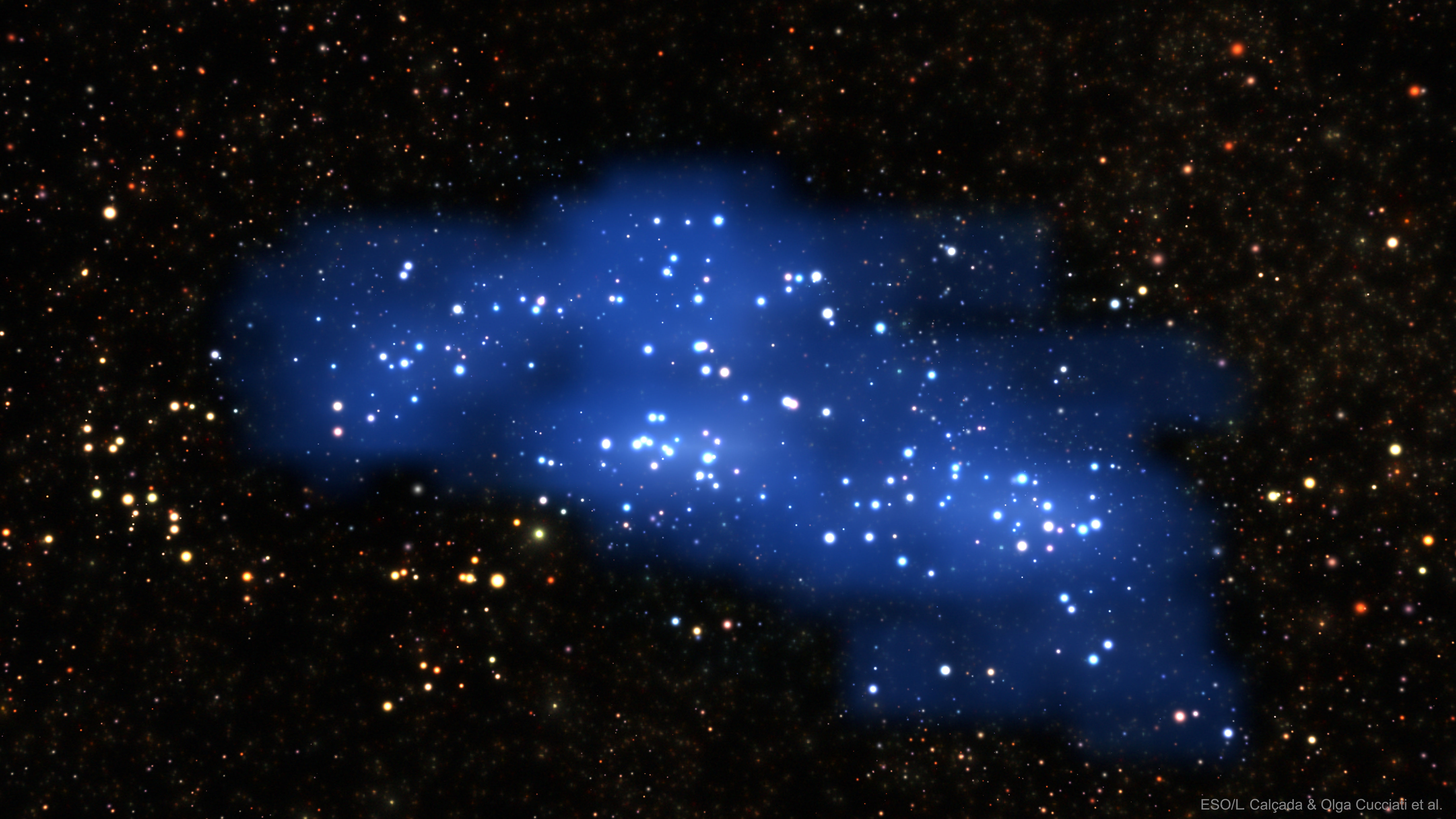
初期宇宙では銀河はどのように形成されたのでしょうか?その解明のため、天文学者たちはチリの超大型望遠鏡アレイを用いて暗い夜空の一帯を観測し、宇宙がまだ若かった頃に形成された銀河を探して数えました。遠方の銀河(赤方偏移が約2.5)の分布を分析した結果、3億光年に及ぶ巨大な銀河の集合体が見つかりました。その質量は天の川銀河の約5,000倍にもなります。ハイペリオンと名付けられたこの銀河は、初期宇宙で発見された中で現在までで最大かつ最も質量が大きい原始超銀河団です。原始超銀河団とは、重力によって収縮して超銀河団を形成する若い銀河の集まりであり、超銀河団自体が複数の銀河団の集まりであり、さらにその銀河団は数百の銀河の集まりであり、さらにその銀河団は数十億の星の集まりです。この図では、巨大な銀河は白色で、多数の小さな銀河を含む領域は青色で示されています。このような初期銀河の大きな集団を特定し理解することは、宇宙全体の構成と進化に関する人類の理解を深めることにつながります。
原文(English)
How did galaxies form in the early universe? To help find out, astronomers surveyed a patch of dark night sky with the Very Large Telescope array in Chile to find and count galaxies that formed when our universe was very young. Analysis of the distribution of some distant galaxies (redshifts near 2.5) found an enormous conglomeration of galaxies that spanned 300 million light years and contained about 5,000 times the mass of our Milky Way Galaxy. Dubbed Hyperion, it is currently the largest and most massive proto-supercluster yet discovered in the early universe. A proto-supercluster is a group of young galaxies that is gravitationally collapsing to create a supercluster, which itself a group of several galaxy clusters, which itself is a group of hundreds of galaxies, which itself is a group of billions of stars. In the featured visualization, massive galaxies are depicted in white, while regions containing a large amount of smaller galaxies are shaded blue. Identifying and understanding such large groups of early galaxies contributes to humanity's understanding of the composition and evolution of the universe as a whole.
\ この感動を宇宙仲間にシェア /
宇宙をXでシェア
© NASA / APOD