
🚀 宇宙の記憶・カレンダー検索
🚀 象徴的な写真:
APOD第1回
🚀 創造の柱
🚀 スピリット火星着陸
🚀 ハッブル超深宇宙
🚀 地球へようこそ|ブルー・マーブル
🚀 エンケラドス
🚀 ベテルギウス
🚀 火星着陸
🚀 青い夕焼け
🚀 冥王星のハート
🚀 皆既日食
🚀 アースライズ再構築
🚀 ブラックホール
🚀 ウェッブ初画像
🚀 アポロ11着陸
APOD30周年(2025年6月16日)
夜はもっと素敵
NICER at Night
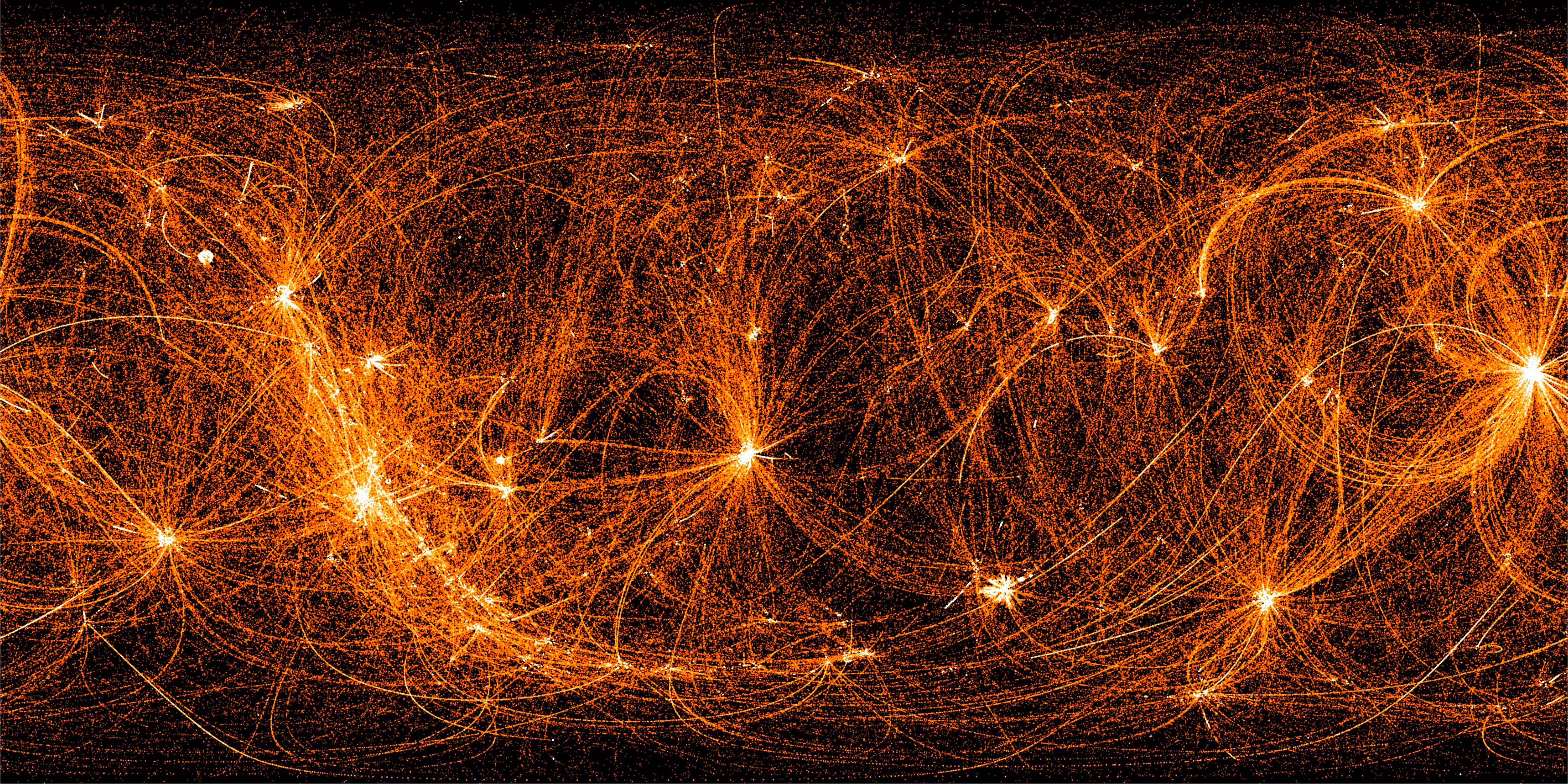
国際宇宙ステーションに搭載されたペイロードである中性子星内部組成探査機(NICER)は、ステーションが93分ごとに地球を周回する間、宇宙のX線源を追跡するために向きを変えます。軌道上の夜間も、そのX線検出器は作動し続けます。そのため、NICERが目標から目標へと向きを変えるにつれて、22か月分のNICERデータから作成されたこの全天マップ上に明るい弧やループが描かれます。これらの弧は、NICERが定期的にターゲットとして監視しているX線空の目立つ明るい点、つまりパルサーに収束する傾向があります。パルサーは、時計のように一定のリズムでX線パルスを放出する回転する中性子星です。そのタイミングは非常に正確なので、宇宙船の速度と位置を決定する航行に利用できます。このNICER X線全天マップは、天の赤道を水平に中心にとった座標で作成されています。
原文(English)
A payload on board the International Space Station, the Neutron star Interior Composition Explorer (NICER) twists and turns to track cosmic sources of X-rays as the station orbits planet Earth every 93 minutes. During orbit nighttime, its X-ray detectors remain on. So as NICER slews from target to target bright arcs and loops are traced across this all-sky map made from 22 months of NICER data. The arcs tend to converge on prominent bright spots, pulsars in the X-ray sky that NICER regularly targets and monitors. The pulsars are spinning neutron stars that emit clock-like pulses of X-rays. Their timing is so precise it can be used for navigation, determining spacecraft speed and position. This NICER X-ray, all-sky, map is composed in coordinates with the celestial equator horizontally across the center.
\ この感動を宇宙仲間にシェア /
宇宙をXでシェア
© NASA / APOD