
🚀 宇宙の記憶・カレンダー検索
🚀 象徴的な写真:
APOD第1回
🚀 創造の柱
🚀 スピリット火星着陸
🚀 ハッブル超深宇宙
🚀 地球へようこそ|ブルー・マーブル
🚀 エンケラドス
🚀 ベテルギウス
🚀 火星着陸
🚀 青い夕焼け
🚀 冥王星のハート
🚀 皆既日食
🚀 アースライズ再構築
🚀 ブラックホール
🚀 ウェッブ初画像
🚀 アポロ11着陸
APOD30周年(2025年6月16日)
小惑星ケレスにある珍しい山、アフナ・モンス
Unusual Mountain Ahuna Mons on Asteroid Ceres
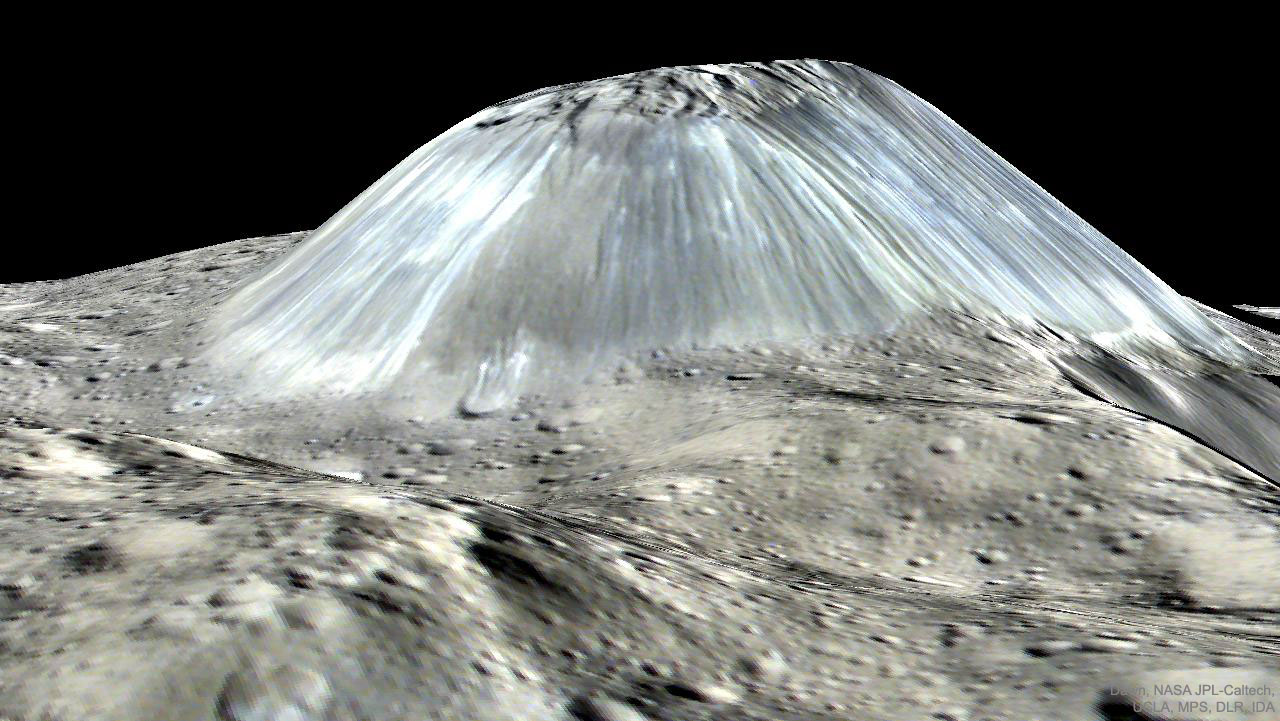
この珍しい山はどのようにしてできたのでしょうか?新たな説があります。アフナ・モンスは、火星と木星の間の小惑星帯で太陽を周回する、太陽系最大の既知の小惑星ケレスにある最大の山です。しかし、アフナ・モンスは、人類がこれまで見たことのないような山です。まず、その斜面には古いクレーターではなく、若い垂直の筋が見られます。多数の重力測定に基づく新しい仮説では、泥の泡が準惑星の奥深くから上昇し、反射性の塩分が豊富な弱い部分で氷の表面を押し出し、その後凍結したとされています。明るい筋は、ケレスの有名な明るい斑点に見られるような、最近表面に現れた他の物質に似ていると考えられています。掲載されている2倍の高さのデジタル画像は、2016年にロボット探査機ドーンが撮影したケレスの表面マップから作成されました。2018年にミッションを成功裏に完了したドーンは、アンテナを地球に向けておくのに必要な燃料を使い果たした後も、ケレスの周回を続けています。記念日:最初のAPOD(今日の1日)が公開されてから24年が経ちました。
原文(English)
What created this unusual mountain? There is a new theory. Ahuna Mons is the largest mountain on the largest known asteroid in our Solar System, Ceres, which orbits our Sun in the main asteroid belt between Mars and Jupiter. Ahuna Mons, though, is like nothing that humanity has ever seen before. For one thing, its slopes are garnished not with old craters but young vertical streaks. The new hypothesis, based on numerous gravity measurements, holds that a bubble of mud rose from deep within the dwarf planet and pushed through the icy surface at a weak point rich in reflective salt -- and then froze. The bright streaks are thought to be similar to other recently surfaced material such as visible in Ceres' famous bright spots. The featured double-height digital image was constructed from surface maps taken of Ceres in 2016 by the robotic Dawn mission. Successfully completing its mission in 2018, Dawn continues to orbit Ceres even though it has exhausted the fuel needed to keep its antennas pointed toward Earth. Anniversary: The first APOD appeared 24 years ago today.
\ この感動を宇宙仲間にシェア /
宇宙をXでシェア
© NASA / APOD