
🚀 宇宙の記憶・カレンダー検索
🚀 象徴的な写真:
APOD第1回
🚀 創造の柱
🚀 スピリット火星着陸
🚀 ハッブル超深宇宙
🚀 地球へようこそ|ブルー・マーブル
🚀 エンケラドス
🚀 ベテルギウス
🚀 火星着陸
🚀 青い夕焼け
🚀 冥王星のハート
🚀 皆既日食
🚀 アースライズ再構築
🚀 ブラックホール
🚀 ウェッブ初画像
🚀 アポロ11着陸
APOD30周年(2025年6月16日)
赤外線で見た北アメリカ星雲
The North America Nebula in Infrared
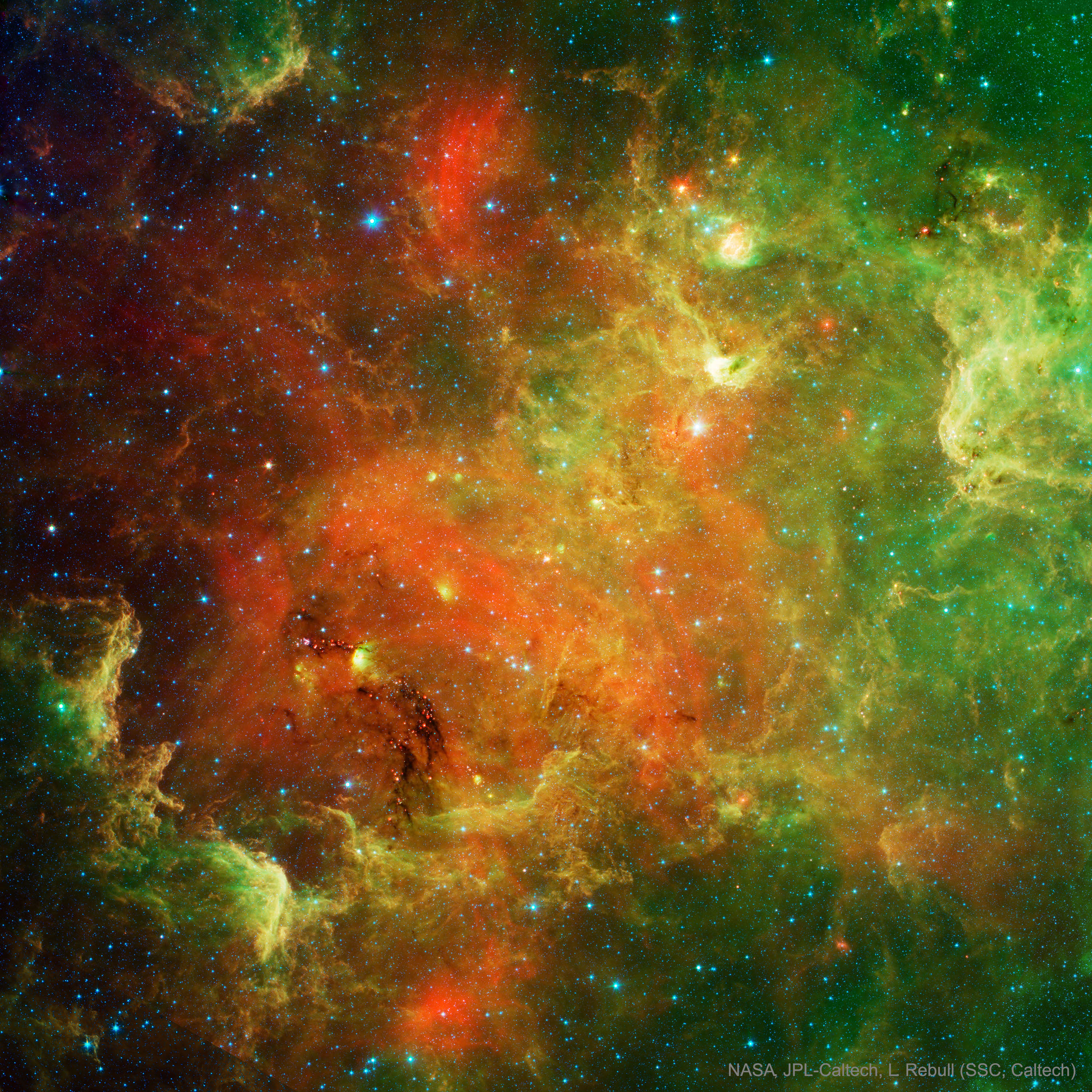
北アメリカ星雲は、ほとんどの北アメリカ人にはできないこと、つまり星を形成することができます。星雲のどの部分でこれらの星が形成されているのかは、可視光を遮る星雲の厚い塵によってほとんど隠されていました。しかし、軌道上のスピッツァー宇宙望遠鏡による北アメリカ星雲の赤外線観測では、塵の大部分を透過して、数千個の新しく形成された星が発見されました。上記の科学的に着色された赤外線画像にカーソルを合わせると、比較のために同じ領域の対応する光学画像が表示されます。赤外線画像は、ガスと塵の密な塊に埋め込まれている状態から、円盤と噴出するジェットに囲まれている状態、そして誕生の繭から完全に離れている状態まで、さまざまな形成段階にある若い星を鮮明に捉えています。北アメリカ星雲(NGC 7000)は、約50光年にわたって広がり、白鳥座(はくちょう座)の方向に約1,500光年離れたところに位置しています。しかし、北アメリカ星雲に存在する既知の星の中で、どの質量のある星が電離した赤い輝きを生み出す高エネルギーの光を発しているのかについては、依然として議論が続いている。
原文(English)
The North America Nebula can do what most North Americans cannot -- form stars. Precisely where in the nebula these stars are forming has been mostly obscured by some of the nebula's thick dust that is opaque to visible light. However, a view of the North America Nebula in infrared light by the orbiting Spitzer Space Telescope has peered through much of the dust and uncovered thousands of newly formed stars. Rolling your cursor over the above scientifically-colored infrared image will bring up a corresponding optical image of the same region for comparison. The infrared image neatly captures young stars in many stages of formation, from being imbedded in dense knots of gas and dust, to being surrounded by disks and emitted jets, to being clear of their birth cocoons. The North America Nebula (NGC 7000) spans about 50 light years and lies about 1,500 light years away toward the constellation of the Swan (Cygnus). Still, of all the stars known in the North America Nebula, which massive stars emit the energetic light that gives the ionized red glow is still debated.
\ この感動を宇宙仲間にシェア /
宇宙をXでシェア
© NASA,
JPL-Caltech,
L. Rebull
(SSC, Caltech);
Optical Rollover:
DSS, D. De Martin / APOD