
🚀 宇宙の記憶・カレンダー検索
🚀 象徴的な写真:
APOD第1回
🚀 創造の柱
🚀 スピリット火星着陸
🚀 ハッブル超深宇宙
🚀 地球へようこそ|ブルー・マーブル
🚀 エンケラドス
🚀 ベテルギウス
🚀 火星着陸
🚀 青い夕焼け
🚀 冥王星のハート
🚀 皆既日食
🚀 アースライズ再構築
🚀 ブラックホール
🚀 ウェッブ初画像
🚀 アポロ11着陸
APOD30周年(2025年6月16日)
はくちょう座ループのフィラメント
Filaments of the Cygnus Loop
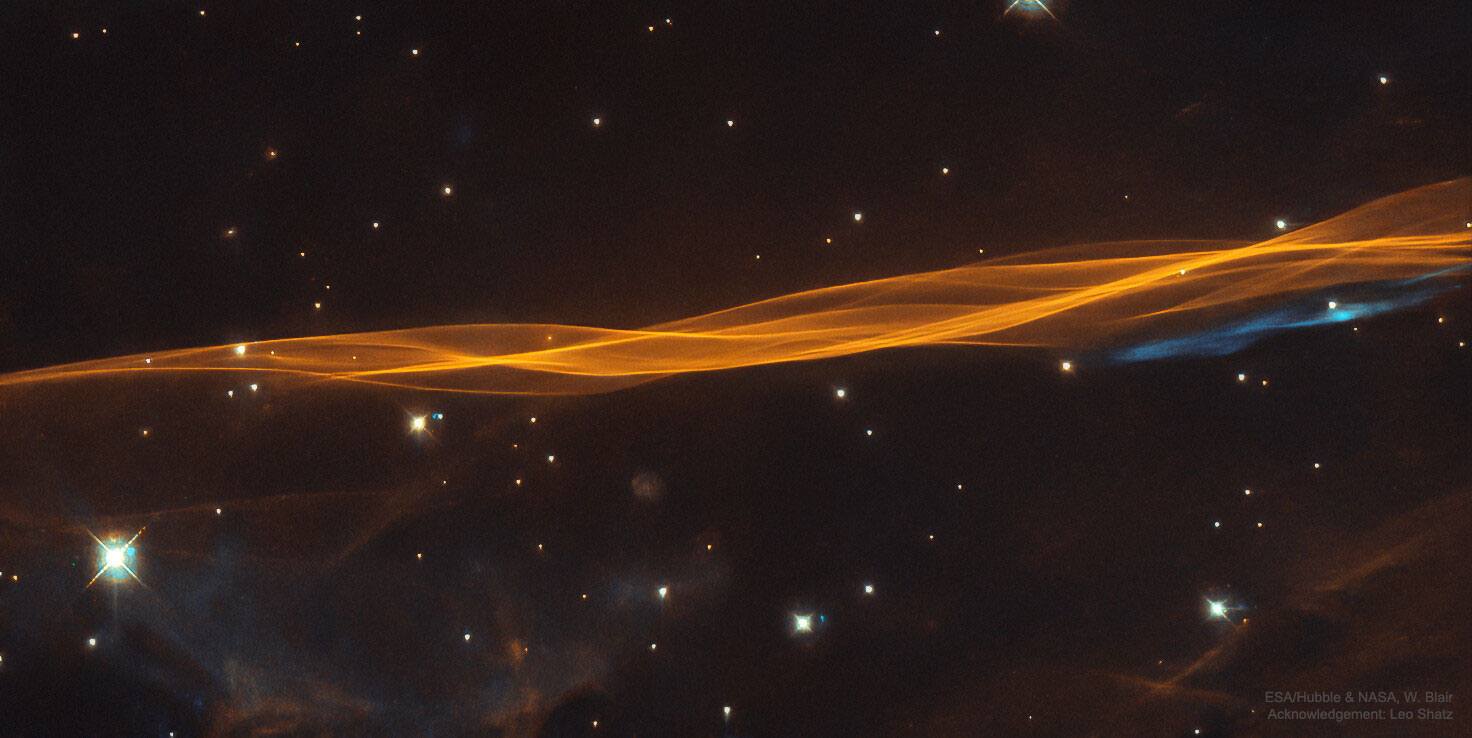
膨張する超新星の端には何があるのか? 見た目は繊細で儚いこれらの衝撃を受けた星間ガスの帯は、約2万年前の後期石器時代には人類が容易に見ることができたであろう、激しい恒星爆発の膨張する端の爆風波の一部である。掲載されている画像はハッブル宇宙望遠鏡によって撮影されたもので、白鳥座ループまたはベール星雲として知られる超新星残骸の外縁のクローズアップである。フィラメント状の衝撃波面は、励起された水素ガスの原子から放出される光を放ちながら、フレームの上部に向かって秒速約170キロメートルで移動している。白鳥座ループと相互作用していると考えられる恒星までの距離は、ガイアミッションによって最近約2400光年であることがわかった。白鳥座ループ全体は、空を横切って満月6個分、約130光年にわたって広がり、その一部は小型望遠鏡で白鳥座の方向から見ることができる。
原文(English)
What lies at the edge of an expanding supernova? Subtle and delicate in appearance, these ribbons of shocked interstellar gas are part of a blast wave at the expanding edge of a violent stellar explosion that would have been easily visible to humans during the late stone age, about 20,000 years ago. The featured image was recorded by the Hubble Space Telescope and is a closeup of the outer edge of a supernova remnant known as the Cygnus Loop or Veil Nebula. The filamentary shock front is moving toward the top of the frame at about 170 kilometers per second, while glowing in light emitted by atoms of excited hydrogen gas. The distances to stars thought to be interacting with the Cygnus Loop have recently been found by the Gaia mission to be about 2400 light years distant. The whole Cygnus Loop spans six full Moons across the sky, corresponding to about 130 light years, and parts can be seen with a small telescope toward the constellation of the Swan (Cygnus).
\ この感動を宇宙仲間にシェア /
宇宙をXでシェア
© NASA / APOD