
🚀 宇宙の記憶・カレンダー検索
🚀 象徴的な写真:
APOD第1回
🚀 創造の柱
🚀 スピリット火星着陸
🚀 ハッブル超深宇宙
🚀 地球へようこそ|ブルー・マーブル
🚀 エンケラドス
🚀 ベテルギウス
🚀 火星着陸
🚀 青い夕焼け
🚀 冥王星のハート
🚀 皆既日食
🚀 アースライズ再構築
🚀 ブラックホール
🚀 ウェッブ初画像
🚀 アポロ11着陸
APOD30周年(2025年6月16日)
月が沈む時の超大型電波望遠鏡群
The Very Large Array at Moonset
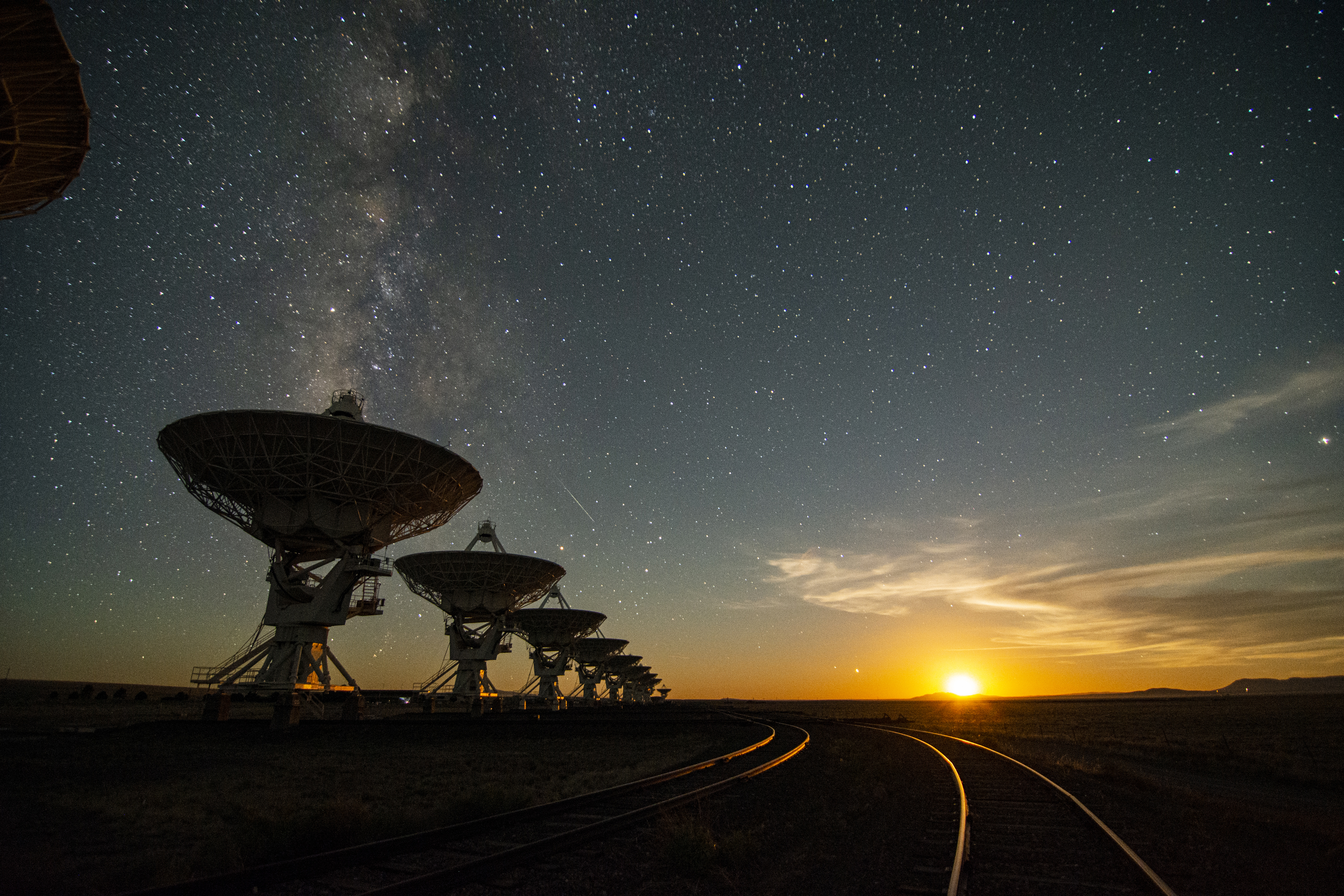
カール・G・ジャンスキー超大型電波望遠鏡群(VLA)の巨大なパラボラアンテナが、月の入りとともにニューメキシコの砂漠にそびえ立つ光景は、まさに感動的です。VLAは、支柱の上に設置されていますが、鉄道線路で移動して構成を変更できる27基の稼働中のアンテナは、それぞれ家ほどの大きさ(直径25メートル)で、都市ほどの大きさ(35キロメートル)に及ぶアレイに編成することができます。電波天文学の主力として活躍するVLAは、水星の水、恒星の周りの電波で明るいコロナ、銀河内のマイクロクエーサー、遠方の銀河の周りの重力によって誘発されるアインシュタインリング、宇宙論的に遠いガンマ線バーストの電波対応天体の発見に利用されてきました。その巨大な規模により、天文学者は電波銀河や超高速の宇宙ジェットの詳細を研究し、私たちの銀河の中心をマッピングすることができました。開設から40年が経った今、VLAは14,000件以上の観測プロジェクトに利用され、500件以上の博士論文に貢献してきました。10月10日、国立電波天文台は、VLA開設40周年を記念するオンラインイベントを終日開催します。このイベントでは、VLAの歴史、運用、科学、そして未来に関するバーチャルツアーやプレゼンテーションが行われます。
原文(English)
An inspirational sight, these giant dish antennas of the Karl G. Jansky Very Large Array (VLA) rise above the New Mexico desert at moonset. Mounted on piers but transportable on railroad tracks to change the VLA’s configuration, its 27 operating antennas are each house-sized (25 meters across) and can be organized into an array spanning the size of a city (35 kilometers). A prolific radio astronomy workhorse, the VLA has been used to discover water on planet Mercury, radio-bright coronae around stars, micro-quasars in our Galaxy, gravitationally-induced Einstein rings around distant galaxies, and radio counterparts to cosmologically distant gamma-ray bursts. Its vast size has allowed astronomers to study the details of radio galaxies, super-fast cosmic jets, and map the center of our own Milky Way. Now 40 years since its dedication the VLA has been used in more than 14,000 observing projects and contributed to more than 500 Ph.D. dissertations. On October 10, the National Radio Astronomy Observatory will host a day-long online celebration of the VLA at 40 featuring virtual tours and presentations on the history, operations, science, and future of the Very Large Array.
\ この感動を宇宙仲間にシェア /
宇宙をXでシェア
© NASA / APOD