
🚀 宇宙の記憶・カレンダー検索
🚀 象徴的な写真:
APOD第1回
🚀 創造の柱
🚀 スピリット火星着陸
🚀 ハッブル超深宇宙
🚀 地球へようこそ|ブルー・マーブル
🚀 エンケラドス
🚀 ベテルギウス
🚀 火星着陸
🚀 青い夕焼け
🚀 冥王星のハート
🚀 皆既日食
🚀 アースライズ再構築
🚀 ブラックホール
🚀 ウェッブ初画像
🚀 アポロ11着陸
APOD30周年(2025年6月16日)
シミュレーションされた宇宙におけるダークマター
Dark Matter in a Simulated Universe
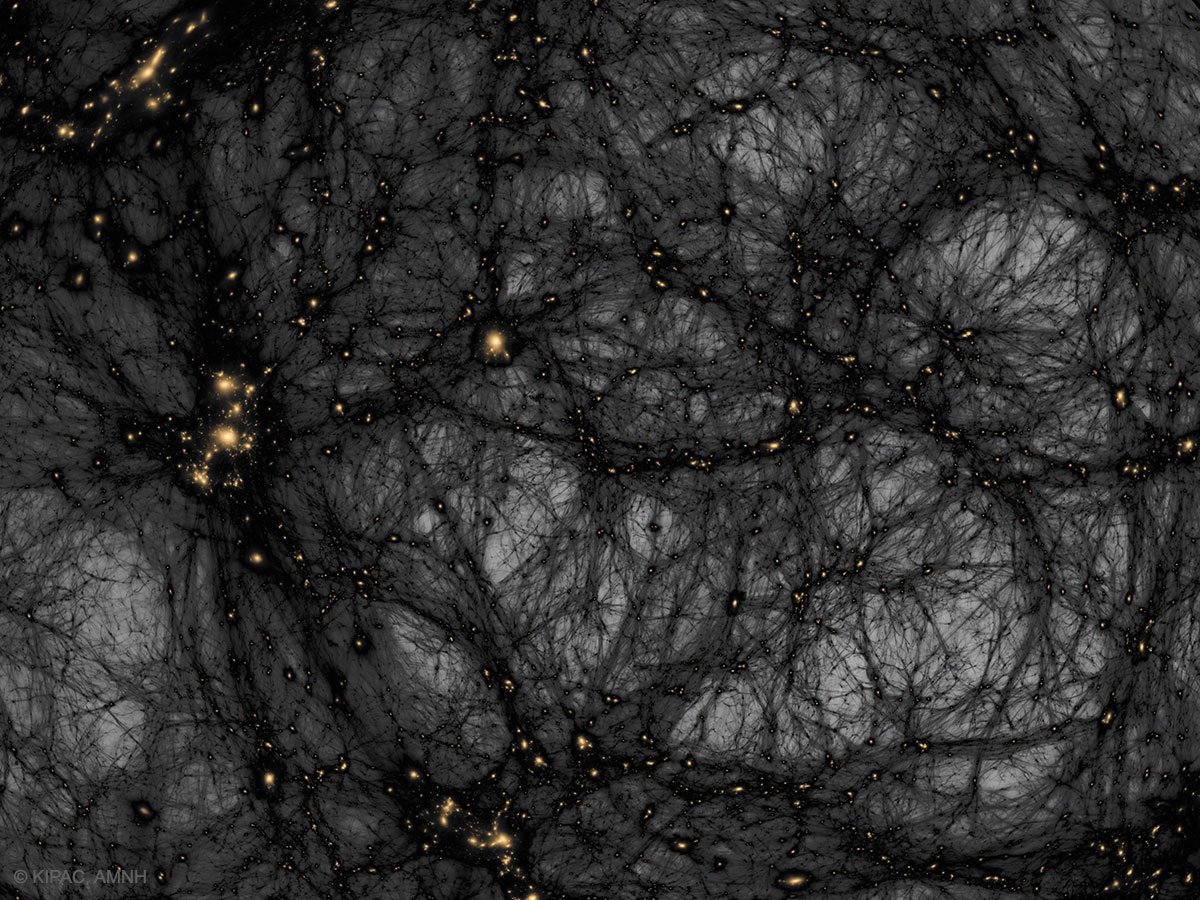
私たちの宇宙は幽霊に取り憑かれているのでしょうか?この暗黒物質マップを見ると、そう見えるかもしれません。目に見えない暗黒物質の重力は、銀河がなぜこれほど速く回転するのか、銀河がなぜ銀河団をなぜこれほど速く公転するのか、なぜ重力レンズが光をこれほど強く偏向させるのか、そしてなぜ可視物質が局所宇宙と宇宙マイクロ波背景放射の両方でこのように分布しているのかを説明する有力な説です。アメリカ自然史博物館のヘイデンプラネタリウムの以前の宇宙ショー「暗黒の宇宙」の特集画像は、遍在する暗黒物質が私たちの宇宙に取り憑いているかもしれない例を示しています。詳細なコンピュータシミュレーションのこのフレームでは、黒で示された複雑な暗黒物質のフィラメントがクモの巣のように宇宙中に散らばっており、比較的まれな馴染みのあるバリオン物質の塊はオレンジ色で示されています。これらのシミュレーションは、天文学的観測と統計的によく一致しています。おそらくもっと恐ろしい展開として、暗黒物質は、非常に奇妙で未知の形態であるにもかかわらず、もはや宇宙で最も奇妙な重力源とは考えられていません。その栄誉は今やダークエネルギーに譲られ、ダークエネルギーはより均一な反発重力源であり、現在では宇宙全体の膨張を支配しているように見える。
原文(English)
Is our universe haunted? It might look that way on this dark matter map. The gravity of unseen dark matter is the leading explanation for why galaxies rotate so fast, why galaxies orbit clusters so fast, why gravitational lenses so strongly deflect light, and why visible matter is distributed as it is both in the local universe and on the cosmic microwave background. The featured image from the American Museum of Natural History's Hayden Planetarium previous Space Show Dark Universe highlights one example of how pervasive dark matter might haunt our universe. In this frame from a detailed computer simulation, complex filaments of dark matter, shown in black, are strewn about the universe like spider webs, while the relatively rare clumps of familiar baryonic matter are colored orange. These simulations are good statistical matches to astronomical observations. In what is perhaps a scarier turn of events, dark matter -- although quite strange and in an unknown form -- is no longer thought to be the strangest source of gravity in the universe. That honor now falls to dark energy, a more uniform source of repulsive gravity that seems to now dominate the expansion of the entire universe.
\ この感動を宇宙仲間にシェア /
宇宙をXでシェア
© Tom Abel &
Ralf Kaehler
(KIPAC,
SLAC),
AMNH / APOD