
🚀 宇宙の記憶・カレンダー検索
🚀 象徴的な写真:
APOD第1回
🚀 創造の柱
🚀 スピリット火星着陸
🚀 ハッブル超深宇宙
🚀 地球へようこそ|ブルー・マーブル
🚀 エンケラドス
🚀 ベテルギウス
🚀 火星着陸
🚀 青い夕焼け
🚀 冥王星のハート
🚀 皆既日食
🚀 アースライズ再構築
🚀 ブラックホール
🚀 ウェッブ初画像
🚀 アポロ11着陸
APOD30周年(2025年6月16日)
V838 Monからの光エコー
Light Echoes from V838 Mon
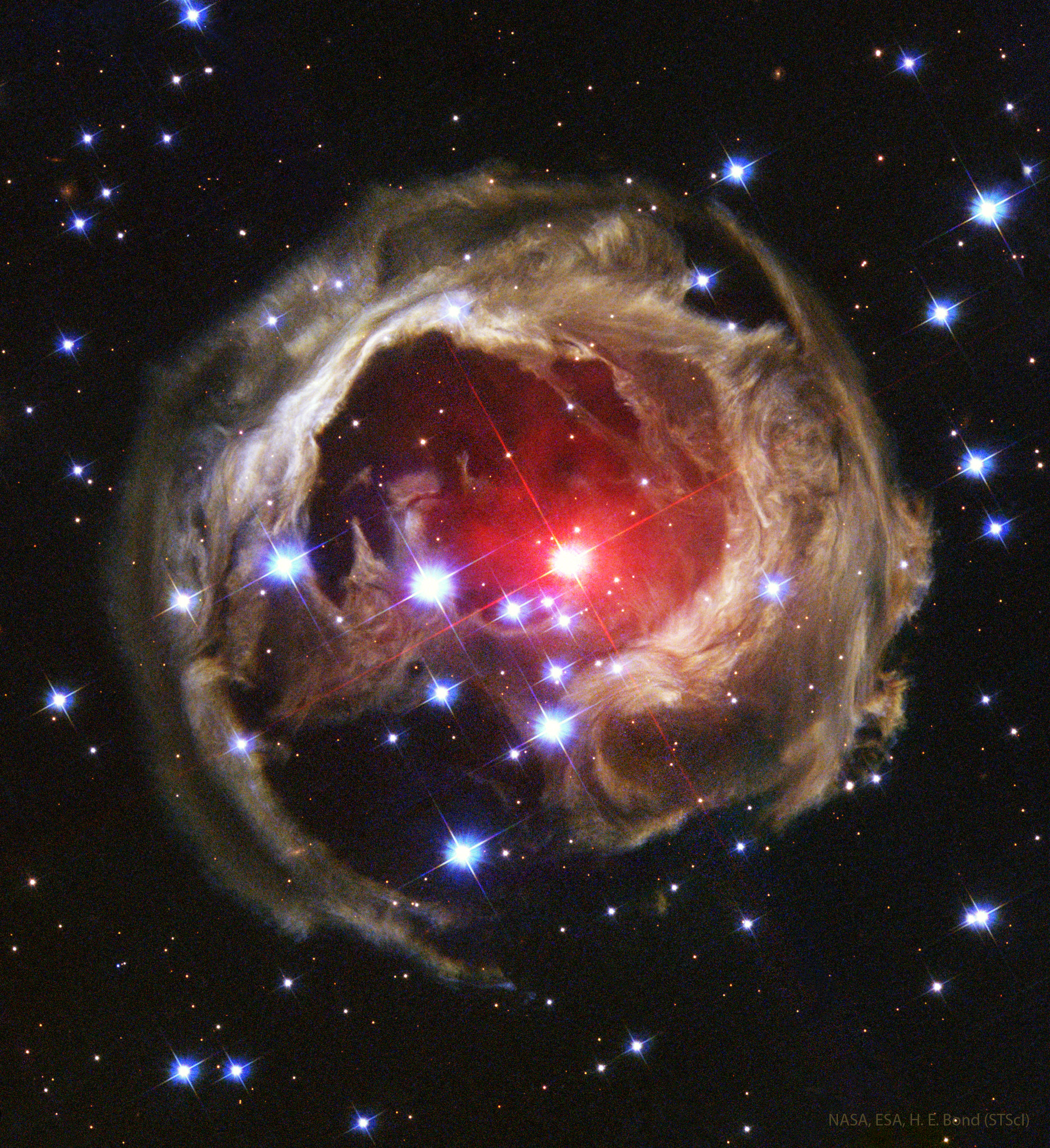
V838 Mon のこの爆発は何が原因だったのでしょうか? 理由は不明ですが、恒星 V838 Mon の外表面が突然大きく膨張し、2002 年初頭には天の川銀河で最も明るい恒星の 1 つとなりました。その後、同じように突然、縮小して暗くなりました。このような恒星の閃光はこれまで観測されたことがありませんでした。超新星や新星は物質を宇宙空間に放出します。V838 Mon の閃光は物質を宇宙空間に放出しているように見えますが、ハッブル宇宙望遠鏡の特集画像に写っているのは、実際には元の閃光が外側に広がっていく光のエコーです。光のエコーでは、閃光からの光が、すでに恒星を取り囲んでいる複雑な星間塵の配列の中で、より遠い表面で次々と反射されます。V838 Mon は一角獣座 (いっかくじゅう座) の方向に約 20,000 光年離れたところにあり、上の光のエコーは直径約 6 光年に広がっています。
原文(English)
What caused this outburst of V838 Mon? For reasons unknown, star V838 Mon's outer surface suddenly greatly expanded with the result that it became one of the brighter stars in the Milky Way Galaxy in early 2002. Then, just as suddenly, it shrunk and faded. A stellar flash like this had never been seen before -- supernovas and novas expel matter out into space. Although the V838 Mon flash appears to expel material into space, what is seen in the featured image from the Hubble Space Telescope is actually an outwardly expanding light echo of the original flash. In a light echo, light from the flash is reflected by successively more distant surfaces in the complex array of ambient interstellar dust that already surrounded the star. V838 Mon lies about 20,000 light years away toward the constellation of the unicorn (Monoceros), while the light echo above spans about six light years in diameter.
\ この感動を宇宙仲間にシェア /
宇宙をXでシェア
© NASA / APOD