
🚀 宇宙の記憶・カレンダー検索
🚀 象徴的な写真:
APOD第1回
🚀 創造の柱
🚀 スピリット火星着陸
🚀 ハッブル超深宇宙
🚀 地球へようこそ|ブルー・マーブル
🚀 エンケラドス
🚀 ベテルギウス
🚀 火星着陸
🚀 青い夕焼け
🚀 冥王星のハート
🚀 皆既日食
🚀 アースライズ再構築
🚀 ブラックホール
🚀 ウェッブ初画像
🚀 アポロ11着陸
APOD30周年(2025年6月16日)
溶融銀河アインシュタインリング
A Molten Galaxy Einstein Ring
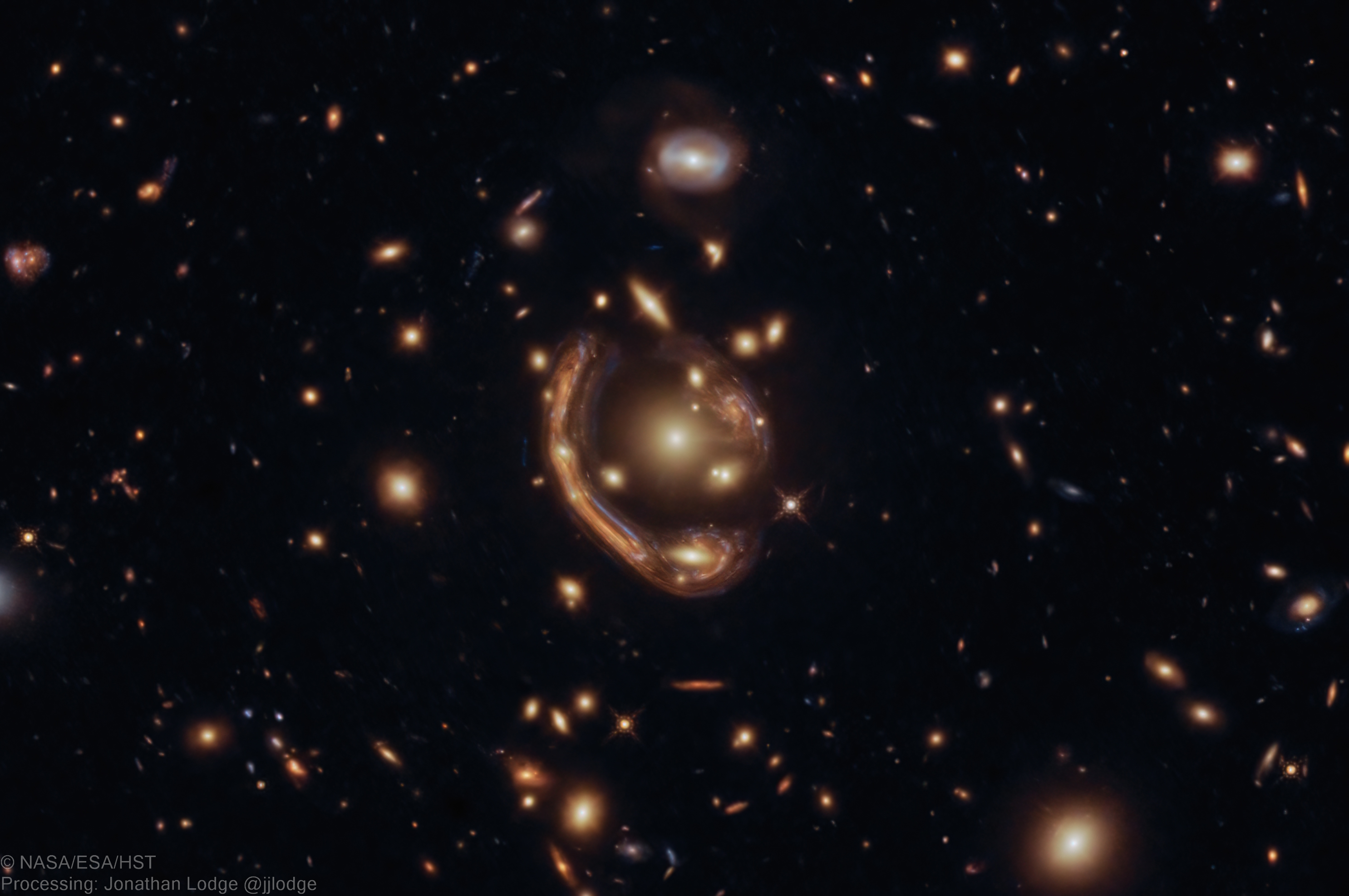
銀河団の背後に銀河を隠すのは難しい。近い銀河団の重力は巨大なレンズのように働き、遠方の銀河の像を周囲に引き寄せ、大きく歪ませる。これは、ハッブル宇宙望遠鏡で最近再処理された特集画像で観測されたまさにその例である。銀河団GAL-CLUS-022058cは多数の銀河で構成されており、黄色がかった赤色の背景銀河の像をレンズ効果で歪ませ、画像の中心付近に弧状の像を描いている。その特異な形状から「溶融アインシュタインリング」と呼ばれ、同じ背景銀河の像が4つ確認されている。通常、前景の銀河団がこのような滑らかな弧状の像を形成できるのは、その質量の大部分が滑らかに分布している場合のみであり、つまり、見える銀河団の銀河に集中していない場合に限られる。これらの重力弧の位置を分析することで、天文学者は銀河団におけるダークマターの分布を推定する方法を得るとともに、これらの初期銀河の星がいつ形成され始めたかを推測することができます。APODの新しいソーシャルミラー(アラビア語):Facebook、Instagram、Twitter
原文(English)
It is difficult to hide a galaxy behind a cluster of galaxies. The closer cluster's gravity will act like a huge lens, pulling images of the distant galaxy around the sides and greatly distorting them. This is just the case observed in the featured image recently re-processed image from the Hubble Space Telescope. The cluster GAL-CLUS-022058c is composed of many galaxies and is lensing the image of a yellow-red background galaxy into arcs seen around the image center. Dubbed a molten Einstein ring for its unusual shape, four images of the same background galaxy have been identified. Typically, a foreground galaxy cluster can only create such smooth arcs if most of its mass is smoothly distributed -- and therefore not concentrated in the cluster galaxies visible. Analyzing the positions of these gravitational arcs gives astronomers a method to estimate the dark matter distribution in galaxy clusters, as well as infer when the stars in these early galaxies began to form. New APOD Social Mirrors in Arabic: On Facebook, Instagram, and Twitter
\ この感動を宇宙仲間にシェア /
宇宙をXでシェア
© NASA / APOD