
🚀 宇宙の記憶・カレンダー検索
🚀 象徴的な写真:
APOD第1回
🚀 創造の柱
🚀 スピリット火星着陸
🚀 ハッブル超深宇宙
🚀 地球へようこそ|ブルー・マーブル
🚀 エンケラドス
🚀 ベテルギウス
🚀 火星着陸
🚀 青い夕焼け
🚀 冥王星のハート
🚀 皆既日食
🚀 アースライズ再構築
🚀 ブラックホール
🚀 ウェッブ初画像
🚀 アポロ11着陸
APOD30周年(2025年6月16日)
スターゲイト ミルキーウェイ
Stargate Milky Way
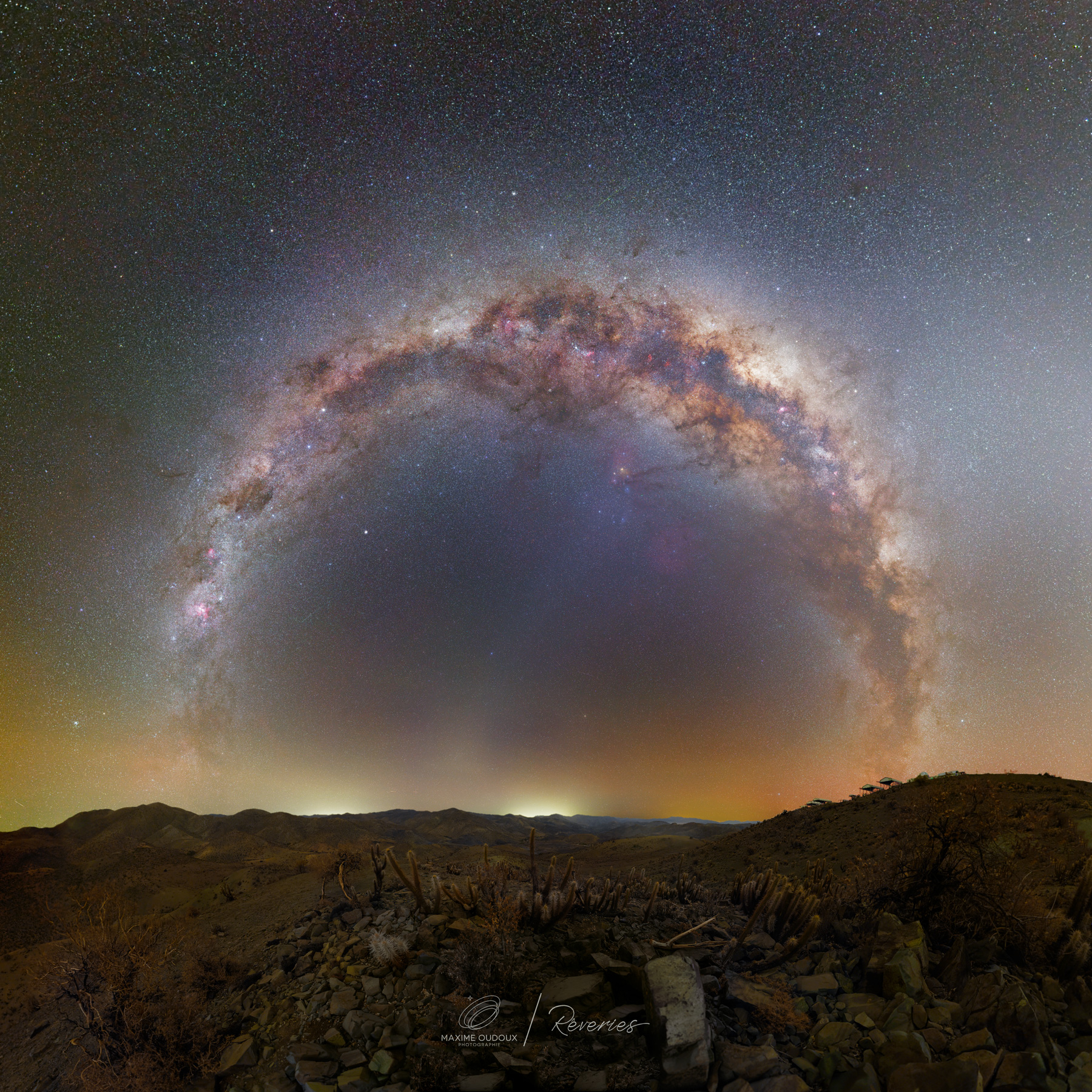
空には巨大な星の門があり、私たちはそれを一日に二度通り抜けます。この星の門は実際には私たちの天の川銀河であり、地球の自転が私たちをそこへ押し進めているように見えます。通常、天の川の中心帯は空を横切るかすかな帯として見え、明るい街の明かりから離れた場所でしか見えません。しかし、このような暗い場所から長時間露光の広角画像では、天の川の中心面が容易に見えます。掲載されている写真は、同じ夜に同じカメラで撮影された複数の露光画像を合成したデジタル画像ですが、立体投影法を用いることで、天の川が巨大な円形のポータルのように見えます。私たちの銀河の星の門のような弧の内側には、黄道光と呼ばれるかすかな帯があります。これは、太陽系の塵によって反射された太陽光です。手前には、チリの高地砂漠の険しい地形に見られるサボテンや乾燥した岩が写っている。ここはエル・サウセ天文台や、現在建設中のベラ・ルビン天文台からほど近い場所であり、後者は2024年に定期運用を開始する予定である。
原文(English)
There is a huge gate of stars in the sky, and you pass through it twice a day. The stargate is actually our Milky Way Galaxy, and it is the spin of the Earth that appears to propel you through it. More typically, the central band of our Milky Way appears as a faint band stretching across the sky, only visible in away from bright city lights. In a long-exposure wide-angle image from a dark location like this, though, the Milky Way's central plane is easily visible. The featured picture is a digital composite involving multiple exposures taken on the same night and with the same camera, but employing a stereographic projection that causes the Milky Way to appear as a giant circular portal. Inside the stargate-like arc of our Galaxy is a faint stripe called zodiacal light -- sunlight reflected by dust in our Solar System. In the foreground are cacti and dry rocks found in the rough terrain of the high desert of Chile, not far from the El Sauce Observatory and the developing Vera Rubin Observatory, the latter expected to begin routine operations in 2024.
\ この感動を宇宙仲間にシェア /
宇宙をXでシェア
© Maxime Oudoux / APOD