
🚀 宇宙の記憶・カレンダー検索
🚀 象徴的な写真:
APOD第1回
🚀 創造の柱
🚀 スピリット火星着陸
🚀 ハッブル超深宇宙
🚀 地球へようこそ|ブルー・マーブル
🚀 エンケラドス
🚀 ベテルギウス
🚀 火星着陸
🚀 青い夕焼け
🚀 冥王星のハート
🚀 皆既日食
🚀 アースライズ再構築
🚀 ブラックホール
🚀 ウェッブ初画像
🚀 アポロ11着陸
APOD30周年(2025年6月16日)
NGC 6357:ロブスター星雲
NGC 6357: The Lobster Nebula
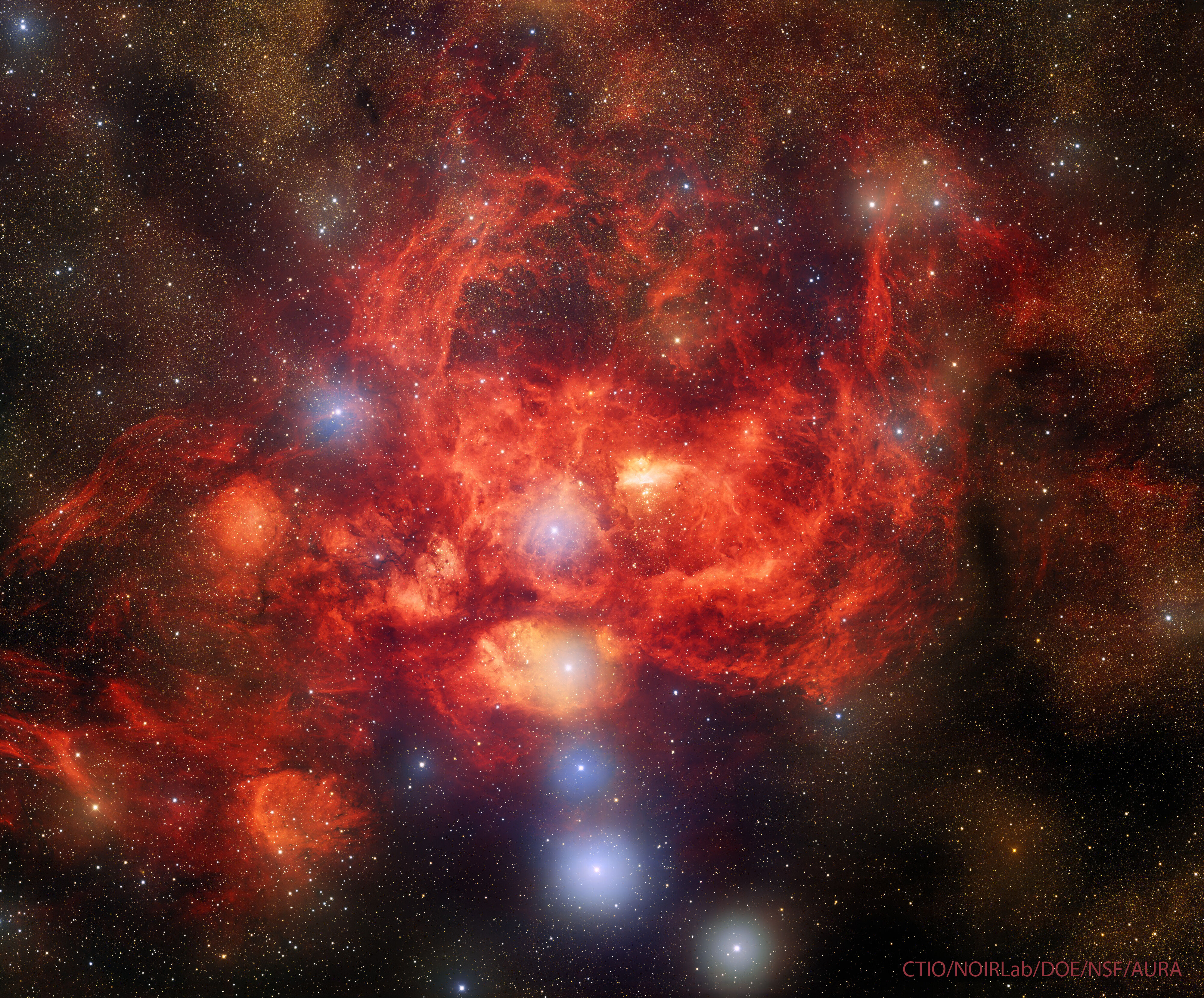
ロブスター星雲が、既知の星の中で最も質量が大きい星のいくつかを形成している理由は、まだ誰も確信していません。NGC 6357としてカタログ化されているロブスター星雲は、中心付近に散開星団ピスミス24を擁しており、そこは異常に明るく質量が大きい星々の宝庫です。内側の星形成領域付近の全体的に赤い輝きは、電離水素ガスの放出によるものです。ここに写っている周囲の星雲は、ガス、暗黒塵、形成中の星、そして生まれたばかりの星が複雑に織りなすタペストリーのようです。この複雑な模様は、星間風、放射圧、磁場、重力の複雑な相互作用によって生み出されています。この画像は、チリのセロ・トロロ汎米天文台にある4メートルブランコ望遠鏡に搭載されたDOEのダークエネルギーカメラで撮影されました。NGC 6357は、約400光年にわたって広がり、さそり座の方向に約8,000光年離れたところに位置しています。
原文(English)
Why is the Lobster Nebula forming some of the most massive stars known? No one is yet sure. Cataloged as NGC 6357, the Lobster Nebula houses the open star cluster Pismis 24 near its center -- a home to unusually bright and massive stars. The overall red glow near the inner star forming region results from the emission of ionized hydrogen gas. The surrounding nebula, featured here, holds a complex tapestry of gas, dark dust, stars still forming, and newly born stars. The intricate patterns are caused by complex interactions between interstellar winds, radiation pressures, magnetic fields, and gravity. The image was taken with DOE's Dark Energy Camera on the 4-meter Blanco Telescope at the Cerro Tololo Inter-American Observatory in Chile. NGC 6357 spans about 400 light years and lies about 8,000 light years away toward the constellation of the Scorpion.
\ この感動を宇宙仲間にシェア /
宇宙をXでシェア
© NASA / APOD