
🚀 宇宙の記憶・カレンダー検索
🚀 象徴的な写真:
APOD第1回
🚀 創造の柱
🚀 スピリット火星着陸
🚀 ハッブル超深宇宙
🚀 地球へようこそ|ブルー・マーブル
🚀 エンケラドス
🚀 ベテルギウス
🚀 火星着陸
🚀 青い夕焼け
🚀 冥王星のハート
🚀 皆既日食
🚀 アースライズ再構築
🚀 ブラックホール
🚀 ウェッブ初画像
🚀 アポロ11着陸
APOD30周年(2025年6月16日)
ウルフズケーブ星雲
Wolf's Cave Nebula
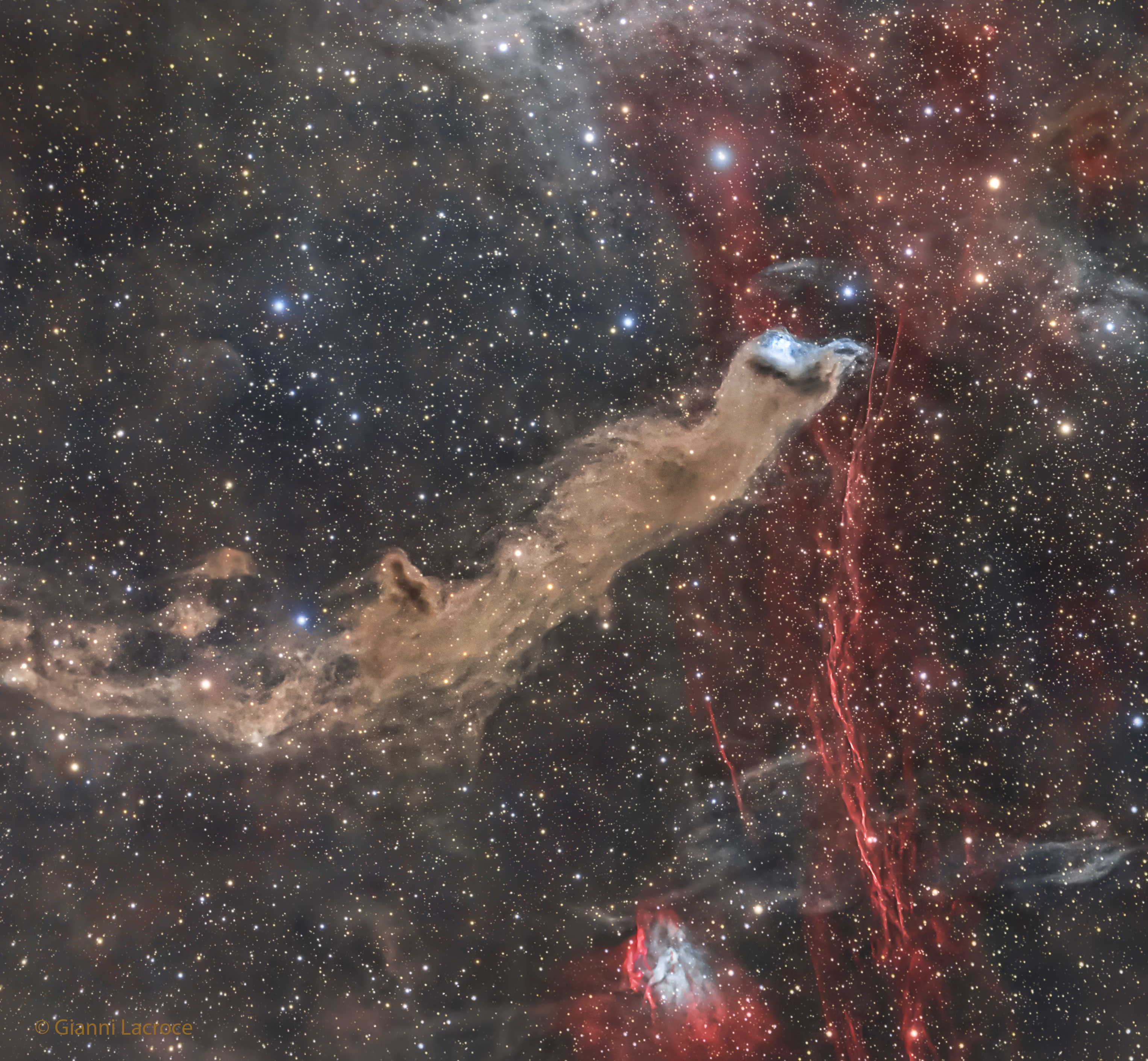
カタログにVdB 152またはCed 201として記載されている謎の青い反射星雲は、実際には非常に淡い。それは、長い暗黒星雲Barnard 175の先端に位置し、Wolf's Caveとも呼ばれる塵の複合体の中にある。この望遠鏡で撮影された深宇宙の幻影は、天の川の北側、王座ケフェウス座に沿って約1400光年離れたところにある。この領域の星間塵は背景の星からの光を遮り、埋め込まれた明るい星からの光を散乱させるため、端の星雲は特徴的な青色をしている。星は分子雲で形成されるが、この星は偶然この領域に迷い込んだようで、宇宙空間での測定速度は分子雲の速度とは大きく異なっている。画像の下部には惑星状星雲Dengel-Hartl 5があり、画像の右側には古代の超新星残骸からの赤い輝くガスも見える。
原文(English)
The mysterious blue reflection nebula found in catalogs as VdB 152 or Ced 201 really is very faint. It lies at the tip of the long dark nebula Barnard 175 in a dusty complex that has also been called Wolf's Cave. At the center of this deep telescopic view, the cosmic apparitions are nearly 1,400 light-years away along the northern Milky Way in the royal constellation Cepheus. Interstellar dust in the region blocks light from background stars and scatters light from the embedded bright star, giving the end nebula its characteristic blue color. Though stars do form in molecular clouds, this star seems to have only accidentally wandered into the area, as its measured velocity through space is very different from the cloud's velocity. At the image bottom is the planetary nebula Dengel-Hartl 5, while red glowing gas from an ancient supernova remnant is also visible along the image's right side.
\ この感動を宇宙仲間にシェア /
宇宙をXでシェア
© Gianni Lacroce / APOD