
🚀 宇宙の記憶・カレンダー検索
🚀 象徴的な写真:
APOD第1回
🚀 創造の柱
🚀 スピリット火星着陸
🚀 ハッブル超深宇宙
🚀 地球へようこそ|ブルー・マーブル
🚀 エンケラドス
🚀 ベテルギウス
🚀 火星着陸
🚀 青い夕焼け
🚀 冥王星のハート
🚀 皆既日食
🚀 アースライズ再構築
🚀 ブラックホール
🚀 ウェッブ初画像
🚀 アポロ11着陸
APOD30周年(2025年6月16日)
トラピスト第1の七番目の世界
The Seventh World of Trappist-1
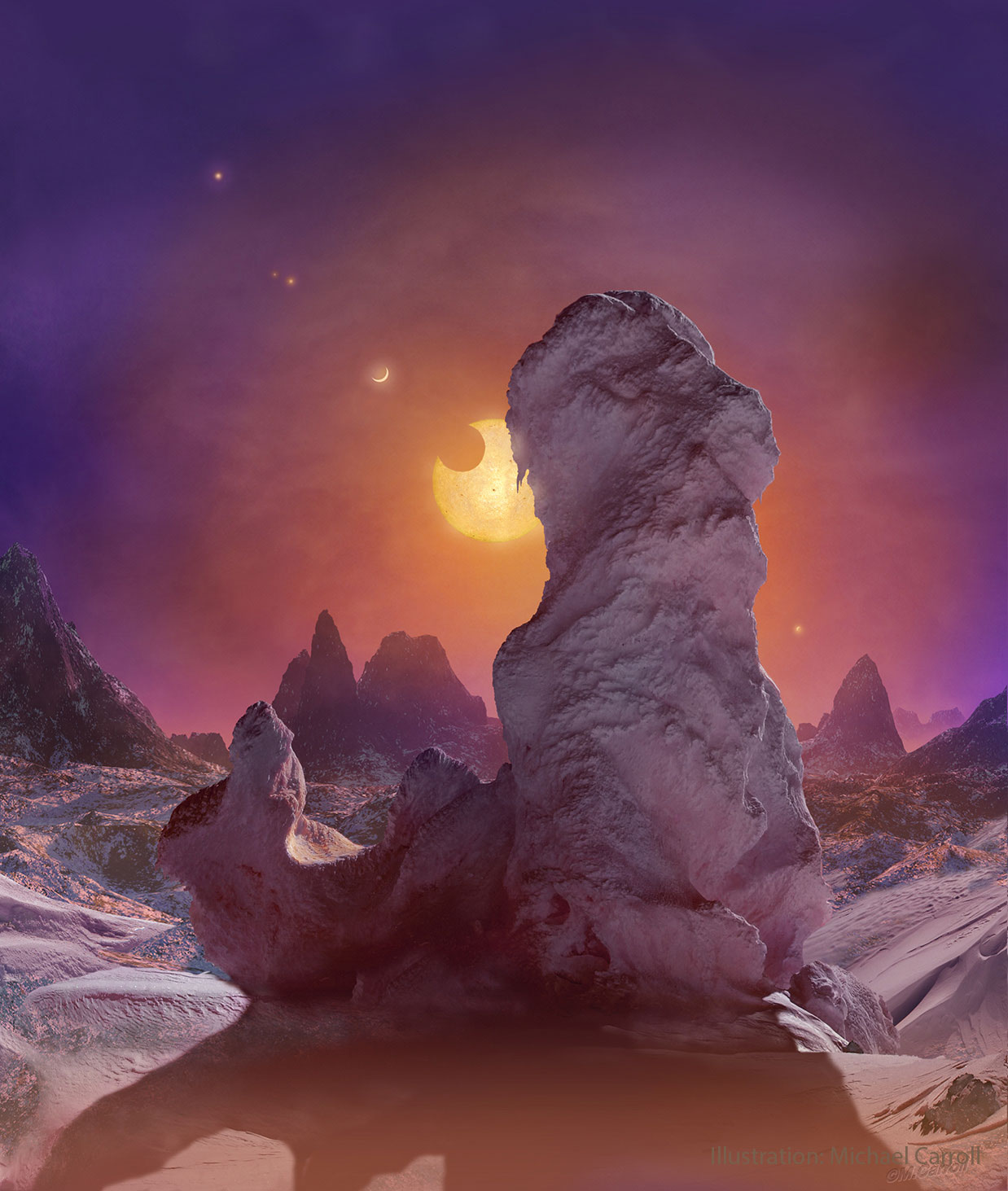
7つの惑星が、極低温矮星TRAPPIST-1の周りを公転している。わずか40光年離れたこれらの系外惑星の多くは、2016年にチリのラ・シヤ天文台にあるトランジット惑星・微惑星小型望遠鏡(TRAPPIST)を用いて発見され、その後NASAのスピッツァー宇宙望遠鏡を含む複数の望遠鏡によって確認された。TRAPPIST-1の惑星はすべて岩石質で地球とほぼ同じ大きさであると考えられており、単一の恒星の周りで発見された地球型惑星としては最大級の宝庫となっている。これらの惑星は、暗く小さな恒星のすぐ近くを公転しているため、表面温度が氷や液体の水が存在する可能性のある領域も存在する。液体の水は生命にとって重要な要素である。地球に非常に近いことから、これらの惑星は、将来的に居住可能な惑星の大気を望遠鏡で探査する際の有力候補となる。掲載されているイラストには、7つの系外惑星すべてが描かれており、この系で最も遠い既知の惑星であるTRAPPIST-1hから見た景色が、氷に覆われた岩だらけの地表として描かれています。一方、想像上の背景には、この系の内惑星の1つが、薄暗いオレンジ色の、木星に近い大きさの主星の前を横切っています。天体物理学者の皆様へ:天体物理学ソースコードライブラリで3,000以上のコードをご覧ください。
原文(English)
Seven worlds orbit the ultracool dwarf star TRAPPIST-1. A mere 40 light-years away, many of the exoplanets were discovered in 2016 using the Transiting Planets and Planetesimals Small Telescope (TRAPPIST) located at La Silla Observatory in Chile and later confirmed with telescope including NASA's Spitzer Space Telescope. The TRAPPIST-1 planets are likely all rocky and similar in size to Earth, and so compose one of the largest treasure troves of terrestrial planets ever detected around a single star. Because they orbit very close to their faint, tiny star they could also have regions where surface temperatures allow for the presence of ice or even liquid water, a key ingredient for life. Their tantalizing proximity to Earth makes them prime candidates for future telescopic explorations of the atmospheres of potentially habitable planets. All seven exoplanets appear in the featured illustration, which imagines a view from the most distant known world of this system, TRAPPIST-1h, as having a rocky landscape covered in ice. Meanwhile, in the imagined background, one of the system's inner planets crosses in front of the dim, orange, nearly Jupiter-sized parent star. Astrophysicists: Browse 3,000+ codes in the Astrophysics Source Code Library
\ この感動を宇宙仲間にシェア /
宇宙をXでシェア
© Michael Carroll / APOD