
🚀 宇宙の記憶・カレンダー検索
🚀 象徴的な写真:
APOD第1回
🚀 創造の柱
🚀 スピリット火星着陸
🚀 ハッブル超深宇宙
🚀 地球へようこそ|ブルー・マーブル
🚀 エンケラドス
🚀 ベテルギウス
🚀 火星着陸
🚀 青い夕焼け
🚀 冥王星のハート
🚀 皆既日食
🚀 アースライズ再構築
🚀 ブラックホール
🚀 ウェッブ初画像
🚀 アポロ11着陸
APOD30周年(2025年6月16日)
土星のイアペトゥス:奇妙な表面を持つ衛星
Saturn's Iapetus: Moon with a Strange Surface
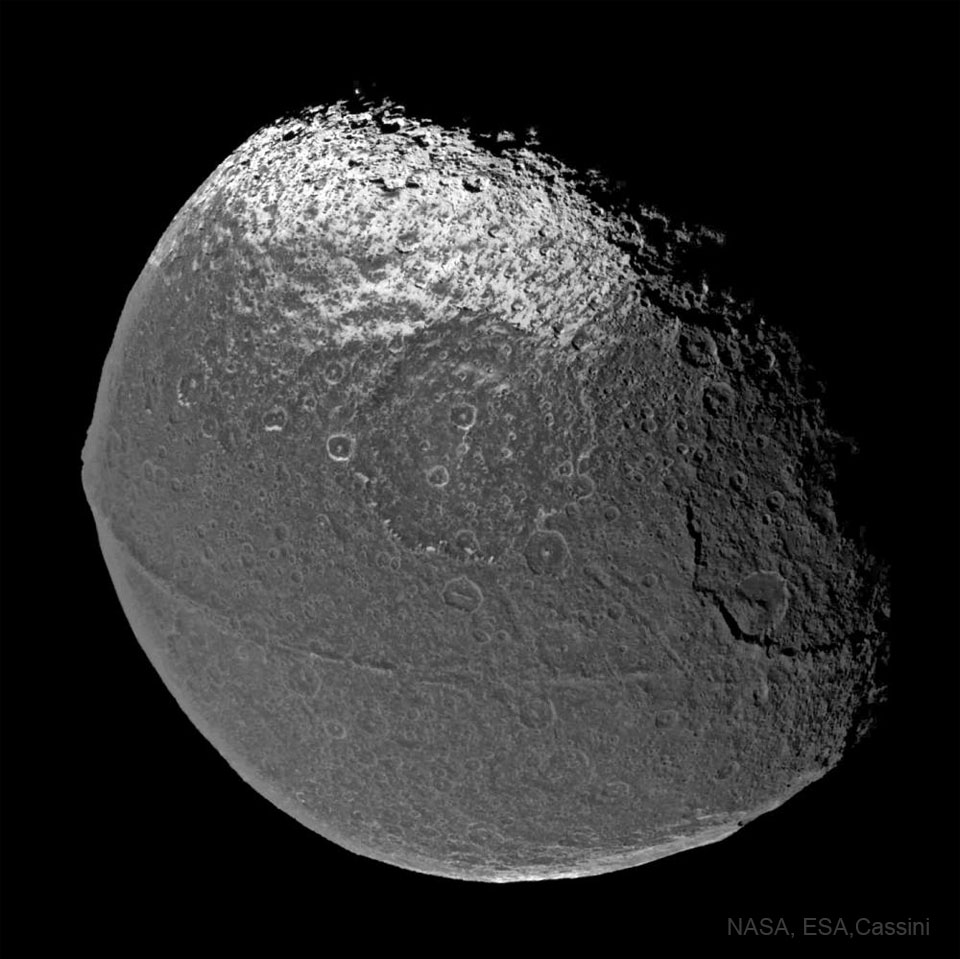
月がクルミのように見えるのはなぜでしょうか?土星の衛星イアペトゥスの赤道を囲む奇妙な尾根は、特集画像の下部付近に見え、人気の食用ナッツであるクルミに似ているように見えます。しかし、この尾根の起源は未だ不明で、下から湧き上がった氷、上から落下した環、おそらく1億年前に形成された際の構造物など、様々な仮説が立てられています。また、イアペトゥスの約半分は地球から見るとほとんど見えないほど暗いのに、残りの部分は反射光によって非常に明るいという奇妙な点もあります。観測によると、地形の暗さは奇妙なほど均一で、まるで古代のクレーターだらけの表面に最近になって暗いコーティングが施されたかのようです。最後に、イアペトゥスの周囲にはいくつかの大きな衝突盆地があり、画像の中心付近には直径400キロメートルのクレーターが見え、その周囲はクレーター底まで急峻に落ち込む深い崖に囲まれています。掲載されている画像は、土星周回軌道を周回するカッシーニ探査機が2004年末にイアペトゥスをフライバイした際に撮影されたものです。
原文(English)
What would make a moon look like a walnut? A strange ridge that circles Saturn's moon Iapetus's equator, visible near the bottom of the featured image, makes it appear similar to a popular edible nut. The origin of the ridge remains unknown, though, with hypotheses including ice that welled up from below, a ring that crashed down from above, and structure left over from its formation perhaps 100 million years ago. Also strange is that about half of Iapetus is so dark that it can nearly disappear when viewed from Earth, while the rest is, reflectively, quite bright. Observations show that the degree of darkness of the terrain is strangely uniform, as if a dark coating was somehow recently applied to an ancient and highly cratered surface. Last, several large impact basins occur around Iapetus, with a 400-kilometer wide crater visible near the image center, surrounded by deep cliffs that drop sharply to the crater floor. The featured image was taken by the Saturn-orbiting Cassini spacecraft during a flyby of Iapetus at the end of 2004.
\ この感動を宇宙仲間にシェア /
宇宙をXでシェア
© NASA / APOD